Ancient Observatory
 Beijing Ancient Observatory, towering in southwest of Jianguomen Overpass, was originally built in 1442 as one of the world's earliest royal observatories, two centuries ahead of the Greenwich in Britain (1675). It was once called 'Star Observation Platform' in Ming Dynasty (1368 - 1644) and 'Observatory' in Qing Dynasty (1644 - 1911). After 1911, it had been regarded as 'Central Star Observation Platform'. In 1927, it was taken place by newly-established Purple Mountain Observatory, so the old observatory became the Astronomical Instrument Museum under the jurisdiction of Beijing Planetarium. Nowadays, the Ancient Observatory wins popularity worldwide for its longest continuous astronomical observation among world's existing observatories. It is also famous for its architecture integrity and well-equipped instruments.
The Ancient Observatory mainly consists of two parts, the ancient astronomical instruments display hall and affiliated architecture.
With a rectangle shape, the observatory is 58 feet high and extends 26 yards from east to west. On the platform lie eight sets of ancient bronze astronomical instruments. From the southeast corner clockwise, they are Armillary, Quadrant Altazimuth, Celestial Globe, Ecliptic Armilla, Altazimuth, Azimuth Theodolite, Sextant and Equatorial Armilla. These instruments are delicate in shape and patterns, accurate in gradation and measurement, influenced by Western Europe astronomy in Renaissance; so they are historical witnesses to East and West cultural communications.
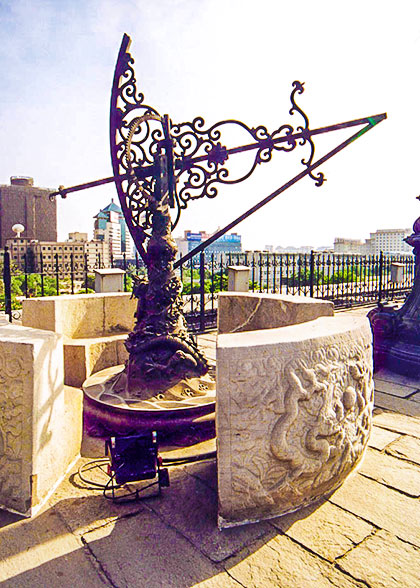 The Ancient Observatory enjoys a high reputation in the world, so it gains much popularity among oversea visitors. Many superior officials and illustrious scholars have left their footprints there, such as former British Prime Minister Tony Blair and former Belgian prime minster Guy Verhofstadt.
 How to go to Ancient Observatory
 By Subway
Take Subway Line 1 or Subway Line 2 to Jianguomen Station. Get out from Exit C. Then walk for about 220m (250 yards) to the ticket office.
 By Bus
Take bus 20, 39, 122, 637, 638, 43, 44, 139 or 142, and get off at Jianguomen Nan (South Jianguomen). After that, walk northward along Jianguomen South Street for about 500 meters (547 yards) to the ticket office of Ancient Observatory.
Beijing Bus / Subway Search
| Admission Fee | CNY 20; Purchasing on-site is accepted. |
| Opening Hours | 09:00 – 17:00 (Closed on Mondays) Note: Ticket sale stops at 16:30. Note: Ticket sale stops at 16:30. |
