
Lhasa Travel Guide
Lhasa Facts
Chinese Name: 拉萨 (lā sà)
Population: 950,000
Area: 30,000 square kilometers (11,583 square miles)
Location: in the south-central of Tibet, southwest China
Administrative Division: 3 districts (Chengguan, Tuilong Deqing, Dazi), 6 counties (Linzhou, Dangxiong, Nimu, Qushui, Mozhu Gongka)
Area Code: 0891
Zip Code: 850000
GDP (2019): CNY 61.788 billion (USD 8.956 billion)
Nationalities: Tibetan, Han, Hui
 You may like: Top 10 Biggest Cities in China by Area
Holy Land of the Tibetan Buddhist World
As the beautiful capital city of Tibet Autonomous Region (TAR), Lhasa is situated in the south-central part of the region, on the North bank of the Kyichu River in a mountain-fringed valley. In the Tibetan language, Lhasa means the Holy Land or the Buddha Land. The grandeur of the red-and-white Potala Palace may leave you the first impression of the city. For a long time, countless believers set out from their hometown and kowtowed to Lhasa for a pilgrimage. If you imagine that Lhasa is an original ecological world, then it may give you different expectations. There are also high-rise business districts and busy streets full of banks, shopping malls and restaurants.
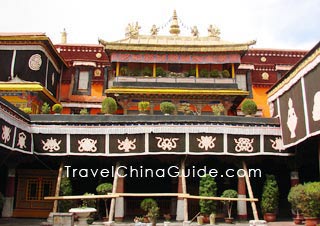 |
| Jokhang Temple |
 |
| Ganden Monastery |
In the Tibetan language, Lhasa means the Holy Land or the Buddha Land. It is the center of Tibet's politics, economy and culture. The city has also been appointed as one of the 24 historical and cultural cities of China. The splendor and grandeur of the Potala Palace remains a world-famous symbol of the enigmatic power of politics and religion in this region.
 |
| Potala Palace |
|
|

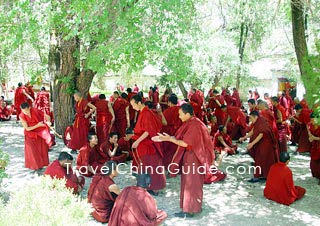
You may like: Top 10 Things to Do in Lhasa
Recommended Tour Itineraries
Devout Buddhist Appreciation: 6 Days Private Tour of Lhasa - Gyangtse - Shigatse
Mysterious Lhasa Tour Package: 4 Days Private Tour of Lhasa
Currently there are three options to reach this mysterious high land, by plane, by road and by train.
1. Taking plane is comfortable and time saving , but offers little time for you to acclimatise to the altitude; this may cause sickness. Lhasa Gonggar Airport, about 62 kilometers (38.5 miles) south of downtown area, has 40 more flights to/from major domestic cities including Beijing, Chamdo, Changsha, Chengdu, Chongqing, Dazhou, Diqing, Fuzhou, Golmud, Guangzhou, Guiyang, Hangzhou, Kangding, Kunming, Lanzhou etc.
2. Taking the bus along one of five highways that have been opened-up for visitors' use. This will take longer but will enable you to see the amazing scenery en route. Furthermore, taking extra time allows for a more gradual acclimatization to the altitude.
3. Taking the train, is a fabulous new option, giving the opportunity to see hitherto unseen mountain scenery. With the operation of Tibet Railway from July 1st, 2006, more and more visitors have swarmed into the land via train.
Generally the period from March to October is the best time to pay a visit. Since the city is located at such a high altitude it is wise to be prepared before starting your journey. Generally speaking, due to the large temperature differences during any given day, warm clothes should be taken to keep away the cold. However, because it also receives a great deal of sunshine, sunglasses, suntan oil, and a sun hat are indispensable items if you're going anywhere in the area.
Local Highlights: It is rightly one of the most featured and dreamt-about cities in the world. This is not only because of its high altitude at 3,650 meters (11,975 feet) which means remoteness and limited accessibility, but also because of its over 1,000 years' cultural and spiritual history which leaves an impressive heritage that has helped to create the romantic and mysterious Tibetan religion.
Physical Features: Different from the inland cities and other places in that high land, this area is unique with an allure all of its own. One word of warning: although there is a gradually increasing tourism industry here, it is a city with many difficulties yet to be overcome due to its unique location and geography. Please bear in mind that a visit to this area is more challenging than in any other part of China. Despite this more and more people from every corner of the world are being attracted towards this vibrant city with its mysterious culture. Its unique scenery, long history, exotic culture, mystical religion and spectacular monuments will ensure your stay is unforgettable. Further Reading:
10 Best China Honeymoon Destinations for Couples Sichuan - Tibet Overland Adventure Ultimate Guide to Lhasa - Tsetang Hiking