Nepal & Bhutan Highlights
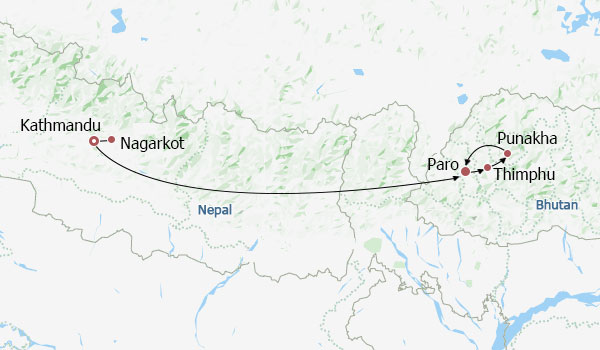
9 Days Kathmandu - Nagarkot - Kathmandu - Paro - Thimphu - Punakha - Paro
Tour Type: Private guided tour, flexible and customizable
Guide: English-speaking guide, experienced and knowledgeable
Driver: Private driver with a spacious air-conditioned car
Hotels: Handpicked 4- or 3-star hotels, open to your choice
Meals: 8 breakfasts, 5 lunches and 6 dinners
Code: TSA06
Guide: English-speaking guide, experienced and knowledgeable
Driver: Private driver with a spacious air-conditioned car
Hotels: Handpicked 4- or 3-star hotels, open to your choice
Meals: 8 breakfasts, 5 lunches and 6 dinners
Code: TSA06
This trip can be customized to meet your individual needs!
- Itinerary
- Prices
- Reviews
Trip Highlights
- Stand in awe before the great dome of Boudhanath Stupa, the largest of its kind on earth.
- Witness Hindu open-air cremation at Pashupatinath Temple by sacred Bagmati River.
- Explore Bhaktapur Durbar Square, a medieval masterpiece of local Newari architecture.
- Hike to Tiger’s Nest Monastery, a cliffside sanctuary suspended above Paro Valley.
- Lost in the Punakha Dzong, the most beautiful monastic fortresses in Bhutan.
Expand All
Collapse All
Day 1 Arrival in Nepal; Kathmandu Airport Pick-up & City Tour
Welcome to Nepal! Upon arrival at Kathmandu’s Tribhuvan International Airport, your guide and the driver will meet you outside the arrival hall and escort you to your downtown hotel. A guided city tour awaits after check-in.
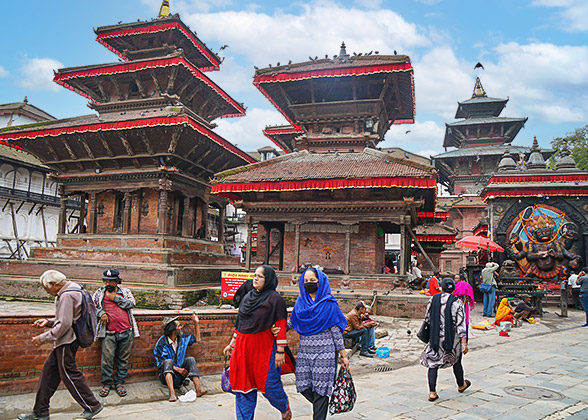
We’ll kick off at Kathmandu Durbar Square, once the royal palace square of one of the three kingdoms that split from Kathmandu Valley in the late 15th century. Here, ancient red-brick temples and palaces are adorned with intricate carvings of wood, brick, and stone, seamlessly blending with local dwellings, bustling street stalls, and flocks of pigeons. As you stroll to the three-tiered Kasthamandap Temple, one of the valley’s oldest buildings, your guide will reveal to you the origin of Kathmandu’s name: in the 12th century, the kingdom gradually grew around it, and thus the city gradually took its name. We’ll also pass by the Kumari Temple, home to the world’s only living goddess tradition. If we happen to be there around 11:00 am or 4:00 pm, you may have a chance to spot the young goddess appearing briefly at the second-floor window.
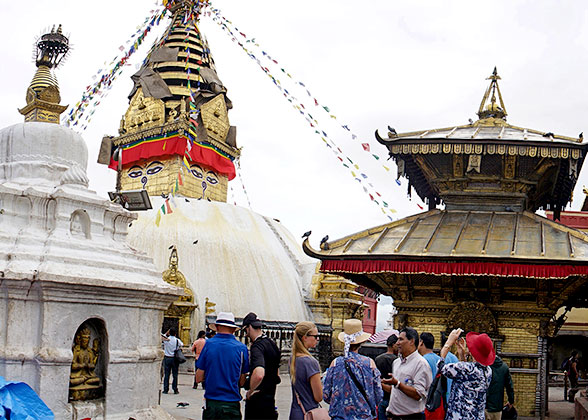
Afterward, let’s make our way up to the Swayambhunath Stupa, a hilltop Buddhist shrine with over 2,500 years of history. As you stand before the iconic structure, a white dome base topped with a golden cube tower painted with the iconic Buddha eyes, you’ll feel an inner spiritual serenity. If your trip falls in April or May during the Buddha Jayanti festival, you’ll also witness crowds of devotees chanting, offering incense, and bathing Buddha statues in ceremonial rituals. Besides, the view from here is also rewarding: the valley spreads out beneath, dotted with colorful-roofed houses in a dense cluster, and the distant Himalayan snowcaps stretch across the horizon.
After the tour, your guide and the driver will escort you to your hotel.
► Recommended Activity (at your own expense)
If you’re not ready to call it a night, consider grabbing a Pathao or InDrive ride to the night market lanes just off Durbar Square, about 10 minutes from your hotel, by yourself. Soak up this down-to-earth slice of Kathmandu life: browse stalls piled with handmade copperware, fresh fruit, and thangka painting scrolls, and sample street snacks like charcoal-grilled meat, curried chickpeas, and momo dumplings. Most vendors accept cash in Nepalese rupees only, so keep some small notes handy. For reference, USD 1≈NPR 151.5.
Accommodation: Ramada Encore by Wyndham Kathmandu Thamel (4 stars) or similar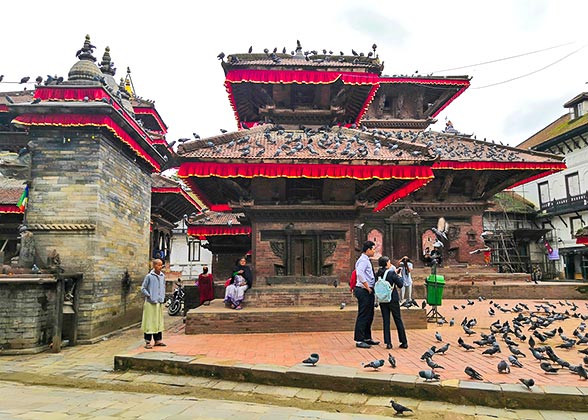
We’ll kick off at Kathmandu Durbar Square, once the royal palace square of one of the three kingdoms that split from Kathmandu Valley in the late 15th century. Here, ancient red-brick temples and palaces are adorned with intricate carvings of wood, brick, and stone, seamlessly blending with local dwellings, bustling street stalls, and flocks of pigeons. As you stroll to the three-tiered Kasthamandap Temple, one of the valley’s oldest buildings, your guide will reveal to you the origin of Kathmandu’s name: in the 12th century, the kingdom gradually grew around it, and thus the city gradually took its name. We’ll also pass by the Kumari Temple, home to the world’s only living goddess tradition. If we happen to be there around 11:00 am or 4:00 pm, you may have a chance to spot the young goddess appearing briefly at the second-floor window.
Afterward, let’s make our way up to the Swayambhunath Stupa, a hilltop Buddhist shrine with over 2,500 years of history. As you stand before the iconic structure, a white dome base topped with a golden cube tower painted with the iconic Buddha eyes, you’ll feel an inner spiritual serenity. If your trip falls in April or May during the Buddha Jayanti festival, you’ll also witness crowds of devotees chanting, offering incense, and bathing Buddha statues in ceremonial rituals. Besides, the view from here is also rewarding: the valley spreads out beneath, dotted with colorful-roofed houses in a dense cluster, and the distant Himalayan snowcaps stretch across the horizon.
After the tour, your guide and the driver will escort you to your hotel.
► Recommended Activity (at your own expense)
If you’re not ready to call it a night, consider grabbing a Pathao or InDrive ride to the night market lanes just off Durbar Square, about 10 minutes from your hotel, by yourself. Soak up this down-to-earth slice of Kathmandu life: browse stalls piled with handmade copperware, fresh fruit, and thangka painting scrolls, and sample street snacks like charcoal-grilled meat, curried chickpeas, and momo dumplings. Most vendors accept cash in Nepalese rupees only, so keep some small notes handy. For reference, USD 1≈NPR 151.5.
Accommodation: Ramada Encore by Wyndham Kathmandu Thamel (4 stars) or similar
Kathmandu Durbar Square
Swayambhunath Stupa, Kathmandu
Day 2 Kathmandu - Nagarkot
Visit Boudhanath Stupa and Patan Durbar Square; drive to Nagarkot. (B+D)
With the company of your guide and the driver, start the morning with a visit to the UNESCO-listed Boudhanath Stupa, the world’s largest dome-shaped stupa, standing for over 1600 years. If you like, join the devotees to circle the stupa, where locals believe three times erases a lifetime of sins, ten times dispels misfortune and brings longevity, and a hundred fulfills any wishes. Nearby, you’ll also see pilgrims bow fully to the ground, travelers admire sacred statues, and vendors peddle prayer wheels, thangkas, and oil lamps - faith and daily life intertwine here.
Then, let’s proceed to Patan Durbar Square, another royal palace site of the Kathmandu Valley, which is flanked by royal palace complex on the eastern side and densely packed Hindu and Buddhist temples on the western side. Follow your guide into Sundari Chowk, a former royal bathing and ritual courtyard, and be wowed by the sunken stone pool at its center, whose walls are adorned with exquisite carvings. At the Patan Museum, marvel at countless masterpieces of Buddhist sculptures, stone and wood carvings, and fine metalwork from Patan’s heyday. We’ll also visit the unique stone Krishna Mandir and the Taleju Temple, dedicated to the city’s guardian goddess, gaining a deeper appreciation of Nepal’s rich religious atmosphere.
After the visit, enjoy a scenic 1-hour drive to Nagarkot, a small hilltop village often hailed as the “viewpoint of the Himalayas.” Upon arrival, your guide will assist you with hotel check-in, and then you can have a good rest.
Meals: Breakfast, Dinner
Accommodation: Country Villa Nagarkot or similar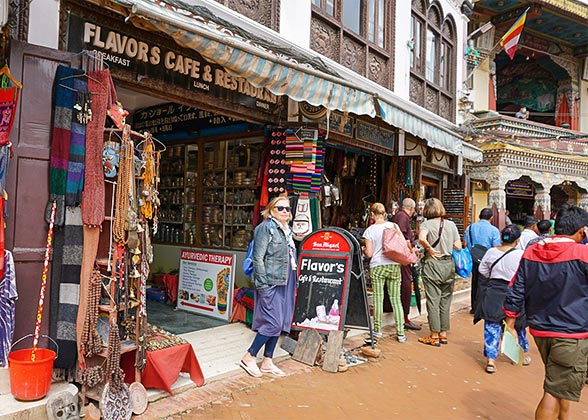
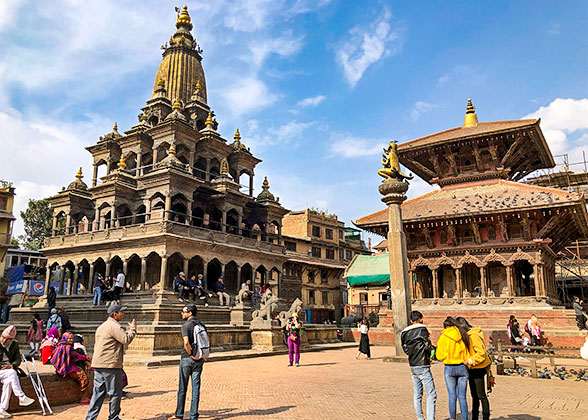
Then, let’s proceed to Patan Durbar Square, another royal palace site of the Kathmandu Valley, which is flanked by royal palace complex on the eastern side and densely packed Hindu and Buddhist temples on the western side. Follow your guide into Sundari Chowk, a former royal bathing and ritual courtyard, and be wowed by the sunken stone pool at its center, whose walls are adorned with exquisite carvings. At the Patan Museum, marvel at countless masterpieces of Buddhist sculptures, stone and wood carvings, and fine metalwork from Patan’s heyday. We’ll also visit the unique stone Krishna Mandir and the Taleju Temple, dedicated to the city’s guardian goddess, gaining a deeper appreciation of Nepal’s rich religious atmosphere.
After the visit, enjoy a scenic 1-hour drive to Nagarkot, a small hilltop village often hailed as the “viewpoint of the Himalayas.” Upon arrival, your guide will assist you with hotel check-in, and then you can have a good rest.
Meals: Breakfast, Dinner
Accommodation: Country Villa Nagarkot or similar
Streetscape around Boudhanath Stupa, Kathmandu
Patan Durbar Square
Day 3 Nagarkot - Kathmandu
Enjoy sunrise over the Himalayas; visit Bhaktapur Durbar Square and Pashupatinath Temple; drive back to Kathmandu. (B+L)
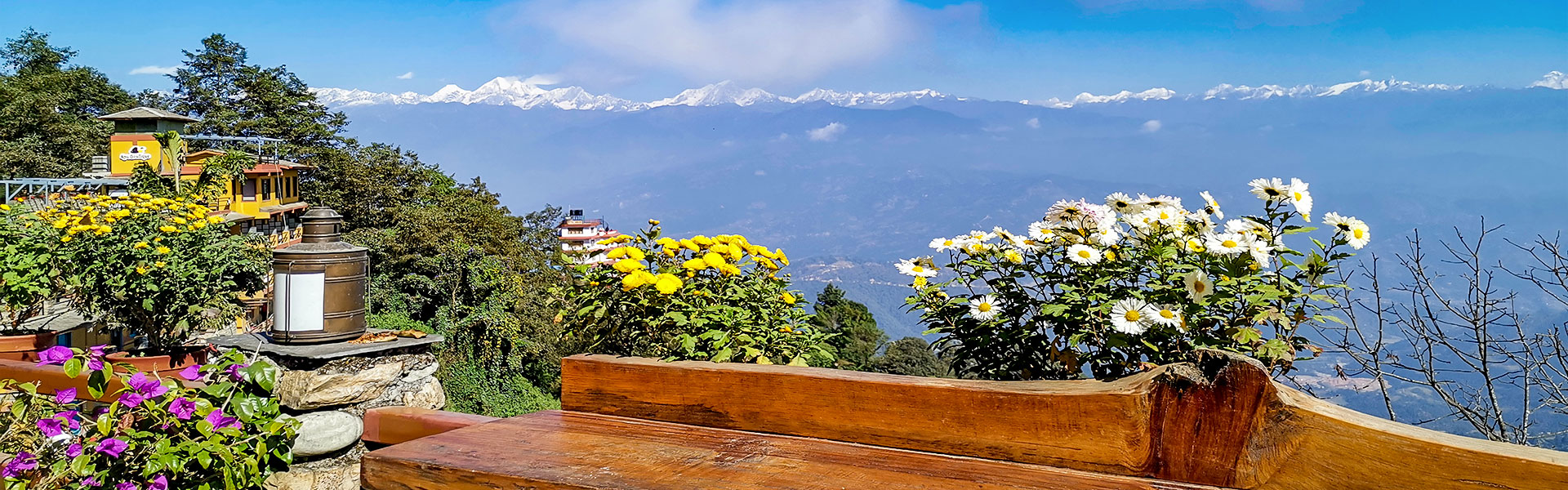
Get up early! A spectacular Himalayan sunrise is calling! With your guide, standing at a prime viewpoint in Nagarkot, at over 2,000 m (6,562 ft), gaze upon the majestic lineup of snow-capped peaks, from Mt. Everest, the world’s highest summit, to Nepal’s famed Annapurna range. As the first light breaks over the rolling sea of clouds, the summits are gilded in a brilliant golden glow - a truly breathtaking sight to behold!
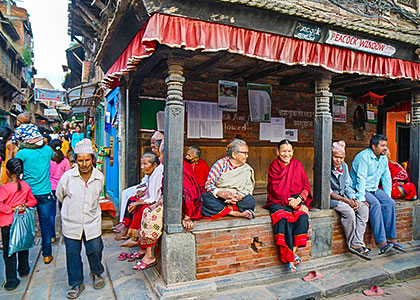
Afterward, let’s travel back in time to the medieval era at Bhaktapur Durbar Square, the last of the valley’s royal palace square. Walk through the Golden Gate and admire the 55-Window Palace, a four-story, brick-and-wood masterpiece featuring 55 identical black-lacquered sandalwood windows beneath its eaves, each intricately carved with deities and animals in varied poses. It took two centuries to finish and is considered the pinnacle of Nepalese woodcarving. We’ll also climb the five-tiered Nyatapola Temple, the tallest in the square, for a bird’s-eye view of the city’s grand layout. Then, venture down a side alley to find the famous Peacock Window, featuring a carved wooden peacock spreading its tail feathers, so lifelike that it looks ready to fly.
The following visit comes to another UNESCO gem, Pashupatinath Temple, dedicated to Shiva, the Hindu god of destruction and creation. Being Nepal’s largest temple complex, it boasts a main sanctum, open to Hindus only, and over 500 smaller shrines and niches. While wandering around the outer grounds, you’ll see many sadhus, local holy men with painted faces and vibrant robes, some sitting in deep meditation, some chatting with devotees. Down by the sacred Bagmati River, open-air cremations take place on numerous stone platforms. You may witness family members washing the feet of the deceased, offering prayers, and finally pushing the ashes into the river. Hindus believe that the ritual releases the soul, making this spot Nepal’s holiest cremation site, with dozens of ceremonies performed daily. Finally, your guide and the driver will escort you back to your hotel in Kathmandu.
► Warm Tips on Pashupatinath Temple:
1. Cremation produces heavy smoke and odors, so it’s advisable to prepare a mask in advance.
2. Think twice before taking a photo with the sadhus, as they usually expect a small tip in return.
3. The temple holds an atmospheric Aarti fire dance ritual at sunset daily, and if you’re interested, stay and enjoy it on your own, and finally take a 25-minute taxi ride to your Kathmandu hotel by yourself.
Meals: Breakfast, Lunch
Accommodation: Ramada Encore by Wyndham Kathmandu Thamel (4 stars) or similar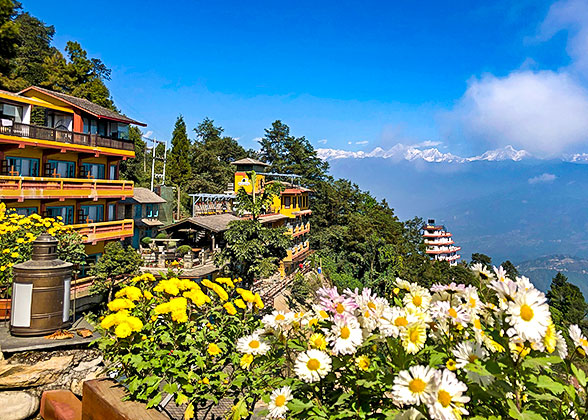
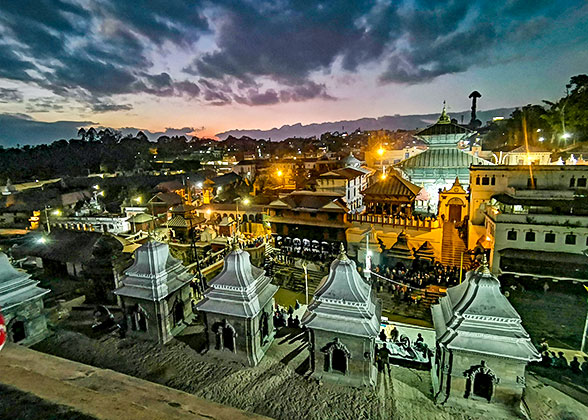
Afterward, let’s travel back in time to the medieval era at Bhaktapur Durbar Square, the last of the valley’s royal palace square. Walk through the Golden Gate and admire the 55-Window Palace, a four-story, brick-and-wood masterpiece featuring 55 identical black-lacquered sandalwood windows beneath its eaves, each intricately carved with deities and animals in varied poses. It took two centuries to finish and is considered the pinnacle of Nepalese woodcarving. We’ll also climb the five-tiered Nyatapola Temple, the tallest in the square, for a bird’s-eye view of the city’s grand layout. Then, venture down a side alley to find the famous Peacock Window, featuring a carved wooden peacock spreading its tail feathers, so lifelike that it looks ready to fly.
The following visit comes to another UNESCO gem, Pashupatinath Temple, dedicated to Shiva, the Hindu god of destruction and creation. Being Nepal’s largest temple complex, it boasts a main sanctum, open to Hindus only, and over 500 smaller shrines and niches. While wandering around the outer grounds, you’ll see many sadhus, local holy men with painted faces and vibrant robes, some sitting in deep meditation, some chatting with devotees. Down by the sacred Bagmati River, open-air cremations take place on numerous stone platforms. You may witness family members washing the feet of the deceased, offering prayers, and finally pushing the ashes into the river. Hindus believe that the ritual releases the soul, making this spot Nepal’s holiest cremation site, with dozens of ceremonies performed daily. Finally, your guide and the driver will escort you back to your hotel in Kathmandu.
► Warm Tips on Pashupatinath Temple:
1. Cremation produces heavy smoke and odors, so it’s advisable to prepare a mask in advance.
2. Think twice before taking a photo with the sadhus, as they usually expect a small tip in return.
3. The temple holds an atmospheric Aarti fire dance ritual at sunset daily, and if you’re interested, stay and enjoy it on your own, and finally take a 25-minute taxi ride to your Kathmandu hotel by yourself.
Meals: Breakfast, Lunch
Accommodation: Ramada Encore by Wyndham Kathmandu Thamel (4 stars) or similar
Landscape of Nagarkot
Pashupatinath Temple, Kathmandu
Day 4 Kathmandu
Visit Dakshinkali Temple, Kirtipur Town, and Chobhar Gorge; Nepalese dinner with cultural dance show. (B+D)
This morning, enjoy a comfy private car transfer to Dakshinkali Temple, a tranquil Hindu sanctuary tucked in the woods, dedicated to the goddess Kali, the fierce avatar of Lord Shiva’s consort Parvati. When you see her fearsome image standing upon a lying Shiva, hear your guide recount the tale behind it: during her battle with a demon whose spilled blood spawned countless soldiers, Kali drank up all its blood to resist successfully, but her rage still uncontrollable. Shiva lay down at her feet, and the moment she stepped on him, she came to her senses - thus this classic image and the tradition of animal sacrifice to the goddess to seek protection. If your visit falls on a Tuesday, Saturday, or during the Dashain Festival around October, you may see offerings of roosters, ducks, and male goats at the small shrine behind the main temple.
Then, let’s make our way to Kirtipur, a hilltop town that used to be a fortified outpost of the valley. Stroll through its narrow lanes and admire traditional Newari houses adorned with intricate wood carvings and latticed windows. Stop by the landmark Chilancho Stupa, whose white dome and golden spire gleam with a reverent aura. Then, we’ll proceed to Chobhar Gorge to unveil a fascinating legend: Kathmandu Valley was once a vast lake until the Chinese Bodhisattva Manjushree cleave the hill here with his sword and drained the water, making the land habitable.
Finally, your guide and the driver will escort you back to your hotel.
Meals: Breakfast, Dinner
Accommodation: Ramada Encore by Wyndham Kathmandu Thamel (4 stars) or similar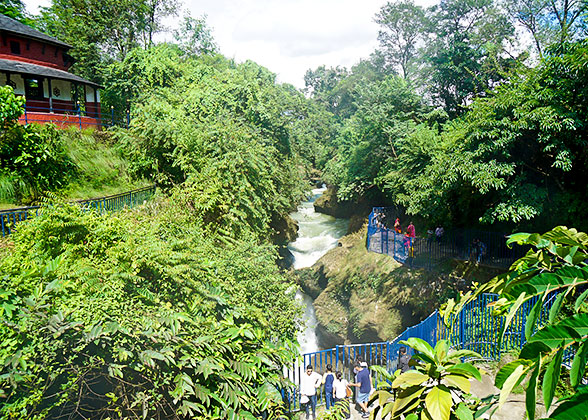
Then, let’s make our way to Kirtipur, a hilltop town that used to be a fortified outpost of the valley. Stroll through its narrow lanes and admire traditional Newari houses adorned with intricate wood carvings and latticed windows. Stop by the landmark Chilancho Stupa, whose white dome and golden spire gleam with a reverent aura. Then, we’ll proceed to Chobhar Gorge to unveil a fascinating legend: Kathmandu Valley was once a vast lake until the Chinese Bodhisattva Manjushree cleave the hill here with his sword and drained the water, making the land habitable.
★ Special Treat: Nepalese Dinner with Dance Show
In the evening, we’ll return to Kathmandu for a traditional Nepali feast at an upscale restaurant. You may savor the signature Dal Bhat set, served on a large platter with separate compartments for rice, vegetables, curry, ghee butter, and soup. Just mix the soup into rice to make it clump and eat with your right hand like the locals, or use the provided forks and spoons. Also sample momo dumplings: delicate wrappers filled with savory meat or vegetables, dipped in spicy curry, each bite bursting with flavor. While you eat, enjoy local dancers performing vibrant folk dances, such as the lively Tamang dance about life and love, and the Newar dance accompanied by hand drums.Finally, your guide and the driver will escort you back to your hotel.
Meals: Breakfast, Dinner
Accommodation: Ramada Encore by Wyndham Kathmandu Thamel (4 stars) or similar
Chobhar Gorge
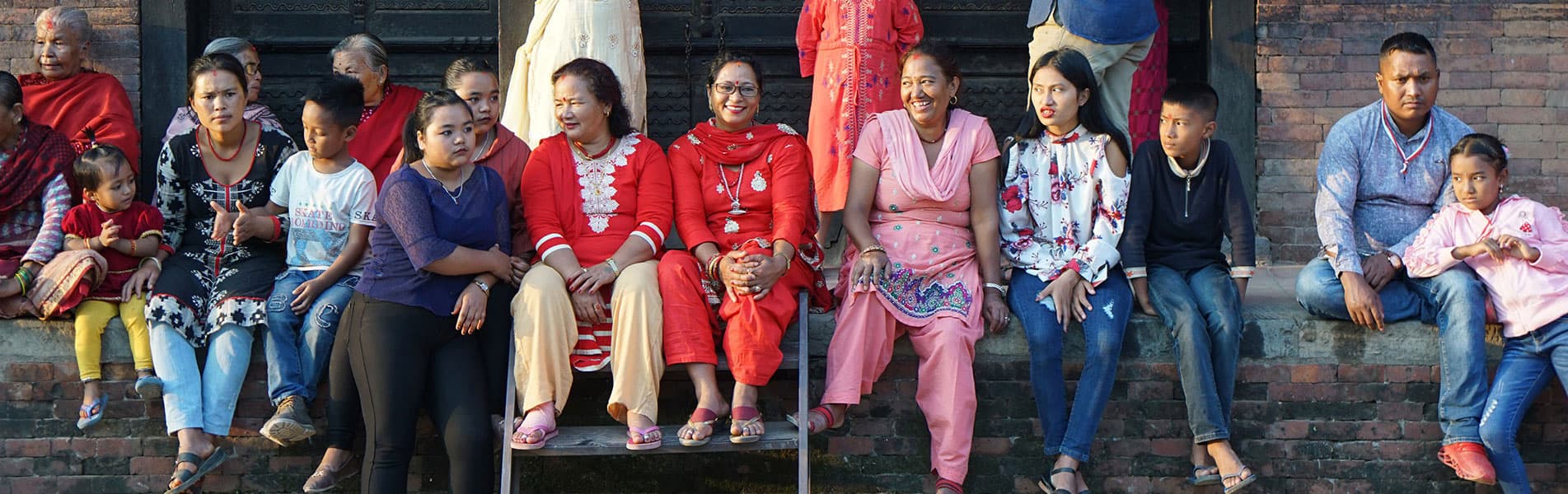
A Backpacker and Nepalese Locals
Day 5 Kathmandu - Paro of Bhutan - Thimphu City Tour
Fly to Paro, Bhutan. Airport pick-up & transfer to Thimphu. Visit Buddha Dordenma Statue, Royal Takin Preserve Motithang, Zilukha Nunnery, Bhutan Post Office Headquarters, Tashichho Dzong (Thimphu Dzong). (B+L+D)
This morning, enjoy a private convoy from your hotel to Kathmandu airport for your flight to Paro, Bhutan. Choose a left-side seat if possible, and enjoy aerial views of snowy peaks over 7,000 m (22,966 ft), including Mt. Everest.
As you land an hour later, your local guide and driver will greet you at the airport exit and escort you on a 1.5-hour drive to your hotel in Bhutan’s capital, Thimphu. En route, you’ll find that locals are all clad in traditional attire: men in Gho, a knee-length robe, with long socks, and women in an ankle-length Kira dress with a short Tego jacket - the national dress code and a proud marker of cultural identity.
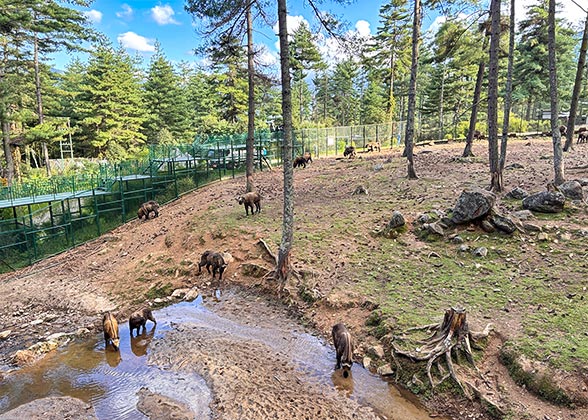
After a brief rest, head with your guide and driver to the hilltop Buddha Dordenma Statue, a massive gilded bronze figure and one of the world’s largest of its kind. Seated in meditation with a bowl in its left hand, it gazes serenely over the Thimphu Valley, seemingly guarding its people. Follow your guide to go inside and be stunned to find the statue packed with 125,000 smaller Buddha images within! Then, let’s move to the Royal Takin Preserve Motithang to meet Bhutan’s national animal, the takin. Observe these creatures lounging around lazily up close, and you’ll be surprised to learn that they’re a bizarre mix of cow face, antelope horns, goat hooves, and bear fur. As folklore goes, a divine madman created them by putting a cow’s head on a goat’s body.
Then, after catch a glimpse of the nun’s daily life and practice in Zilukha Nunnery, the largest in Bhutan, let’s stop by the Bhutan Post Office Headquarters in the city center. Here, get insights into the country’s postal history and culture, and witness some rare stamps. If you like, have a custom stamp made with your own photo at your own expense.
We’ll end the day at Tashichho Dzong, aka Thimphu Dzong, an ancient, imposing fortress-monastery that perfectly embodies Bhutan’s unique dzong design, combining religious, administrative, and defensive functions. Wander around and stand in awe of its majestic symmetrical quadrangular towers featuring white walls, red eaves, and golden spires. If we time it right, at 5:00 pm, we’ll witness the flag-lowering ceremony. As the national Thunder Dragon Flag slowly descends, a Lama will serve as the religious representative to witness the ceremony throughout - a sight rarely seen elsewhere. Finally, your guide and driver will escort you back to your hotel.
► Insider Tips for Bhutan Visit:
1. Bhutan’s official currency is the Ngultrum (USD 1≈BTN 95). US dollars are accepted at some hotels, eateries, and shops, but cause an exchange rate loss. It’s best to exchange some Ngultrum at the airport or banks in Paro and Thimphu - larger bills get better rates.
2. Dress modestly for temple visits: long sleeves and long pants are required, and hats and shoes should be removed before entering. Additionally, most shrines do not allow photography inside.
3. Note that Bhutan enforces a nationwide smoking ban, and public smoking can result in heavy fines.
Meals: Breakfast, Lunch, Dinner
Accommodation: Hotel Bhutan Home, Thimphu (3 stars) or similar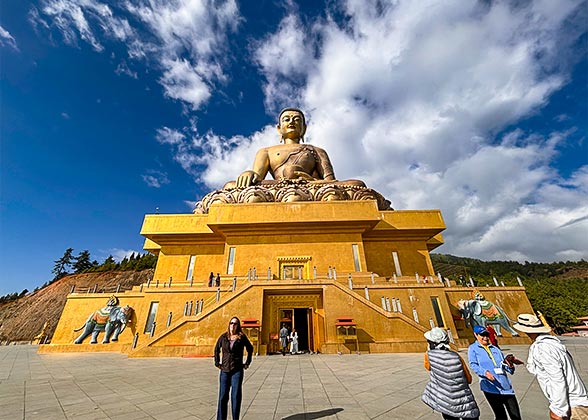
As you land an hour later, your local guide and driver will greet you at the airport exit and escort you on a 1.5-hour drive to your hotel in Bhutan’s capital, Thimphu. En route, you’ll find that locals are all clad in traditional attire: men in Gho, a knee-length robe, with long socks, and women in an ankle-length Kira dress with a short Tego jacket - the national dress code and a proud marker of cultural identity.
After a brief rest, head with your guide and driver to the hilltop Buddha Dordenma Statue, a massive gilded bronze figure and one of the world’s largest of its kind. Seated in meditation with a bowl in its left hand, it gazes serenely over the Thimphu Valley, seemingly guarding its people. Follow your guide to go inside and be stunned to find the statue packed with 125,000 smaller Buddha images within! Then, let’s move to the Royal Takin Preserve Motithang to meet Bhutan’s national animal, the takin. Observe these creatures lounging around lazily up close, and you’ll be surprised to learn that they’re a bizarre mix of cow face, antelope horns, goat hooves, and bear fur. As folklore goes, a divine madman created them by putting a cow’s head on a goat’s body.
Then, after catch a glimpse of the nun’s daily life and practice in Zilukha Nunnery, the largest in Bhutan, let’s stop by the Bhutan Post Office Headquarters in the city center. Here, get insights into the country’s postal history and culture, and witness some rare stamps. If you like, have a custom stamp made with your own photo at your own expense.
We’ll end the day at Tashichho Dzong, aka Thimphu Dzong, an ancient, imposing fortress-monastery that perfectly embodies Bhutan’s unique dzong design, combining religious, administrative, and defensive functions. Wander around and stand in awe of its majestic symmetrical quadrangular towers featuring white walls, red eaves, and golden spires. If we time it right, at 5:00 pm, we’ll witness the flag-lowering ceremony. As the national Thunder Dragon Flag slowly descends, a Lama will serve as the religious representative to witness the ceremony throughout - a sight rarely seen elsewhere. Finally, your guide and driver will escort you back to your hotel.
► Insider Tips for Bhutan Visit:
1. Bhutan’s official currency is the Ngultrum (USD 1≈BTN 95). US dollars are accepted at some hotels, eateries, and shops, but cause an exchange rate loss. It’s best to exchange some Ngultrum at the airport or banks in Paro and Thimphu - larger bills get better rates.
2. Dress modestly for temple visits: long sleeves and long pants are required, and hats and shoes should be removed before entering. Additionally, most shrines do not allow photography inside.
3. Note that Bhutan enforces a nationwide smoking ban, and public smoking can result in heavy fines.
Meals: Breakfast, Lunch, Dinner
Accommodation: Hotel Bhutan Home, Thimphu (3 stars) or similar
Buddha Dordenma Statue, Thimphu
Royal Takin Preserve Motithang, Thimphu
Day 6 Thimphu - Punakha
Transfer to Punakha via Dochula Pass and 108 memorial stupas. Visit Chimi Lhakhang, Punakha Dzong, and a suspension bridge. (B+L+D)
Today, your guide and driver will escort you from your hotel to Punakha, Bhutan’s former capital. En route, stop at Dochula Pass at 3,100 m (10,200 ft), where you can feast your eyes on panoramic views of the snow-capped Himalayas shrouded in drifting clouds and overlook the iconic white 108 memorial stupas, honoring fallen soldiers from a patriotic war.
On arrival in Punakha, follow your guide on a scenic walk through rice fields and flag-draped lanes to Chimi Lhakhang, a Buddhist temple dedicated to the revered Lama Drukpa Kunley (1455-1529), the “Divine Madman”. It’s also a popular site for praying for fertility - you may see women circling the temple, carrying a similar ritual object with auspicious meanings for warding off evil and promoting fertility.
Our sightseeing continues to Punakha Dzong, Bhutan’s second-oldest dzong, built in 1637. Approaching it, you’ll see why it’s hailed as the country’s most beautiful dzong: its whitewashed structure adorned with red roofs and golden spires perches dramatically at the confluence of the Pho Chhu and Mo Chhu - the father and mother rivers of Bhutan. In April and May, the grounds are awash with purple jacaranda blossoms, all set against the majestic Himalayan ranges. It’s so stunning that the current king and queen chose it as their wedding venue. Inside, don’t miss the rich trove of ancient religious relics and vibrant murals.
Afterward, let’s explore the nearby suspension bridge, Bhutan’s longest at over 160 m (525 ft). As you cross, soak up the gentle sway, the roar of glacial water rushing below, and the rustle of colorful prayer flags. Locals believe that each flap of the flags carries a prayer heavenward - so every step you take is blessed.
Finally, your guide and driver will escort you to your hotel in Punakha for check-in.
Meals: Breakfast, Lunch, Dinner
Accommodation: Hotel Zangto Pelri, Punakha (3 stars) or similar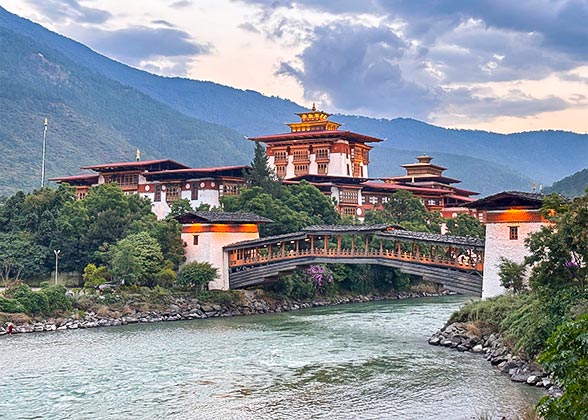
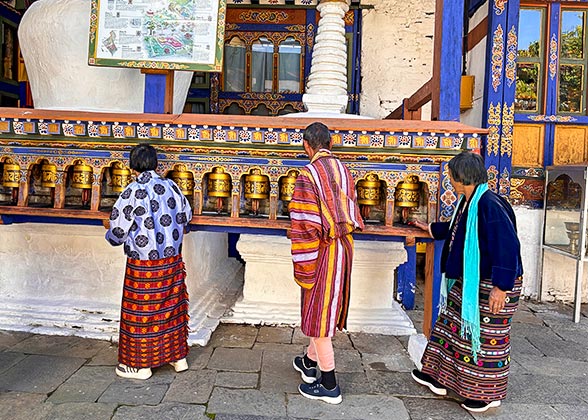
On arrival in Punakha, follow your guide on a scenic walk through rice fields and flag-draped lanes to Chimi Lhakhang, a Buddhist temple dedicated to the revered Lama Drukpa Kunley (1455-1529), the “Divine Madman”. It’s also a popular site for praying for fertility - you may see women circling the temple, carrying a similar ritual object with auspicious meanings for warding off evil and promoting fertility.
Our sightseeing continues to Punakha Dzong, Bhutan’s second-oldest dzong, built in 1637. Approaching it, you’ll see why it’s hailed as the country’s most beautiful dzong: its whitewashed structure adorned with red roofs and golden spires perches dramatically at the confluence of the Pho Chhu and Mo Chhu - the father and mother rivers of Bhutan. In April and May, the grounds are awash with purple jacaranda blossoms, all set against the majestic Himalayan ranges. It’s so stunning that the current king and queen chose it as their wedding venue. Inside, don’t miss the rich trove of ancient religious relics and vibrant murals.
Afterward, let’s explore the nearby suspension bridge, Bhutan’s longest at over 160 m (525 ft). As you cross, soak up the gentle sway, the roar of glacial water rushing below, and the rustle of colorful prayer flags. Locals believe that each flap of the flags carries a prayer heavenward - so every step you take is blessed.
Finally, your guide and driver will escort you to your hotel in Punakha for check-in.
Meals: Breakfast, Lunch, Dinner
Accommodation: Hotel Zangto Pelri, Punakha (3 stars) or similar
Punakha Dzong
Bhutanese Locals Turning Prayer Wheels
Day 7 Punakha - Paro
Drive 5 hours to Paro. Visit Paro Dzong, Ta Dzong (National Museum), and Kyichu Lhakhang. (B+L+D)
This morning, your guide and driver will accompany you on a nearly 5-hour road trip back to Paro. Once there, we’ll head straight to the 400-year-old Paro Dzong, aka Rinpung Dzong. As you wander the courtyard, gaze up at the intricately carved wooden gallery and vivid murals depicting Buddhist stories and the kingdom’s history, revealing the profound spirituality embedded in every detail. Step into the central hall to pay tribute to the majestic 20-meter-tall (66-feet-tall) golden Buddha statue. Furthermore, from the terrace, you can enjoy a panoramic view of Paro Town.
► Tsechu Festival Trivia
Tsechu, one of Bhutan’s grandest religious festivals, honors Guru Rinpoche, the 8th-century Indian sage who brought Buddhism to the kingdom. The largest annual celebration is the five-day event held in Paro from late March to early April and the three-day one in Thimphu from late September to early October. During the festival, dancers in traditional robes and fearsome masks perform sacred Cham dances, reenacting the saint’s triumph over demons. Especially, Paro’s “Throngdrel’s unfurling” on the final day, when a giant, treasured thangka of Guru Rinpoche, locally believed to be a living vision of the saint, is displayed at dawn for only a few hours. If you’re interested, plan your trip within the corresponding time frame.
Then, let’s pay a visit to Ta Dzong, the National Museum of Bhutan, and admire its collection of artifacts, including ancient instruments, Buddhist sculptures, thangkas, and seals.
Afterward, round off at the 1,300-year-old Kyichu Lhakhang, one of Bhutan’s oldest temples. Cross over the wooden threshold of its main hall rather than step on it - as Bhutanese believe it marks the sacred boundary between the ordinary and the divine - and honor the revered 8-year-old life-sized Sakyamuni statue.
At last, your guide and driver will escort you to your hotel in Paro for check-in.
Meals: Breakfast, Lunch, Dinner
Accommodation: Hotel Olathang, Paro (3 stars) or similar
► Tsechu Festival Trivia
Tsechu, one of Bhutan’s grandest religious festivals, honors Guru Rinpoche, the 8th-century Indian sage who brought Buddhism to the kingdom. The largest annual celebration is the five-day event held in Paro from late March to early April and the three-day one in Thimphu from late September to early October. During the festival, dancers in traditional robes and fearsome masks perform sacred Cham dances, reenacting the saint’s triumph over demons. Especially, Paro’s “Throngdrel’s unfurling” on the final day, when a giant, treasured thangka of Guru Rinpoche, locally believed to be a living vision of the saint, is displayed at dawn for only a few hours. If you’re interested, plan your trip within the corresponding time frame.
Then, let’s pay a visit to Ta Dzong, the National Museum of Bhutan, and admire its collection of artifacts, including ancient instruments, Buddhist sculptures, thangkas, and seals.
Afterward, round off at the 1,300-year-old Kyichu Lhakhang, one of Bhutan’s oldest temples. Cross over the wooden threshold of its main hall rather than step on it - as Bhutanese believe it marks the sacred boundary between the ordinary and the divine - and honor the revered 8-year-old life-sized Sakyamuni statue.
At last, your guide and driver will escort you to your hotel in Paro for check-in.
Meals: Breakfast, Lunch, Dinner
Accommodation: Hotel Olathang, Paro (3 stars) or similar
Day 8 Paro Hiking
Hike to Tiger’s Nest Monastery (Taktsang); visit ruins of Drukgyel Dzong and Paro Old Town. (B+L+D)
Our full-day hike today starts at Taktsang, better known as the Tiger’s Nest Monastery, Bhutan’s holiest Buddhist site, clinging dramatically to a cliff at 3,120 m (10,236 ft). According to legend, Guru Rinpoche flew here on the back of a flying tiger and meditated in a cave for three months, sanctifying the site. During the 2-hour hike, the first half follows relatively steady dirt paths and uphill slopes. Pass through lush pine woods and take in the sweeping views of the monastery - your guide will show you the best spot to capture its full grandeur. Continue the latter stretch descending into the valley, passing a waterfall said to be transformed from Guru Rinpoche’s meditation beads. Then, after the final climb of hundreds of stone steps, prepare to be blown away by the white-walled, red-roofed structures with golden spires “hanging” on the sheer vertical rock face, shrouded in mist - a sight that strikes straight to the soul. Stroll around the three-story golden main hall and prayer chambers, and catch a glimpse of the master’s meditation cave and the statue that depicts him astride his mount.
► Notes:
1. Photography and video are strictly prohibited inside the meditation fanes, so you need to leave your phone, camera, and bag at the entrance.
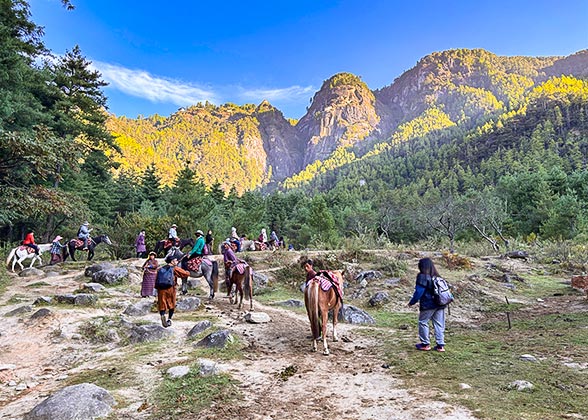
2. Horseback rides are available at the foothill, typically only cover the gentler first half of the trail, roughly USD 20-50 one way. If you’re interested, experience it at your own expense.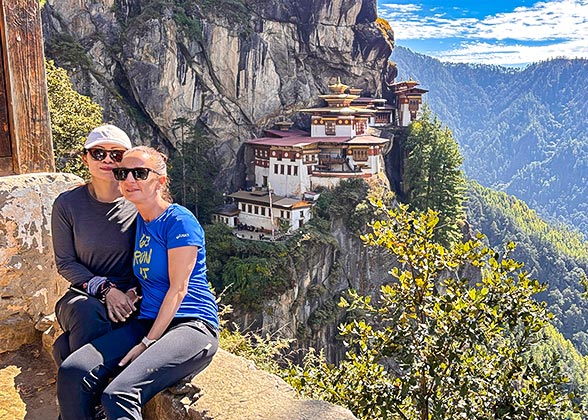
 Our next stop is Drukgyel Dzong, a 17th-century fortress marking Bhutan’s victory over invaders. It was destroyed after a catastrophic fire, so you can just see its fallen walls and stone foundations resting in the peaceful valley.
Finally, take a leisurely stroll with your guide through Paro Old Town. Walk along willow-lined stone paths and browse the open-air farmers’ market by the Paro River, and you’ll find that chili peppers are seemingly indispensable for Bhutanese, as nearly every third stall sells them! Moreover, main street shops packed with handwoven fabrics, Tibetan jewelry, aromatic spices, and painted thangkas also stirs your curiosity. At last, your guide and driver will escort you back to your hotel.
Meals: Breakfast, Lunch, Dinner
Accommodation: Hotel Olathang, Paro (3 stars) or similar
► Notes:
1. Photography and video are strictly prohibited inside the meditation fanes, so you need to leave your phone, camera, and bag at the entrance.
2. Horseback rides are available at the foothill, typically only cover the gentler first half of the trail, roughly USD 20-50 one way. If you’re interested, experience it at your own expense.
Our Guests before Tiger’s Nest Monastery
Hike to Tiger’s Nest Monastery, Paro
Finally, take a leisurely stroll with your guide through Paro Old Town. Walk along willow-lined stone paths and browse the open-air farmers’ market by the Paro River, and you’ll find that chili peppers are seemingly indispensable for Bhutanese, as nearly every third stall sells them! Moreover, main street shops packed with handwoven fabrics, Tibetan jewelry, aromatic spices, and painted thangkas also stirs your curiosity. At last, your guide and driver will escort you back to your hotel.
Meals: Breakfast, Lunch, Dinner
Accommodation: Hotel Olathang, Paro (3 stars) or similar
Day 9 Departure from Paro
Hotel-to-airport transfer by private car & see you off. A nice journey home! (B)
Today, your guide and driver will pick you up from your hotel and escort you to Paro International Airport in time for your homeward flight. Wishing you a safe and pleasant journey!
► FYI: It takes only two hours to fly from Paro to New Delhi, India’s capital. If you have a longer vacation, consider adding India to your journey - a popular and seamless combination. Feel free to reach out to us anytime for a worry-free itinerary tailored just for you!
Meal: Breakfast
► FYI: It takes only two hours to fly from Paro to New Delhi, India’s capital. If you have a longer vacation, consider adding India to your journey - a popular and seamless combination. Feel free to reach out to us anytime for a worry-free itinerary tailored just for you!
Meal: Breakfast
Expand All
Collapse All
This trip can be customized to meet your individual needs!
Tour Prices
Christmas & 2027 Specials: 12% off - Book before Oct 31, 2026
| 2-3 travelers | 4-5 travelers |
|---|---|
| USD2979 USD2621 | USD2799 USD2463 |
- Prices are per person on twin sharing.
- The prices in red reflect 12% discount.
- If you are a group of 6 people or more, we will offer a more favorable price by your group size.
Price Includes
- Accommodation in a double/twin room with daily breakfast
- Private air-conditioned vehicle with a private driver
- Service of English speaking guide during sightseeing
- Entrance fees for all mentioned sites visited
- Meals as indicated outside hotel
- SDF and other taxes to the government in Bhutan
- Bhutan visa fee for a single entry
Price Excludes
- International airfares
- Entry visa fee if applicable
- Holiday peak season supplement
- Gratuities
Itineraries you may also like: