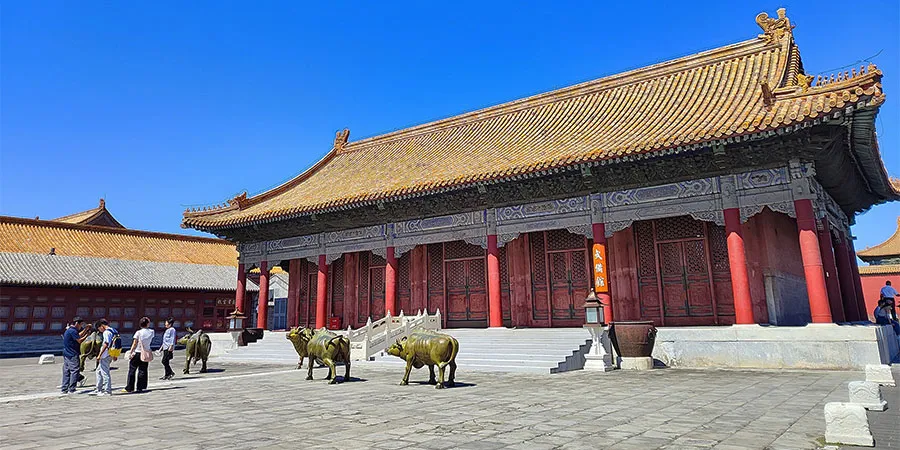
The Arrow Pavilion, once a place for Qing dynasty royals to practice archery and horseback riding, now houses the Weapon Gallery. It features statues of five golden oxen at its entrance.
 |
| Arrow Pavilion, Forbidden City |
When & Why Built – Arrow Pavilion History
Constructed in 1647 as the Shooting Hall, it was renovated and renamed to its current title in 1730. The Qing rulers, being Manchus from the grasslands, were adept at riding and archery, which played a significant role in their conquest of the empire. However, as peace and prosperity settled in, the imperial clan and nobles gradually drifted away from these skills. The Arrow Pavilion was thus built to preserve this ancestral tradition.
Surrounded by open space, it provided an ideal setting for the emperor and his sons to practice archery and horsemanship. During these exercises, targets would be set up before the pavilion, with warriors lining the sides, waving flags and beating drums to cheer them on, creating a spectacular scene.
 |
| A Royal Riding a Horse |
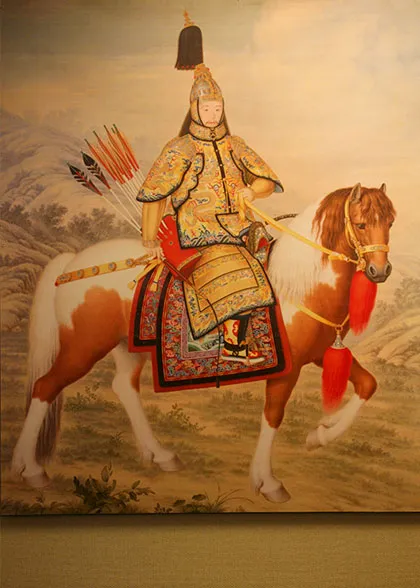
It also served as one of the venues for the triennial imperial examination for military scholars, where candidates were tested on horseback riding, archery, and handling weapons. Additionally, officials granted permission to ride within the palace had to dismount at the pavilion, making it a resting spot for horses.
What Does the Arrow Pavilion Look Like?
Although named a "pavilion", it is in fact a grand, independent hall. It has a single-eave roof with yellow glazed tiles, extending into a veranda on all sides. Facing south, it has five large doors on the southern side and three on the north, with a throne inside. Near the throne stands a stone stele inscribed with an edict issued by Emperor Qianlong (1711-1799) in 1752, urging Manchu nobles to adhere to traditional attire and language, and to regularly practice riding and archery, emphasizing the importance of these practices for future generations.
At the front plaza of the Arrow Pavilion, visitors will find five bronze oxen, inspired by the ancient artwork Five Oxen of more than 1,300 years old. Modeled after the painting, each of the five oxen showcases a unique posture: one grazing and scratching against a shrub, another looking up and walking slowly forward, one standing tall and bellowing, another looking back while licking its tongue, and the last standing quietly with a rope around its neck.
What is the Arrow Pavilion Used for Today?
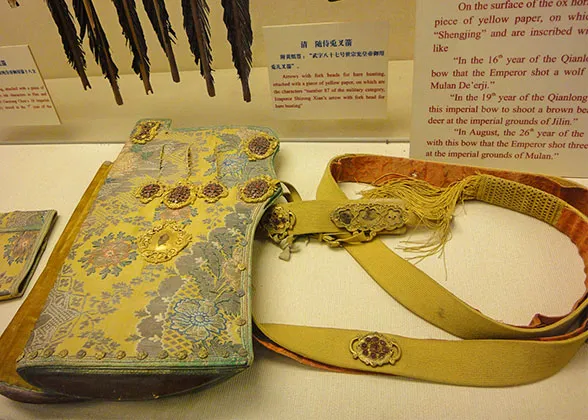
Today, the Arrow Pavilion serves as the Weapon, featuring a permanent exhibition of over 150 artifacts related to weaponry. The hall contains several wooden display cases showcasing various military items, mostly personal items used by Qing emperors. The collection includes two main categories: cold and hot weapons, such as armor, bows and arrows, swords, saddles, guns, warships, and related historical materials.
 | | An Exhibit Inside the Gallery | | 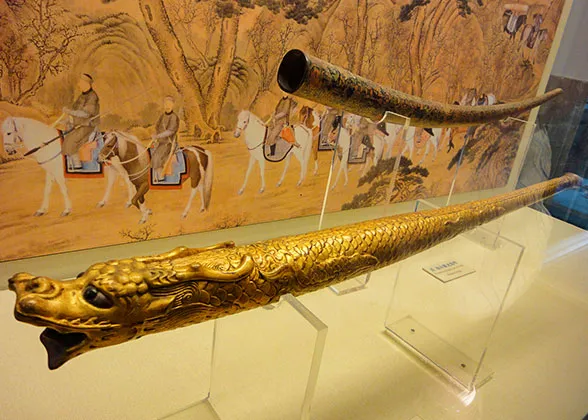 | | A Weapon Exhibit | |
The must-see exhibit is the magnificent armor worn by the Emperor Qianlong during military reviews, displayed in the largest central glass case. This armor is made of bright yellow satin embroidered with colorful auspicious clouds and golden dragon patterns. Its sleeves are woven from gold threads, and the helmet is adorned with pearls and diamonds, making it exceptionally luxurious.
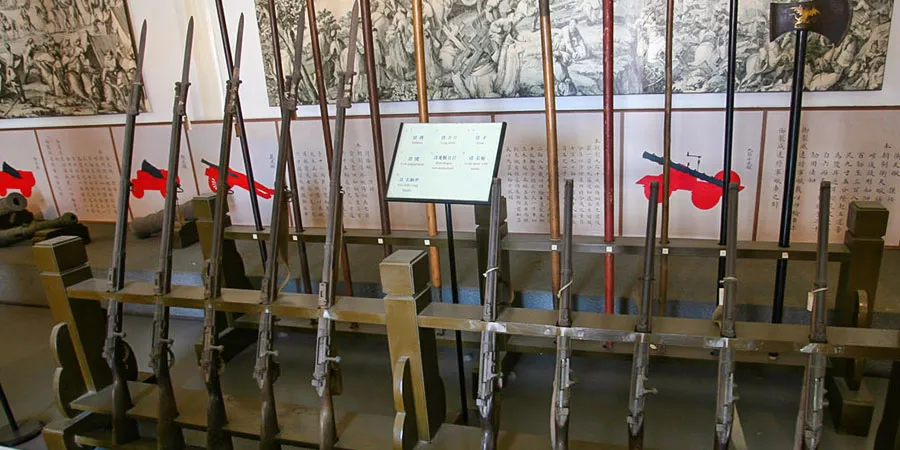 |
| Inside Weapon Gallery |
Visitor Tips at the Arrow Pavilion
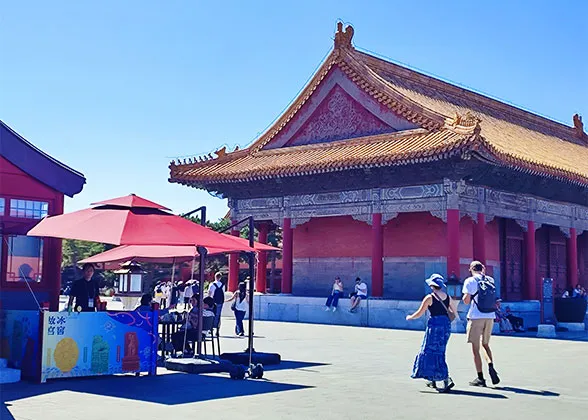 |
| Side View of the Pavilion |
Important Note
Currently, the interior exhibition of the Arrow Pavilion remains closed, with only the exterior accessible to visitors.
Getting There
Located directly south of the Gallery of Timepieces, the Arrow Pavilion is approximately a 10-minute walk from the Meridian Gate. Since it is temporarily closed, it’s recommended just visit the nearby Gallery of Timepieces instead, perhaps stopping briefly to admire the Arrow Pavilion on your way.
- Last updated on Feb. 14, 2026 by Jally Zhang -