Seven Star Stones
The Seven Star Stones consist of seven massive rocks and one smaller stone. These eight stones are arranged in the pattern of the Big Dipper, with the seven larger ones forming a ladle shape, while the smaller stone is placed adjacent to them, slightly to the northeast. Carved with mountain motifs, these ordinary bluestones may seem unremarkable and are often overlooked by visitors. Yet, they carry profound historical and cultural meaning, symbolizing imperial authority, feng shui, ruling philosophy, and ancient astronomical wisdom.
At first glance, you might wonder: Why "Seven" Star Stones when there are clearly eight? The answer unfolds across centuries.
The story begins in the early Ming Dynasty (1368-1644), with Emperor Yongle (1360-1424), the visionary behind the Temple of Heaven. Legend has it that he dreamed of the celestial gate opening wide, and the Big Dipper descending from the heavens to land precisely here. Inspired, he placed seven massive stones to mirror the seven stars of the Big Dipper.
Why did the emperor tell such a dream?
In ancient China, the Big Dipper was not merely a constellation for direction; it was revered as the "Chariot of the Emperor of Heaven." Since the Emperor called himself the "Son of Heaven," his dream of the Emperor's Chariot descending to earth was a proclamation to the world: "Behold, Heaven has come to summon me to office; I am the true Son of Heaven!" From the very beginning, these seven stones served as a political symbol for the emperor to consolidate power and prove his legitimacy.
Over time, folk tales embellished the origin further. Some even claimed the stones were meteorites fallen from the sky. However, credible research indicates that the Seven Star Stones are artificially carved ordinary stones, and the Yongle Emperor's dream was likely a folk legend. Their actual origin is closely tied to another Ming Dynasty emperor, Emperor Jiajing (1507-1567).
Emperor Jiajing was a devout adherent of Taoism. In 1530, acting on advice from court Taoist priests, Jiajing ordered seven stones placed here to stabilize the site’s feng shui, as the place was deemed "too open and vulnerable" for imperial auspices.
Furthermore, the artificially carved mountain patterns on the stones were designed to represent the seven main peaks of Mount Tai. Since ancient times, Mount Tai has been regarded as the "Chief of the Five Great Mountains" and a vital site where ancient emperors offered sacrifices to Heaven and communicated with the divine, symbolizing national stability and a secure empire. The Jiajing Emperor used this sacred symbolism to pray for favorable weather, national prosperity, and to reinforce the stability of imperial power.
But where did the eighth stone come from? Fast-forward to the Qing Dynasty, during the reign of Emperor Qianlong from 1735 to 1795.The Qing imperial family are minority Manchu people from the Changbai Mountain region in the northeast. To solemnly declare that "Manchu people are also an inseparable part of the Chinese nation," Qianlong specifically added a smaller stone to the northeast of the original seven, symbolizing the Manchu ancestral home, Changbai Mountain.
However, some scholars point out that the Seven Star Stones left by the Ming Dynasty might have been eight from the very beginning. This is because the ancients' observations of the "Big Dipper" were far more precise than we imagine.
Beside the seven visible stars of the Big Dipper, there is a relatively faint "Assistant Star" (Alcor, the 80th star in Ursa Major), which forms a pair with one of the main stars. Though not named among the “seven,” this "attendant star" was observed, acknowledged, and honored in symbolic practice by adding a smaller eighth stone.
The Seven Star Stones are located on a grassy stretch in the eastern section of the Temple of Heaven Park, east of the Hall of Prayer for Good Harvests and southeast of the 72 Corridors, not far from the East Gate. Enter through the East Gate, walk west along the main path for 5–10 minutes, and you'll see the site, which is clearly marked and easy to find.
The site follows the general opening hours of Temple of Heaven Park:
April 1 – October 31: 6:00 – 22:00 (last entry 21:00)
November 1 – March 31: 6:30 – 22:00 (last entry 21:00)
Admission is included with the park entry ticket. It only takes about 5–10 minutes to look around, making it a natural addition to your visit.
At first glance, you might wonder: Why "Seven" Star Stones when there are clearly eight? The answer unfolds across centuries.
The story begins in the early Ming Dynasty (1368-1644), with Emperor Yongle (1360-1424), the visionary behind the Temple of Heaven. Legend has it that he dreamed of the celestial gate opening wide, and the Big Dipper descending from the heavens to land precisely here. Inspired, he placed seven massive stones to mirror the seven stars of the Big Dipper.
Why did the emperor tell such a dream?
In ancient China, the Big Dipper was not merely a constellation for direction; it was revered as the "Chariot of the Emperor of Heaven." Since the Emperor called himself the "Son of Heaven," his dream of the Emperor's Chariot descending to earth was a proclamation to the world: "Behold, Heaven has come to summon me to office; I am the true Son of Heaven!" From the very beginning, these seven stones served as a political symbol for the emperor to consolidate power and prove his legitimacy.
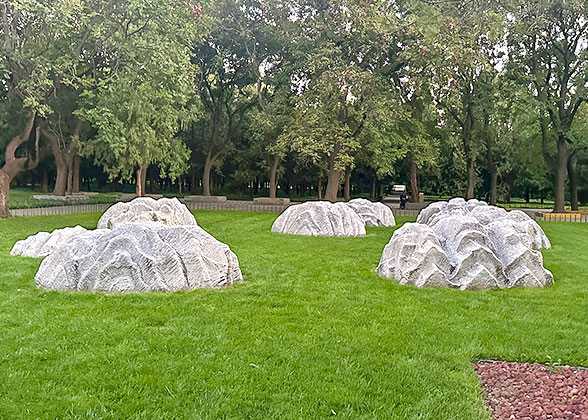 |
| Seven Star Stones |
Over time, folk tales embellished the origin further. Some even claimed the stones were meteorites fallen from the sky. However, credible research indicates that the Seven Star Stones are artificially carved ordinary stones, and the Yongle Emperor's dream was likely a folk legend. Their actual origin is closely tied to another Ming Dynasty emperor, Emperor Jiajing (1507-1567).
Emperor Jiajing was a devout adherent of Taoism. In 1530, acting on advice from court Taoist priests, Jiajing ordered seven stones placed here to stabilize the site’s feng shui, as the place was deemed "too open and vulnerable" for imperial auspices.
Furthermore, the artificially carved mountain patterns on the stones were designed to represent the seven main peaks of Mount Tai. Since ancient times, Mount Tai has been regarded as the "Chief of the Five Great Mountains" and a vital site where ancient emperors offered sacrifices to Heaven and communicated with the divine, symbolizing national stability and a secure empire. The Jiajing Emperor used this sacred symbolism to pray for favorable weather, national prosperity, and to reinforce the stability of imperial power.
But where did the eighth stone come from? Fast-forward to the Qing Dynasty, during the reign of Emperor Qianlong from 1735 to 1795.The Qing imperial family are minority Manchu people from the Changbai Mountain region in the northeast. To solemnly declare that "Manchu people are also an inseparable part of the Chinese nation," Qianlong specifically added a smaller stone to the northeast of the original seven, symbolizing the Manchu ancestral home, Changbai Mountain.
However, some scholars point out that the Seven Star Stones left by the Ming Dynasty might have been eight from the very beginning. This is because the ancients' observations of the "Big Dipper" were far more precise than we imagine.
Beside the seven visible stars of the Big Dipper, there is a relatively faint "Assistant Star" (Alcor, the 80th star in Ursa Major), which forms a pair with one of the main stars. Though not named among the “seven,” this "attendant star" was observed, acknowledged, and honored in symbolic practice by adding a smaller eighth stone.
Getting There
The Seven Star Stones are located on a grassy stretch in the eastern section of the Temple of Heaven Park, east of the Hall of Prayer for Good Harvests and southeast of the 72 Corridors, not far from the East Gate. Enter through the East Gate, walk west along the main path for 5–10 minutes, and you'll see the site, which is clearly marked and easy to find.
Opening Hours & Admission
The site follows the general opening hours of Temple of Heaven Park:
April 1 – October 31: 6:00 – 22:00 (last entry 21:00)
November 1 – March 31: 6:30 – 22:00 (last entry 21:00)
Admission is included with the park entry ticket. It only takes about 5–10 minutes to look around, making it a natural addition to your visit.
- Last updated on Apr. 09, 2026 by Jally Zhang -