Imperial Vault of Heaven: Home of Sacred Tablets & Acoustic Marvels
The Imperial Vault of Heaven was a place to store sacrificial tablets during the Ming and Qing Dynasties (1368-1911). Now it is open to tourists in its original state. This architectural gem balances simplicity and magnificence, reflecting the ancients' cosmic views through numerical symbolism and is renowned for its miraculous acoustic phenomenon of the Echo Wall.
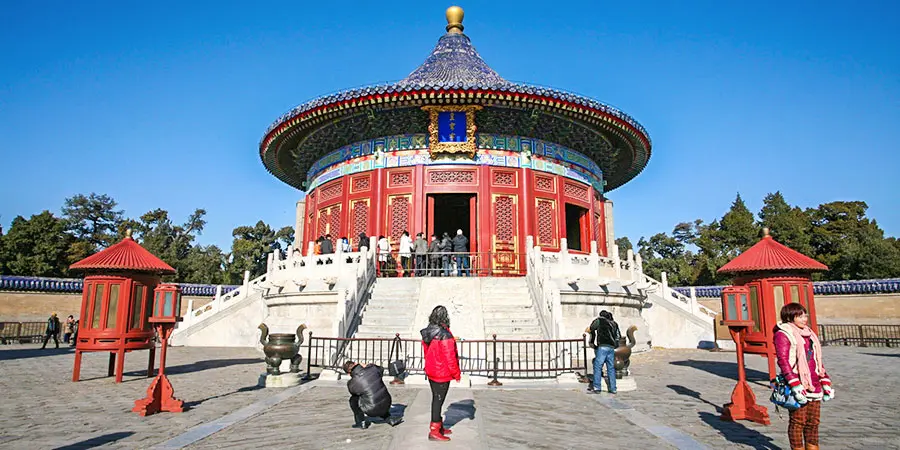 |
| Imperial Vault of Heaven |
When & Why Built – Imperial Vault of Heaven History
Constructed in 1530 as a double-eaved circular building, the Imperial Vault of Heaven was later rebuilt in 1752 to its current form. The primary purpose of the structure was to house the tablets of deities worshipped at the Circular Mound Altar on non-ceremonial days, earning it the nickname "Residence of the Heavenly Deity".
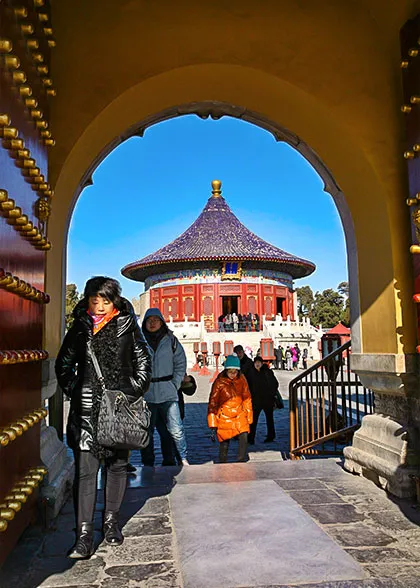
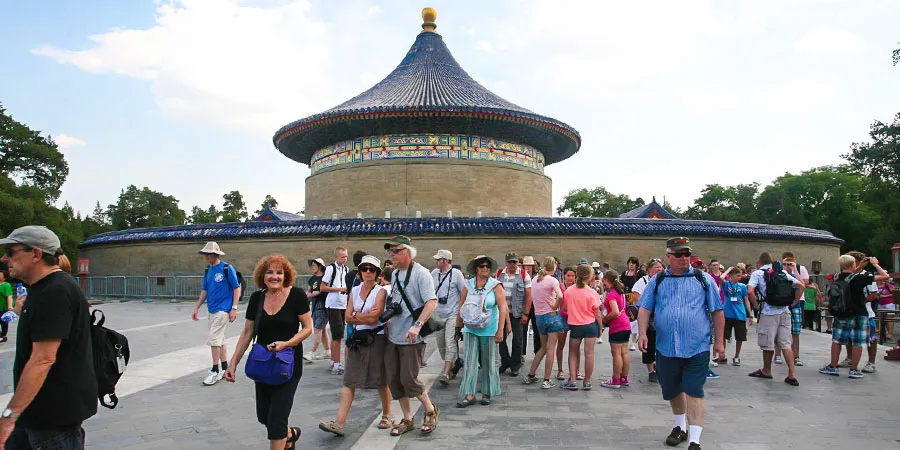
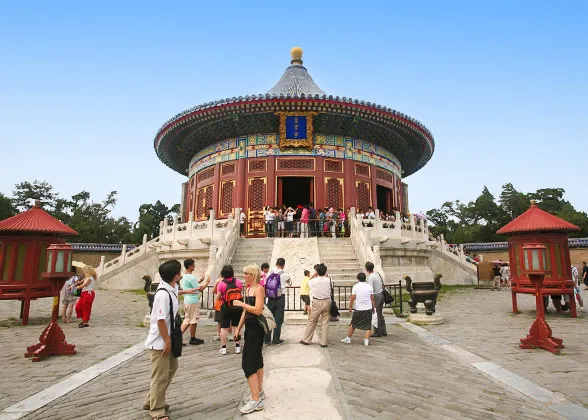
The exterior of the Imperial Vault of Heaven is understated yet grand. Its main hall, circular with a single-eaved pyramidal blue-glazed roof covered with a gilded top, looks like a huge sapphire umbrella with a golden top. The southern facade features red wooden lattice doors and windows, while the rear is composed of unadorned grey brick walls, emphasizing a sense of antiquity and solidity. Sitting on a circular carved seat made of blue-white stone, it was surrounded by stone railings and three-sided steps, with a central staircase featuring a carving of two dragons playing with a pearl.
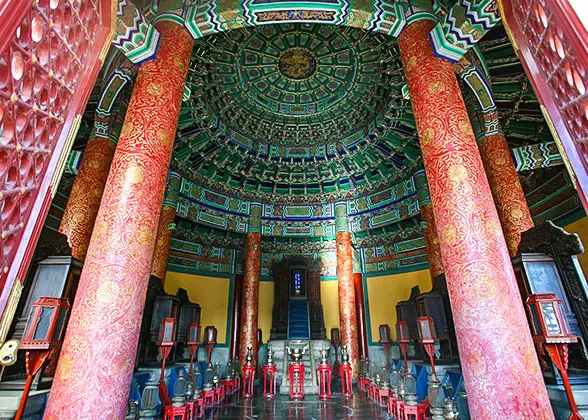
Inside, the hall boasts exquisite decorations. It is constructed without any cross-beams; instead, a triple-layered caisson ceiling with interwoven brackets creates a profound three-dimensional visual effect as it tapers upward. At its center is a massive, gilded relief of a coiling dragon with distinct scales, dazzling against the blue-green background. Beneath the dome is the restored arrangement, with the Heavenly Deity’s tablet enshrined in a golden niche, backed by a dragon-patterned screen and flanked by tablets of emperors' ancestors.
Main Hall Highlight: Sapphire Roof & Beam-Free Dragon Ceiling
The exterior of the Imperial Vault of Heaven is understated yet grand. Its main hall, circular with a single-eaved pyramidal blue-glazed roof covered with a gilded top, looks like a huge sapphire umbrella with a golden top. The southern facade features red wooden lattice doors and windows, while the rear is composed of unadorned grey brick walls, emphasizing a sense of antiquity and solidity. Sitting on a circular carved seat made of blue-white stone, it was surrounded by stone railings and three-sided steps, with a central staircase featuring a carving of two dragons playing with a pearl.
|
|
 |
| Imperial Vault of Heaven |
Acoustic Wonders: Echo Wall & Three Echo Stones
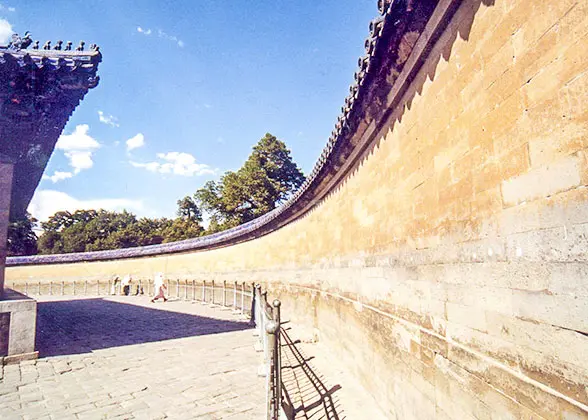
The surrounding wall of the Imperial Vault of Heaven is famously known as the Echo Wall for its remarkable acoustic properties. Scientific analysis shows that the wall's smooth, dense surface reflects sound waves rather than absorbing them, creating distinct echoes.
At the base of the hall's steps lie the Three Echo Stones. Standing on them and clapping produces a unique acoustic effect: one echo from the first stone, two from the second, and three from the third. This occurs because the stones are positioned at the center of the circular wall, allowing sound waves to travel equal distances and reflect back simultaneously.
Additionally, the 18th stone along the path is dubbed the “Dialogue Stone”, from which you can engage in clear conversations with others standing in the eastern or western auxiliary halls. This is due to the formation of an equilateral triangle between the speakers, facilitating the transmission of sound.
Cosmology in Numbers: Pillars, Dragons & the Eight Directions
Ancient Chinese believed that there were eight directions in the heaven, and 360 days in a year. These numbers recur throughout, from the main hall’s floor tiles arranged in eight concentric circles, the eight pillars supporting the roof, to the ceiling's central dragon motif surrounded by 360 smaller golden dragons.
Ticket
 |
| Back View of the Vault |
Opening Hours
 |
| Imperial Vault of Heaven |
The Imperial Vault of Heaven is open from 8:00 to 18:00 from April to October, with ticketing ending at 17:30; from November to March it is open from 8:00 to 17:00, with ticketing ending at 16:30. It is closed every Monday.
Getting There
Located on the southern side of the Temple of Heaven, it is with just 5-minute walk to the South Gate. You can take subway line 14 to Jingtai Station Exit B and walk about 15 minutes to reach the gate or take buses 36, 53, 62, etc., to Temple of Heaven South Gate Station and walk within 5 minutes to arrive.
 Next:
Next: Recommended Tours



- Last updated on Apr. 07, 2026 by Gabby Li -