Nanning Weather
Nanning has a subtropical monsoon climate. Summers are quite long and hot, lasting from May to September; winters from late December to February are not particularly cold compared with China’s northern cities; spring and fall are generally mild with occasional variable temperatures. It is humid year-round, while in spring, it has some extremely humid days. Rainfall is abundant yet sunshine is ample.
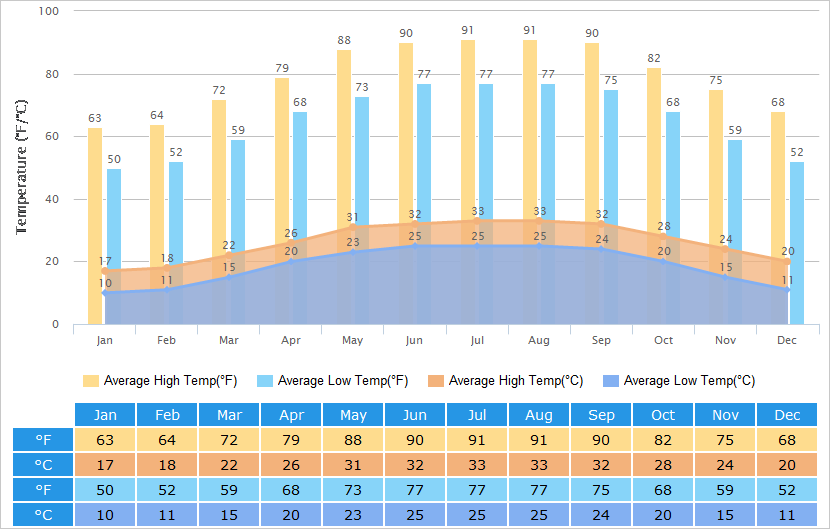
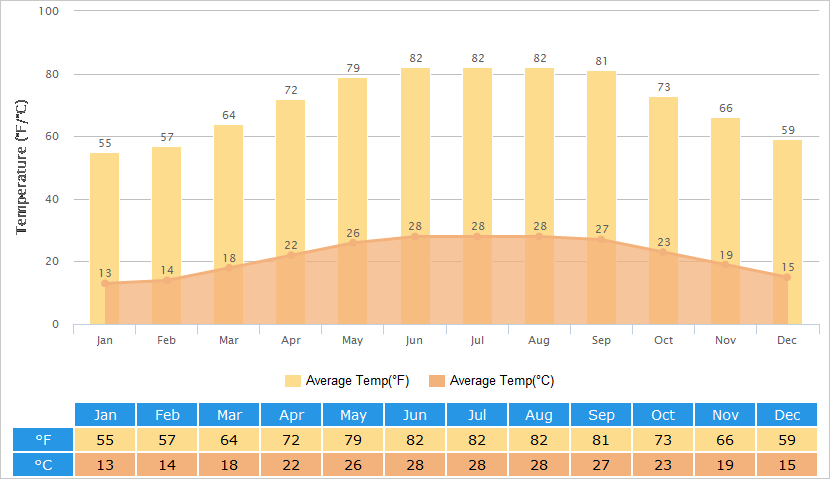
1. Located in southern China at a low latitude, Nanning experiences above-freezing temperatures year-round, generally ranging from 3 to 37 degrees Celsius (37-99 degrees Fahrenheit).
2. Overall, the temperature difference between day and night is not particularly large, typically ranging from 6 to 8°C (11-14°F). In summer, especially on cloudy or rainy days, thick cloud cover acts as an insulator, so the daily temperature range is relatively small. However, in spring, autumn, and winter, when skies are clear, the daily temperature range can be quite large, hovering between 10 and 15°C (18-27°F).
July and August are the hottest months of the year.
This is because Nanning lies near the Tropic of Cancer, so during July and August, it receives the strongest solar radiation, leading to a significant increase in accumulated heat. Consequently, temperatures rise noticeably.
In this period, daily high temperatures frequently exceed 35 degrees Celsius (95 degrees Fahrenheit), especially between 14:00 and 16:00. Extreme heat can reach 40 degrees Celsius (104 degrees Fahrenheit). What’s worse, due to high humidity levels, sweat evaporates very slowly, so even in the shade, people continue to sweat profusely.
January is the coldest month in Nanning, with daytime highs ranging from 13 to 22°C (55-72°F). However, when a cold front sweeps through, daytime highs can drop as low as 4 to 7°C (39-45°F). Although temperatures don’t fall below zero, the damp air and cold wind would make one feel bone-chilling cold, a challenge for new-comers.
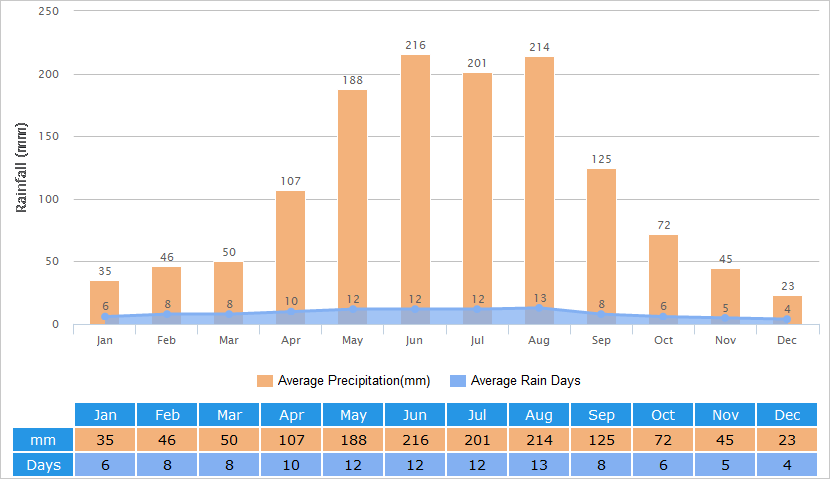
 Nanning’s average annual rainfall is approximately 1,300 mm. The rainy season runs from April to September, with rainfall accounting for 70% to 85% of the annual total. June through August is the peak rainfall period, with monthly rainfall exceeding 200 mm.
Why is Nanning’s rainfall abundant? Influenced by the southeast and southwest monsoons, large amounts of water vapor from the Sea bring abundant precipitation to Nanning. Additionally, as Nanning is surrounded by mountains on three sides, the uplift of warm, moist air creates relatively gentle rainfall. Convective showers are also frequent. They usually come and go very quickly and only over a small area, but the rain intensity is pretty high.
The dry season ranges from October to March, with the average precipitation of 35-72 mm monthly.
Nanning is the area affected by typhoons, particularly in July and August, when one or two typhoons may even make direct landfall. These usually bring prolonged, heavy downpours, with hourly rainfall reaching 60-80 mm. Other extreme weather events may also occur, including thunderstorms, hail, and gusty winds with force 6-8. Consequently, there is a risk of urban flooding and flash floods.
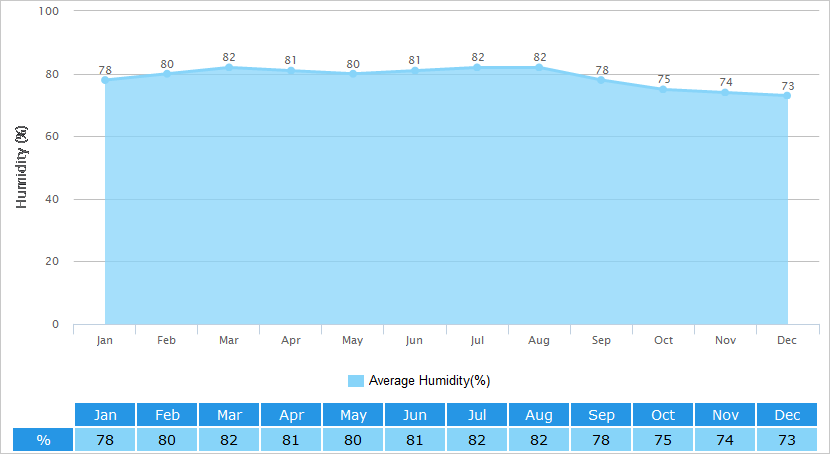
Generally, the air of Nanning remains pretty humid throughout the year, with the average humidity level of 74%-82%. Autumn and winter are relatively less humid.
The most humid period runs from February to April, which is known as “Huinantian” in Chinese. During the transition from winter to spring, as cold air from the north and warm air from the south converge in Nanning, humidity increases sharply; this leads to near-saturated air humidity, to the extent that moisture seeps through walls and clothes are impossible to dry out naturally. This unique weather condition usually lasts for about 3-5 days, and in severe cases can last more than a week. Therefore, it is very important to have a few extra sets of clothes on hand.
Nanning has an average annual sunshine duration of about 1,800 hours, with the highest sunshine duration occurring in summer. In July, sunshine duration reaches as high as 308 hours, and ultraviolet intensity is very high, with an index exceeding 11.
Winter and early spring have the shortest duration of sunshine, because of frequent gray days. From January through March, monthly total sunshine hours range from 123 to 186 hours. Also due to overcast skies and thick cloud cover, ultraviolet radiation is significantly reduced, with the UV index ranging from 7 to 9.
The best times to visit Nanning are from late October to December from autumn to early winter.
During this time, Nanning’s climate is at its most pleasant of the year. The temperature is comfortable, neither too cold nor too hot, with daytime highs generally ranging from 17 to 24 degrees Celsius (62-75 degrees Fahrenheit). It is also the dry season, with limited rainfall and the lowest humidity levels of the year. The sunshine feels warm and comfortable on your skin, and you don’t need to put on heavy sun protection items.
November and December are months when temperatures drop rapidly in most parts of China, but in Nanning, thanks to its pleasant temperatures, many seasonal flowers are in bloom, such as chrysanthemums, plums, and osmanthus. Additionally, late December is the best time to view the metasequoias in Nanning, when their colors are at their most vibrant. At the same time, the trees in the city remain lush and green, giving visitors the feeling that spring and autumn overlap here.
Aside from the weather, there are no public holidays during this period, so visitor numbers are relatively low, making it a low season for tourism, ideal for price-conscious travelers.
 Average Monthly Precipitation: 50-107 mm
Rainy Days: 8-10 days per month
Weather Overview:
Temperatures are gradually rising with some fluctuations. On sunny days, the weather is warm and humid, with daytime highs ranging from 22 to 30 degrees Celsius (72-86 degrees Fahrenheit). However, cold fronts move in frequently, causing periodic drops in temperature, and its daytime temperatures may fall to 11-16 degrees Celsius (52-61 degrees Fahrenheit). Moreover, although this is not the rainy season, the humidity should not be underestimated. It often reaches over 80% - a phenomenon known as “huinantian” as mentioned above, when one feel everything is wet.
Clothes: T-shirts, thin long-sleeved shirts, light jackets, thin knitwear, jeans, long-sleeved dresses, and non-slip sneakers.
Travel Recommendations and Tips:
1. Spring is a blossom season in Nanning, benefiting from warm temperatures. Early to mid-March offers peach flowers and cherry blossoms; Kapok flowers’ peak blossom season ranges from mid-March to April.
2. March and April can be considered shoulder season, with fewer crowds and lower travel costs. But it’s best to avoid the Qingming Festival Holiday from 3rd to 5th of April 2027, which is a minor peak season for short trips.
Average Monthly Precipitation: 125-216 mm
Rainy Days: 8-13 days per month
Weather Overview: In summer, daytime highs range from 25-33°C (77-91°F), with extreme peak temperatures reaching 40°C (104°F). Nights are cooler, with lows of 23-26°C (73-79°F). Influenced by monsoon winds, summer receives most of the annual precipitation, which can easily lead to flooding. Frequent rainfall and plenty of moisture make the weather even more humid, which makes one feel stifling and unbearable.
Why Is Nanning’s Summer So Hot?
Even though Nanning has a very high vegetation coverage rate, which can relieve the heat a bit, it can still be considered one of the hottest cities in China. Geographically, the city is located in a basin surrounded by mountains on three sides, causing hot air to linger and accumulate. Coupled with abundant moisture, this makes it more difficult for the heat to dissipate, resulting in a high number of hot days and heat lasting for long periods. What’s more, in recent years, due to global warming and the intensification of the urban heat island effect, summer temperatures have shown a trend of increasing year by year.
Clothes: Breathable and quick-dry T-shirts, shorts, skirts, light sun-protective jackets, sandals, and light sneakers.
Travel Recommendations and Tips:
1. As midday hours feel unbearably oppressive, visitors are highly advised to stay indoors with air-conditioning, such as the Nanning Museum and the Anthropology Museum of Guangxi.
2. If you are traveling with children, water parks are also a good option, offering a wide variety of recreational activities.
3. July and August are the summer holidays in China, when schools are out, so family tours and study trips are extremely popular, making it peak season when scenic spots are crowded and travel costs soar. What travelers should also avoid is the May Day holiday in early May, which is even more crowded and expensive than July and August.
Average Monthly Precipitation: 45-72 mm
Rainy Days: 6-8 days per month
Weather Overview: Hot temperatures often linger in early October, but after that the weather may gradually cool and become comfortable. Autumn’s daytime high temperatures hover between 21 and 29 degrees Celsius (70-84 degrees Fahrenheit), and nighttime lows remain around 14-22 degrees Celsius (57-72 degrees Fahrenheit). After mid-October, Nanning experiences the most pleasant climate of the year.
Clothes: T-shirts, long-sleeved shirts, thin knitwear, light jacket, light pants, long dresses, and comfortable sneakers.
Travel Recommendations and Tips:
1. From mid-September to mid-October 2027, 31,000 square meters of pink pampas grass in Nanning Garden Expo Park is at their peak. In the sea of pink flowers, visitors can definitely take perfect photos.
2. The bougainvillea on Qingxiu Mountain reaches its peak bloom in October and November, displaying a wide variety of colors, including red, purple, white, and yellow. It even gives the impression of a sea of flowers cascading like a waterfall.
3. National Day Holiday in early October is one of the busiest holidays in China. Apart from crowded attractions and soaring travel costs, the biggest challenge is that you may fail to buy train tickets to or leave Nanning. Therefore, it’s best to avoid this period.
Average Monthly Precipitation: 23-46 mm
Rainy Days: 4-8 days per month
Weather Overview: In most days during midday periods, one feels warm, with daytime highs often exceeding 20°C (68°F). The day-night temperature gap is mild. But when cold air strikes, coupled with high humidity levels, the weather feels unbearably cold, though temperatures rarely drop below zero on the thermometer. Visitors from the dry climate may find this damp, cold climate extremely uncomfortable. But according to historical data, the period when it’s considered cold in Nanning generally lasts less than a month. Precipitation is limited, and it barely snows. Fogs may occur frequently.
Clothes: Long-sleeved shirts, fleece-lined basic layers, hoodies, sweaters, windbreakers, down coats, thermal underwear, jeans, and comfortable sneakers.
Travel Recommendations and Tips:
1. The Chinese New Year Holiday is the longest and most important holiday in China, falling in early February 2027. Nanning offers various festive activities, such as lantern shows and temple fairs, so attracting many visitors. If you are not interested in the festival atmosphere and want to save some money, it’s best to avoid this period.
2. Qingxiu Mountain is recommended in winter, as it provides a great chrysanthemum exhibition from November to January, with cultural performances included.
Temperatures Patterns
2. Overall, the temperature difference between day and night is not particularly large, typically ranging from 6 to 8°C (11-14°F). In summer, especially on cloudy or rainy days, thick cloud cover acts as an insulator, so the daily temperature range is relatively small. However, in spring, autumn, and winter, when skies are clear, the daily temperature range can be quite large, hovering between 10 and 15°C (18-27°F).
What’s the hottest month in Nanning?
This is because Nanning lies near the Tropic of Cancer, so during July and August, it receives the strongest solar radiation, leading to a significant increase in accumulated heat. Consequently, temperatures rise noticeably.
In this period, daily high temperatures frequently exceed 35 degrees Celsius (95 degrees Fahrenheit), especially between 14:00 and 16:00. Extreme heat can reach 40 degrees Celsius (104 degrees Fahrenheit). What’s worse, due to high humidity levels, sweat evaporates very slowly, so even in the shade, people continue to sweat profusely.
What’s the coldest month in Nanning?
Rainy Season and Dry Season
Nanning’s average annual rainfall is approximately 1,300 mm. The rainy season runs from April to September, with rainfall accounting for 70% to 85% of the annual total. June through August is the peak rainfall period, with monthly rainfall exceeding 200 mm. Why is Nanning’s rainfall abundant? Influenced by the southeast and southwest monsoons, large amounts of water vapor from the Sea bring abundant precipitation to Nanning. Additionally, as Nanning is surrounded by mountains on three sides, the uplift of warm, moist air creates relatively gentle rainfall. Convective showers are also frequent. They usually come and go very quickly and only over a small area, but the rain intensity is pretty high.
The dry season ranges from October to March, with the average precipitation of 35-72 mm monthly.
Typhoons
High Humidity Year Round
The most humid period runs from February to April, which is known as “Huinantian” in Chinese. During the transition from winter to spring, as cold air from the north and warm air from the south converge in Nanning, humidity increases sharply; this leads to near-saturated air humidity, to the extent that moisture seeps through walls and clothes are impossible to dry out naturally. This unique weather condition usually lasts for about 3-5 days, and in severe cases can last more than a week. Therefore, it is very important to have a few extra sets of clothes on hand.
Sunshine Hours and UV Rays
Winter and early spring have the shortest duration of sunshine, because of frequent gray days. From January through March, monthly total sunshine hours range from 123 to 186 hours. Also due to overcast skies and thick cloud cover, ultraviolet radiation is significantly reduced, with the UV index ranging from 7 to 9.
Best Time to Visit Nanning
During this time, Nanning’s climate is at its most pleasant of the year. The temperature is comfortable, neither too cold nor too hot, with daytime highs generally ranging from 17 to 24 degrees Celsius (62-75 degrees Fahrenheit). It is also the dry season, with limited rainfall and the lowest humidity levels of the year. The sunshine feels warm and comfortable on your skin, and you don’t need to put on heavy sun protection items.
November and December are months when temperatures drop rapidly in most parts of China, but in Nanning, thanks to its pleasant temperatures, many seasonal flowers are in bloom, such as chrysanthemums, plums, and osmanthus. Additionally, late December is the best time to view the metasequoias in Nanning, when their colors are at their most vibrant. At the same time, the trees in the city remain lush and green, giving visitors the feeling that spring and autumn overlap here.
Aside from the weather, there are no public holidays during this period, so visitor numbers are relatively low, making it a low season for tourism, ideal for price-conscious travelers.
Nanning Climate - Seasons & Travel Advice
Spring: March and April
Average Monthly Precipitation: 50-107 mm Rainy Days: 8-10 days per month Weather Overview: Temperatures are gradually rising with some fluctuations. On sunny days, the weather is warm and humid, with daytime highs ranging from 22 to 30 degrees Celsius (72-86 degrees Fahrenheit). However, cold fronts move in frequently, causing periodic drops in temperature, and its daytime temperatures may fall to 11-16 degrees Celsius (52-61 degrees Fahrenheit). Moreover, although this is not the rainy season, the humidity should not be underestimated. It often reaches over 80% - a phenomenon known as “huinantian” as mentioned above, when one feel everything is wet.
Clothes: T-shirts, thin long-sleeved shirts, light jackets, thin knitwear, jeans, long-sleeved dresses, and non-slip sneakers. Travel Recommendations and Tips:1. Spring is a blossom season in Nanning, benefiting from warm temperatures. Early to mid-March offers peach flowers and cherry blossoms; Kapok flowers’ peak blossom season ranges from mid-March to April.
2. March and April can be considered shoulder season, with fewer crowds and lower travel costs. But it’s best to avoid the Qingming Festival Holiday from 3rd to 5th of April 2027, which is a minor peak season for short trips.
Summer: May to September
Average Monthly Precipitation: 125-216 mm Rainy Days: 8-13 days per month Weather Overview: In summer, daytime highs range from 25-33°C (77-91°F), with extreme peak temperatures reaching 40°C (104°F). Nights are cooler, with lows of 23-26°C (73-79°F). Influenced by monsoon winds, summer receives most of the annual precipitation, which can easily lead to flooding. Frequent rainfall and plenty of moisture make the weather even more humid, which makes one feel stifling and unbearable. Why Is Nanning’s Summer So Hot? Even though Nanning has a very high vegetation coverage rate, which can relieve the heat a bit, it can still be considered one of the hottest cities in China. Geographically, the city is located in a basin surrounded by mountains on three sides, causing hot air to linger and accumulate. Coupled with abundant moisture, this makes it more difficult for the heat to dissipate, resulting in a high number of hot days and heat lasting for long periods. What’s more, in recent years, due to global warming and the intensification of the urban heat island effect, summer temperatures have shown a trend of increasing year by year.
Clothes: Breathable and quick-dry T-shirts, shorts, skirts, light sun-protective jackets, sandals, and light sneakers. Travel Recommendations and Tips:1. As midday hours feel unbearably oppressive, visitors are highly advised to stay indoors with air-conditioning, such as the Nanning Museum and the Anthropology Museum of Guangxi.
2. If you are traveling with children, water parks are also a good option, offering a wide variety of recreational activities.
3. July and August are the summer holidays in China, when schools are out, so family tours and study trips are extremely popular, making it peak season when scenic spots are crowded and travel costs soar. What travelers should also avoid is the May Day holiday in early May, which is even more crowded and expensive than July and August.
Autumn: October and November
Average Monthly Precipitation: 45-72 mm Rainy Days: 6-8 days per month Weather Overview: Hot temperatures often linger in early October, but after that the weather may gradually cool and become comfortable. Autumn’s daytime high temperatures hover between 21 and 29 degrees Celsius (70-84 degrees Fahrenheit), and nighttime lows remain around 14-22 degrees Celsius (57-72 degrees Fahrenheit). After mid-October, Nanning experiences the most pleasant climate of the year. Clothes: T-shirts, long-sleeved shirts, thin knitwear, light jacket, light pants, long dresses, and comfortable sneakers. Travel Recommendations and Tips:1. From mid-September to mid-October 2027, 31,000 square meters of pink pampas grass in Nanning Garden Expo Park is at their peak. In the sea of pink flowers, visitors can definitely take perfect photos.
2. The bougainvillea on Qingxiu Mountain reaches its peak bloom in October and November, displaying a wide variety of colors, including red, purple, white, and yellow. It even gives the impression of a sea of flowers cascading like a waterfall.
3. National Day Holiday in early October is one of the busiest holidays in China. Apart from crowded attractions and soaring travel costs, the biggest challenge is that you may fail to buy train tickets to or leave Nanning. Therefore, it’s best to avoid this period.
Winter: December to February
Average Monthly Precipitation: 23-46 mm Rainy Days: 4-8 days per month Weather Overview: In most days during midday periods, one feels warm, with daytime highs often exceeding 20°C (68°F). The day-night temperature gap is mild. But when cold air strikes, coupled with high humidity levels, the weather feels unbearably cold, though temperatures rarely drop below zero on the thermometer. Visitors from the dry climate may find this damp, cold climate extremely uncomfortable. But according to historical data, the period when it’s considered cold in Nanning generally lasts less than a month. Precipitation is limited, and it barely snows. Fogs may occur frequently. Clothes: Long-sleeved shirts, fleece-lined basic layers, hoodies, sweaters, windbreakers, down coats, thermal underwear, jeans, and comfortable sneakers. Travel Recommendations and Tips:1. The Chinese New Year Holiday is the longest and most important holiday in China, falling in early February 2027. Nanning offers various festive activities, such as lantern shows and temple fairs, so attracting many visitors. If you are not interested in the festival atmosphere and want to save some money, it’s best to avoid this period.
2. Qingxiu Mountain is recommended in winter, as it provides a great chrysanthemum exhibition from November to January, with cultural performances included.
7-Day Nanning Weather Forecast
Averages for Nanning Weather
High/Low Temperatures of Nanning
Average Temperatures of Nanning
Humidity Graph of Nanning
Average Rainfall of Nanning
Air Quality of Nanning
- Last updated on Sep. 20, 2026 by Rachel Hou -