The Tomb of Huo Qubing lies 1,000 meters (about 1,100 yards) northeast of
Maoling Mausoleum in Xingping City, Shaanxi Province. It is a cone-shaped soil and rock mound, adjacent to the Maoling Museum and is surrounded by a scenic environment.
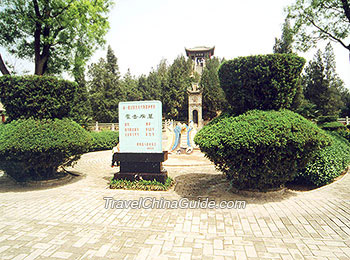 |
| Tomb of Huo Qubing |
Stone Carvings in front of the Tomb of Huo Qubing
Altogether there are 16 stone carvings in front of the Tomb of Huo Qubing, including a galloping horse, a recumbent horse, a bull, a tiger, a wild boar, a toad, a stone fish, a sleeping elephant, a stone man, an ape and a bear. These large groups of carvings comprise an illustrious example of the art of stone caving in the Han Dynasty (206 BC-220). It is the best preserved carving heritage in China.
 | | Stone Bull in front of the Tomb of Huo Qubing | |  | | Sleeping Elephant in front of the Tomb of Huo Qubing | |
'Horse Treads on the Hun' is the main statue placed in front of the tomb with its length of 1.9 meters (about 6.2 feet) and its width of 1.68 meters (about 5.51 feet). In this carving, a stone horse is standing on the ground with perked head and long horsetail. Under its abdomen is a struggling Hun with bow and dagger in his hand. The whole carving is the most representational monumental work and holds an important place in the history of Chinese art.
 |
| Statue of "Horse Threads on the Hun" |
Life Stories about Huoqubing
Huo Qubing (140 BC-117 BC) was a very outstanding and brave general in the Western Han Dynasty (206 BC-24). He and his uncle Wei Qing led the troops to repulse numerous incursions by the Huns and brought peace and prosperity to the society.
 See more about Wei Qing and Huo Qubing Beat Back the Huns
In 117 BC, he died at the age of 23, which was a great loss to the whole society.
Emperor Wudi (156 BC-87 BC) and the entire nation felt very sad for this war hero's death, so the Emperor gave orders to hold a ceremonial funeral for him and built a spacious tomb for him just beside the Emperor's own. This is the present Tomb of Huo Qubing.
To this day there are still many beautiful legends about Huo Qubing spread among the people living in the Qilian Mountain. According to the people in Jiuquan City, Gansu Province, after Huo Qubing and his troops defeated the Huns here, the Emperor vouchsafed good wine to this general to reward him for his great achievement. Instead of enjoying the wine all by himself, Huo poured it into the spring pond and drank it with all his subjects. And from then on, the place was named as Jiuquan (the spring of wine).
To the present day, joss sticks, candles and paper money have never ceased burning throughout the year in the temple at the Tomb of Huo Qubing. Some people are doing so with the hope that he would 'help to avert disasters and cure their diseases,' because 'qubing' in Chinese means 'curing disease.'
- Last updated on Aug. 04, 2025 by Alex Jin -
 Maoling Mausoleum