Maoling Mausoleum (Mao Ling)
 |
 Maoling Mausoleum Photos Maoling Mausoleum Photos |
The tomb of Emperor Wu of Han - Liu Che (157 BC - 87 BC), Maoling Mausoleum is located about 40 kilometers (about 25 miles) away from Xian City. This mausoleum is called ‘the Chinese Pyramid' since it is not only the largest but it also held the richest burial contents of all the mausoleums of Emperors constructed during the Western Han Dynasty (206 BC - 24 AD), and took the longest time, 53 years, to build.
Liu Che was the fifth Emperor of the Western Han Dynasty. He was a great feudal Emperor who can parallel Emperor Qin Shi Huang - the founder Emperor of the Qin Dynasty (221BC - 206BC). During his 54-year reign he exerted himself to make the country prosperous by consolidating and strengthening the unification of many nationalities. With his great talent, he made the Western Han Dynasty's power reach the highest peak and also opened the famous Silk Road.
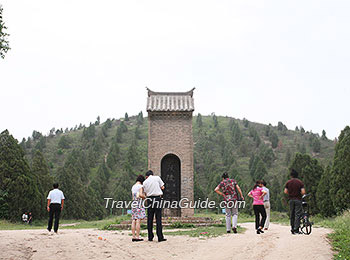
Surrounded by the city wall, the cemetery is in its self quite square. The city wall is 431 meters (about 1,414 feet) long from east-to-west and 415 meters (about 1,362 feet) long from south-to-north. In the center of each wall there is a door.Now the ruins of east, west and north doors are still to be found in well preserved condition. The whole mausoleum is lofty and majesty. It is like a great cone in shape and even resembles a pyramid without its top. It is 46.5 meters (about 153 feet) high and the side length at the bottom, the widest part of the tomb is about 240 meters (about 787 feet). According to historic records, the Emperor Wu used one-third of the taxes to build his tomb and it was filled with an abundant array of burial objects, many of which are now exhibited in Maoling Museum.
Around Maoling Mausoleum, more than 20 tombs now still accompany Emperor Wu. Most of them are the tombs of imperial wives, meritorious ministers and worthy nobles. Here also to be found is the Tomb of Huo Qubing, which is much more famous for its magnificent stone carvings.
 Maoling Mausoleum It takes about 2 hours from Xian to reach the Maoling Mausoleum by public transport.
Take a train to Xingping from Xian Railway Station, and then walk northward to the crossroad, then turn right to take Xingping Bus 11 to Maoling Mausoleum.
Or passengers can take a direct bus at Xian Bus Station near Xi'an Railway Station to Maoling Junction, then take bus no. 4 to Gaodian. At Gaodian station, walk northward to take Xingping 11 to Maoling Mausoleum.
Xian Train Schedule
Liu Che was the fifth Emperor of the Western Han Dynasty. He was a great feudal Emperor who can parallel Emperor Qin Shi Huang - the founder Emperor of the Qin Dynasty (221BC - 206BC). During his 54-year reign he exerted himself to make the country prosperous by consolidating and strengthening the unification of many nationalities. With his great talent, he made the Western Han Dynasty's power reach the highest peak and also opened the famous Silk Road.
Surrounded by the city wall, the cemetery is in its self quite square. The city wall is 431 meters (about 1,414 feet) long from east-to-west and 415 meters (about 1,362 feet) long from south-to-north. In the center of each wall there is a door.Now the ruins of east, west and north doors are still to be found in well preserved condition. The whole mausoleum is lofty and majesty. It is like a great cone in shape and even resembles a pyramid without its top. It is 46.5 meters (about 153 feet) high and the side length at the bottom, the widest part of the tomb is about 240 meters (about 787 feet). According to historic records, the Emperor Wu used one-third of the taxes to build his tomb and it was filled with an abundant array of burial objects, many of which are now exhibited in Maoling Museum.
Around Maoling Mausoleum, more than 20 tombs now still accompany Emperor Wu. Most of them are the tombs of imperial wives, meritorious ministers and worthy nobles. Here also to be found is the Tomb of Huo Qubing, which is much more famous for its magnificent stone carvings.
|
|

 Maoling Mausoleum
 How to get to Maoling Mausoleum from Xian
Take a train to Xingping from Xian Railway Station, and then walk northward to the crossroad, then turn right to take Xingping Bus 11 to Maoling Mausoleum.
Or passengers can take a direct bus at Xian Bus Station near Xi'an Railway Station to Maoling Junction, then take bus no. 4 to Gaodian. At Gaodian station, walk northward to take Xingping 11 to Maoling Mausoleum.
Xian Train Schedule
| Admission Fee | March to November: CNY 75; December to next February: CNY 55 * The entrance ticket includes the museum and the mausoleum. |
|---|---|
| Opening Hours | 8:00 - 17:30 |
| Recommended Time for a Visit | Two hours |
- Last updated on Aug. 04, 2025 by Alex Jin -