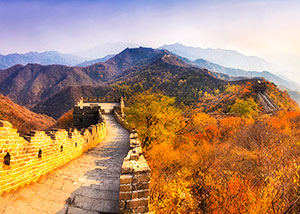
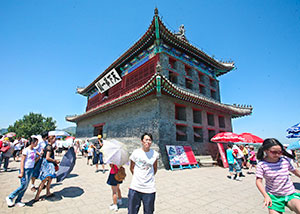
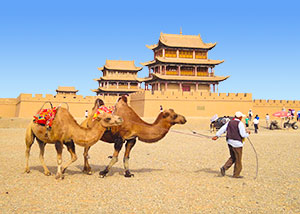
The Great Wall of China, the largest man-made project in the world, is a series of ancient fortifications built in northern China. Although named the 'wall', it is an integrated defense system including not only lofty and solid walls, but also massive signal towers, barriers, barracks, garrison stations, and fortresses along the walls, together forming an insurmountable line, for thousands of years, to protect the territories of ancient Chinese states against the nomadic tribes from the northern steppe. This long wall, just like a gigantic dragon, winds up and down across deserts, grasslands, mountains and plateaus, stretching approximately 21,196 kilometers (13,170 miles) from west to east of China.
The Great Wall of China
Renowned as a UNESCO World Heritage site since 1987 and one of the Seven Wonders of the Medieval World, the Great Wall of China is not just 'medieval'. Early in the 7th century BC, several ancient states built their own boundary walls, which were later connected by Qin Shi Huang (259 - 210 BC), the First Emperor of China, and known as the “10,000-li Long Wall”. In the following 2,000 years, many dynasties continued to consolidate and extend the Great Wall, for not only defense but also border trade management, imposing tariffs, and immigration control.
The Great Wall's military use faded away, but now, as an unparalleled architectural feat with historical significance, it is certainly the No. 1 iconic attraction in China. There are wall remains found in 15 provinces of China. Notable among these are Badaling, Mutianyu, Juyongguan, and Simatai. A day tour or a long hike along the Great Wall allows you to travel back in time to feel the thousands of years’ vicissitudes and the ethos of the ancient Kingdom of China.
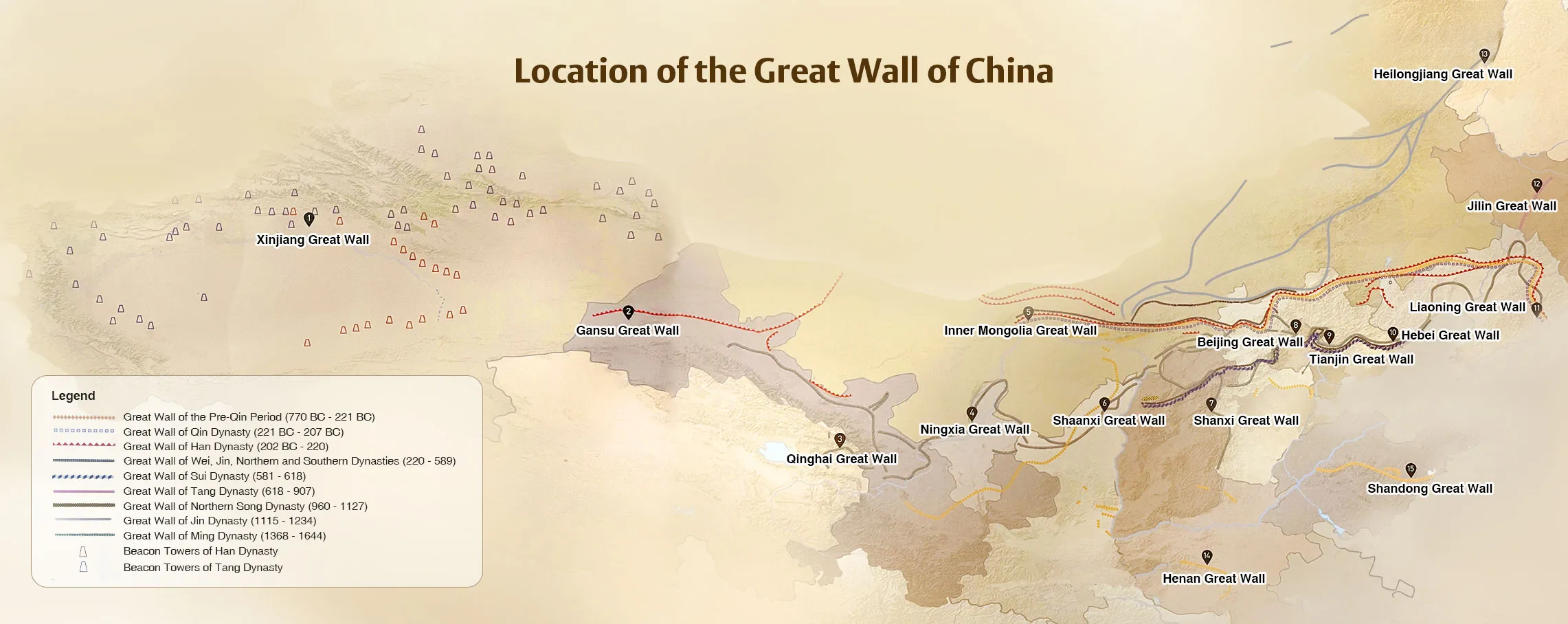
The construction of the Great Wall dates back over 2,700 years to the Spring and Autumn Period (770 BC - 221 BC). During this era, powerful vassal states such as Chu, Qin, and Qi erected defensive walls on their territories, laying the groundwork for the Great Wall. After Qin Shi Huang unified the six states in 221 BC, he connected the old walls of various states, creating the rudimentary form of the Great Wall. During the Han Dynasty (202 BC - 220), it was further expanded and extended westward to Xinjiang. Subsequent dynasties made smaller-scale constructions, until the Ming Dynasty (1368 - 1644) carried out large-scale reconstructions using brick and stone, forming the best-preserved Great Wall system we have today. Most of the Great Wall we see today was built during the Ming Dynasty and has a history of about 600 years.
The Great Wall is more than just a wall; it is a sophisticated defense system. Besides blocking invaders with the wall itself, the beacon towers on the Great Wall also played a crucial role. Upon spotting enemy forces, soldiers would light beacons, sending plumes of thick smoke into the sky. This was an extremely fast military warning method before the advent of the telegraph.
The location of the Great Wall usually relied on natural barriers, avoiding flat terrain as much as possible to increase the difficulty for nomadic cavalry to reach and cross. However, the Great Wall itself was like a highway, capable of transporting troops. The watchtowers distributed along the Great Wall could be used by soldiers for residence and storage of weapons and provisions, providing convenience for their own forces. Key passes, such as Shanhaiguan Pass and Jiayuguan Pass, served as crucial garrison points, allowing for both offensive maneuvers and solid defense.
The Great Wall has evolved beyond its status as an architectural masterpiece and tourist attraction to become a profound cultural symbol. For the Chinese people, it represents national spirit, while for foreigners, it embodies the allure and mystery of the East and China.
The Great Wall of China is located in northern China, spanning 15 provinces and covering various terrains such as deserts, grasslands, mountains, and plateaus. Some of the most renowned and well-preserved sections are located near Beijing.
If you plan to visit the Great Wall, Beijing is undoubtedly your premier destination, as it boasts some of the most exquisite sections. The choice of which section to visit depends on personal preferences:
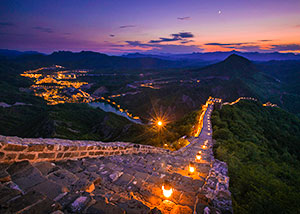
● Classic Tour Sections: For first-time visitors, Mutianyu is an excellent option, boasting fewer crowds, stunning scenery, and a thrilling slide for descent. Badaling is grand and imposing, and has the highest popularity, but with more tourists. Nighttime visitors shouldn't miss Simatai section, which offers a magical atmosphere that's completely different from daytime visits.
● Adventurous Hiking Sections: For hiking enthusiasts, Jiankou and Jinshanling are excellent choices. Jinshanling is hailed as a paradise for hikers; Jiankou retains its original appearance with its perilous terrain, allowing visitors to experience the thrill and time-worn beauty of the Great Wall.
● Best Sections out of Beijing: Shanhaiguan in Hebei, which guards the seaside, and Jiayuguan in Gansu, standing in the desert, are also good choices.
The best time to visit the Great Wall is in spring (March to May) and autumn (September to November), when the climate is mild and the scenery of the Great Wall is at its most beautiful. It is advisable to avoid public holidays such as Labor Day (May 1 - 5) and National Day (October 1 - 7) due to large crowds.
Great Wall hiking attracts adventurers worldwide. Unlike the renovated sections, many hikers prefer the “wild Great Wall,” which retains its original, often dilapidated state. Most people choose classic sections such as Jiankou and Gubeikou for 1 - 2 day short expeditions, touching the real historical traces among the weathered and mottled bricks.
Hiking the entire length of the Great Wall is regarded as the ultimate test of human perseverance, yet it has been accomplished by some. In 1908, British explorer William Edgar Geil became the first to complete this feat. Renowned Great Wall expert Dong Yaohui, along with two friends, became the first Chinese to achieve the same milestone in 508 days from 1984 to 1985. Their real-life experiences prove that hiking the entire Great Wall is not an unattainable goal.
Each year, sections of the Great Wall, including Jinshanling, Huangyaguan, and Jiayuguan, host marathon events, transforming the ancient structure into a premier running track. Runners from all over the world race along the thousand-year-old bricks and stones, passing through watchtowers and passes. If you're a marathon enthusiast, why not sign up? Experience this unique course and immerse yourself in the dual appeal of sport and culture.
The Current State and Protection of the Great Wall
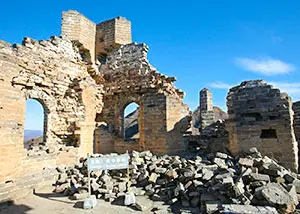
The Great Wall of China is on the list of 100 endangered sites issued by the World Monuments Fund. In fact, less than 10% of the Great Wall is visible to ordinary tourists. The real majority, more than 90%, are crumbling walls snaking between the mountains, undeveloped and poorly protected. What's more serious is that the current length of the Great Wall is not unchanging but is constantly reducing. 30% of the Great Wall is disappearing at an alarming rate, mainly due to natural weathering and human destruction.
Damaged Great Wall in West China
Volunteers repairing the Great Wall
Since the 1980s, China has intensified efforts to preserve the Great Wall. In 2006, China’s State Council issued the “Regulations on the Protection of the Great Wall,” raising public awareness and strengthening conservation measures. Volunteer groups have also emerged, organizing clean-up efforts and discouraging destructive behavior. Every visitor can contribute to the Great Wall's preservation by respecting its environment and refraining from defacing the ancient structure.