Hong Kong Transportation
Getting There
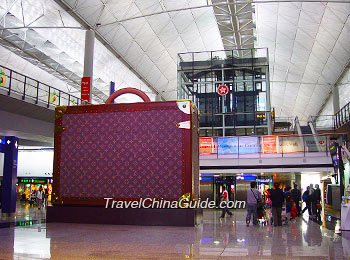 |
| HKIA |
Air
- Airport Express
- Special Service of Airport Express
- Airport Express Travel Pass
- Airport Bus
- Airport A21 Bus
- Airport Taxi
- Airport Shuttle Bus to Hotel
- Airport to City
- Airport to Kowloon
- Airport to Tsim Sha Tsui
- Hong Kong Airport - Guangzhou
- Hong Kong Airport to Shenzhen
- Shenzhen to Hong Kong Airport
- Airport Amenities & Services
The Guangzhou-Shenzhen-Hong Kong High Speed Railway has connected Hong Kong with many cities in Mainland China including Beijing, Shanghai, Guangzhou, Shenzhen, Guilin, Kunming, Guiyang, Xiamen, Fuzhou, Changsha, and Wuhan. A few traditional style trains still run between Hong Kong and Beijing/ Shanghai/ Guangzhou, taking much longer time.
- West Kowloon Railway Station
- Hung Hom Railway Station
- HK - Guangzhou High Speed Train
- HK - Guangzhou High Speed vs. Through Trains
- HK - Shenzhen High Speed Train
- HK - Beijing High Speed Train
- HK - Shanghai High Speed Train
- HK - Guilin High Speed Train
- Map
- How to Buy High Speed Train Tickets in HK
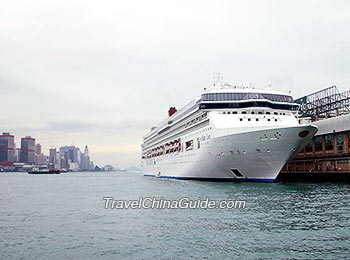
Developed from a fishing village, this area has a lot of waters and piers. There are all together 4 cross-boundary ferry piers, one near the International Airport, one in Hong Kong (HK) Island, one in Tsim Sha Tsui, Kowloon, and one in Tuen Mun, New Territories. Star Ferry has served the city for a century which brings a great joy for passengers to take star ferry for the glittery and glamorous high-rises between Central and Tsim Sha Tsui, especially during Christmas and New Year time. For those who head for outlying islands, taking ferry seems to be the only choice. Daily direct sailings also transfer between the city and Shenzhen, Macau as well as cities of Guangdong Provinces, like Zhuhai & Zhongshan.
 Shenzhen Bao'an International Airport - HK, Hong Kong to Guangzhou Bus
Transportation to Other Cities
How to Travel from Hong Kong to Guangzhou
How to Travel between Hong Kong and Shenzhen
How to Travel between Hong Kong and Zhangjiajie
How to Travel between Hong Kong and Dongguan
How to Travel between Hong Kong and Foshan
How to Travel between Hong Kong and Zhuhai
How to Travel between Hong Kong and Beijing: Train vs. Flight
How to Travel Between Hong Kong and Guilin & Yangshuo
How to Travel between Hong Kong and Zhongshan
How to Travel between Hong Kong and Shanghai: Train vs. Flight
Getting Around
 |
| MTR |
It is compact and easy to navigate, with street, bus and subway signs clearly marked in English. Travelers can ride on subway trains, the light rail, city buses, minibusses, ferries, trams and taxis, yet they all have their own fare system and require a new ticket each time you transfer from one to another. However, if you are going to stay there for several days, think of buying the Octopus Card, with which you can hop on and off trains, trams and most buses and ferries, not worrying about purchasing tickets each time.
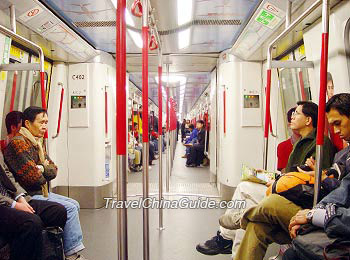
The city's Mass Transit Railway (MTR) is modern, fast and easy to use. It is safe to say that railroads are the backbone of the whole transportation network in this area. The city's MTR network now runs 10 urban subway lines, 1 airport express line, 1 light rail system with 12 routes and 1 tourist cable car system Ngong Ping 360. By 2025, 5 new subway lines are expected to be put into use, which are Guangzhou - HK Express Rail Link, Shantin - Central Line, Tuen Mun South Extension, Tung Chung West Extension and Kowloon East Extension.
Subway Map
|
|
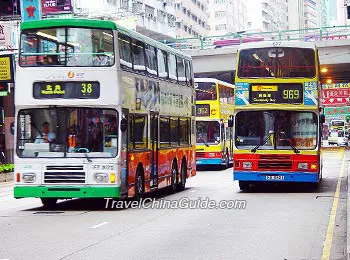
Big Bus has 2 daytime routes covering Hong Kong Island, Kowloon, Aberdeen and Stanley and 1 night route in Kowloon. Passengers can hop off at any of its stops.
See more Hop on Hop off Buses in Hong Kong
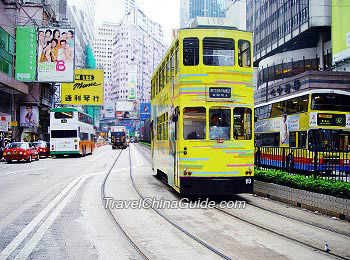
Trams have run for more than a century solely in HK Island. Because of the sound trams make, they are called "Ding Ding" by the local. Trams are cheap and move slowly in downtown HK Island and thus a chance to enjoy the pictures around.
Central Mid-levels Escalator, formed of roofed pedestrian walkways, overbridges, 20 escalators and three moving travellators, is 800 meters (875 yards) long with a vertical height of 150 meters (165 yards), which makes it the longest roofed escalator system in the world. And it is free for all the passengers.
|
|