Located about 120 kilometers (75 miles) west to downtown Xi’an, the Famen Temple Cultural Scenic Area has long been a must-visit place for Buddhist culture enthusiasts. Composed of an entrance square, the Buddha’s Light Avenue, the Namaste Pagoda, and the Famen Temple Museum, it collects millennium-old priceless treasures and boasts majestic Buddhist buildings and statues.
Where did people find all these treasures? The answer is from the underground palace of the Famen Temple immediately to the east of the Cultural Scenic Area. Established in the
China’s Eastern Han Dynasty (25 - 220 AD), the Famen Temple is renowned for enshrining the only relic of Sakyamuni Buddha’s finger bone in the world. Along with it, nearly 2,500 pieces of cultural relics were also discovered in the underground palace of the temple in 1987.
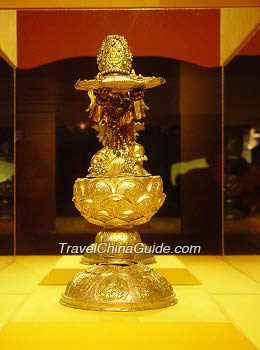 |
| Cultural Relics from Famen Temple Underground Palace |
Four Gates on the Entrance Square
Once you step into the Famen Temple Cultural Scenic Area, four symmetrically arranged gates on the large Entrance Square will amaze you. Their names are respectively Buddha’s Light, Prajna, Bodhi, and Perfect Wisdom, showing the process of receiving the enlightenment of Buddhism and attaining Buddhahood. Between the gates, you can not only view the Ponds of Serenity featuring stone-made lotus flowers within and statues of auspicious elephants and lions on both sides, but also admire vivid statues of Eighteen Arhats in Buddhism.
Buddha’s Light Avenue - Sacred Path
The way to attain greatness in Buddhism is never easy, just like the journey on the 1,230-meter-long (1,450 yards) avenue. It’s quite uncommon to find such a long path in other attractions, and one has to reach the end of the avenue to closely admire the Namaste Pagoda there, the most eye-catching building in the Cultural Scenic Area. Thus, it’s regarded as a pilgrimage road among Buddhist believers. Along the avenue, you will see ten statues of well-known Bodhisattvas, which are approximately three stories high and with distinctive mounts and ritual objects.
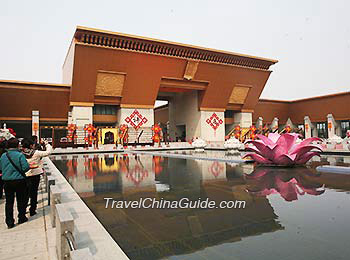 | | Majestic Prajna Gate | | 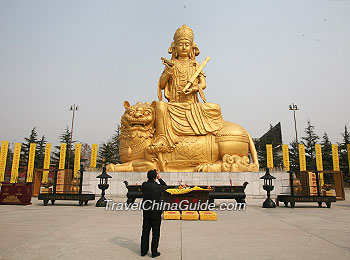 | | Bodhisattva along Buddha’s Light Avenue | |
Namaste Pagoda - Iconic Building
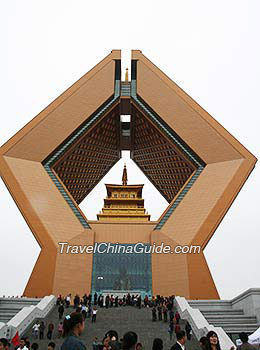 |
| Namaste Pagoda |
The 148-meter-high (485 feet) Namaste Pagoda is the signature building of the Famen Temple Cultural Scenic Area. The reason why the pagoda reaches such a height is that “1” indicates the respect for the only sarira of the finger bone of Sakyamuni, the founder of Buddhism, and “48” comes from his birthday, the 8th day of the 4th lunar month.
The shape of the golden-colored pagoda is also unique, and it looks like two palms being put together devoutly. In Buddhist, this posture shows people’s respect for and gratitude to Sakyamuni.
In the pagoda, statues of Sakyamuni and Maitreya Buddha are shrined, and many people come here to seek a blessing.
Famen Temple Museum with Treasures from Underground Palace
Rain once lasted for nearly a month in 1981, and flashes of lightning collapsed half of the True Body Pagoda in the Famen Temple. After six years, when people were rebuilding the pagoda, they discovered the underground palace of the temple. This underground palace is the oldest and largest pagoda underground palace at the highest level in the world.
Moreover, 2,499 treasures from
China’s Tang Dynasty (618 - 907 AD) within were found, with the most precious one being the world's only surviving finger bone relic of Sakyamuni, found in the deepest part of the palace. Three jade replicas of the finger bone were also unearthed, crafted specifically to protect the authentic relic and called “Shadow Bones”.
To better preserve these cultural relics and also display the most representative ones, the museum was constructed and has become the place quite worth a visit in the Cultural Scenic Area. What’s more, a model of the underground palace was constructed within the museum.
What to see in the Famen Temple Museum?
1. “The King of Monk’s Staff”
Among all the Buddhist ritual objects, monk staffs are at the highest grade. What’s more, this staff is the largest and the most delicate of its kind in the world, and has twelve rings which can not be found on any other monk’s staff, and that’s why Sakyamuni is the only owner of it.
 |
| King of Monk’s Staff |
2. Seven of Eight-layer Treasure Boxes
The sizes of these boxes decrease successively like those of Matryoshka dolls, and they were used to contain one of the “Shadow Bones”. Since the outermost box had decayed when unearthed, you can just see the remaining seven ones right now.
 |
| Treasure Boxes Unearthed from Underground Palace |
3. Celadon Porcelain Bowl
As one of imperial treasures offered to the finger bone relic, this porcelain bowl not only features the precious greyish-green glaze, but also creates an illusion of containing water, while in fact it’s empty.
 | | Celadon Porcelain Giving Water Illusion | |  | | Spherical Incense Burner | |
4. Spherical Silver Incense Burner
This spherical incense burner is famous for its technique, and no matter how it’s rotated, the incense cup within will always stay level, holding the incense stably. In addition, its diameter is approximately the width of an adult's palm, making it the largest one of its kind worldwide.
Famen Temple - Free-entry Place beside the Cultural Scenic Area
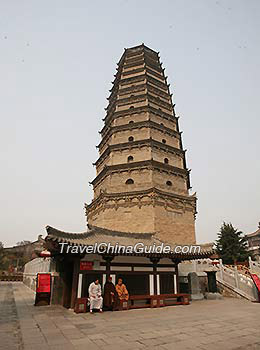 |
| True Body Pagoda in Famen Temple |
In the Famen Temple, there are the newly-built True Body Pagoda and the site of the underground palace. In its history, a total of 8 emperors of the Tang Dynasty came to this imperial temple to receive and send off the finger bone relic. Nowadays, it has become a good place to pray for blessings and enjoy a serene tour.
Tips for Visiting Famen Temple Cultural Scenic Area
1. To gain a better experience, it’s advised to take the shuttle vehicle in the attraction to visit the quite long Buddhist’s Light Avenue instead of walking the whole way for sightseeing. The single trip by sightseeing vehicle takes about 15 minutes, half the time spent on the walk.
2. Since October 2026, the Famen Temple will present the relic of Sakyamuni’s finger bone to the tourists twice in a year, respectively in May and October. For those who want to view the relic and pay devotions to it, it’s suggested that they visit the temple in these two months.
3. To fully learn about the symbolic meanings of buildings and more exciting stories about the cultural relics in the Famen Temple Cultural Scenic Area, why not hire a guide for your visit, or join our
One Day Tour to Famen Temple and Qianling Mausoleum.
Entrance Fee & Opening Hours of Famen Temple Cultural Scenic Area
| Entrance Fee | March - November: CNY 78
December - February: CNY 58
 Free for children no taller than 1.2 meters (3 feet 11 inches) Free for children no taller than 1.2 meters (3 feet 11 inches)
or under the age of 6, and also people over the age of 65. |
| Shuttle Vehicle Fare | CNY 10 per person for a single-way trip;
CNY 20 per person for a round-way trip. |
| Opening Hours | 8:30 - 17:30, with the last admission at 17:00. |
| Recommended Visit Duration | 3 hours. |
How to Get to Famen Temple from Xi’an?
Take
Xi’an Metro Line 1 to Hanchenglu Station, get off from Exit D, and you will see the Xi’an West Coach Station, from which you can take the coach to the south gate of the Famen Temple.
There are only two coaches bound for the Famen Temple each day, respectively at 9:00 and 16:30. If you plan to visit Famen Temple and return to Xi'an on the same day, it is recommended to arrive at the station before 8:40 to take the 9:00 bus.

You may like:
Terracotta ArmyStele Forest MuseumYangling Mausoleum of Han DynastyHuaqing PalaceQianling Mausoleum
- Last updated on May. 13, 2026 by Alex Jin -
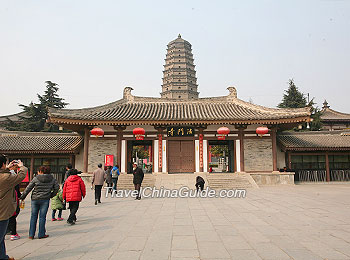
 Famen Temple Pictures