Corner Towers of the Forbidden City (Jiaolou)
The Corner Towers, positioned at each corner of the Forbidden City's city wall, are celebrated for their exquisite triple-eaved roofs and interlocking ridges. They achieve a perfect balance with the city wall and the Moat, which makes them an unmissable landmark and a must-capture photo spot.
 |
| Corner Tower Photos |
What does the Corner Tower look like?
The four towers share a largely consistent architectural design.
Each tower rests on a platform adorned with exquisite carvings. The platform, encircled by white marble balustrades, forms a right angle along the corner of the city wall, with seven-step stairs at the end of each side. A rectangular main pavilion sits at the center of the platform, with two rooms extending towards each set of stairs.
While the Corner Towers may resemble traditional Chinese pavilions at first glance, they are significantly more intricate and complex.
The most exquisite feature is the three-tiered, compound roof covered with yellow glazed tiles. The upper tier combines a four-angled pinnacle with a hip-and-gable roof, creating a cross-shaped ridge pattern. At its center sits a gilded copper finial. The middle tier features four hip-and-gable roofs, one on each side, with additional ridges at the corners, creating an interlocking, multi-angled surface. The lowest level features a half-sloped eave as the conclusion of the roof.
In total, the roof boasts 28 eave corners, 76 ridges, and 234 statues of immortals and mythical beasts. Beneath the eaves, blue and green paintings on the beams and brackets add to the tower's refined beauty.
While the Corner Towers may resemble traditional Chinese pavilions at first glance, they are significantly more intricate and complex.
|
|
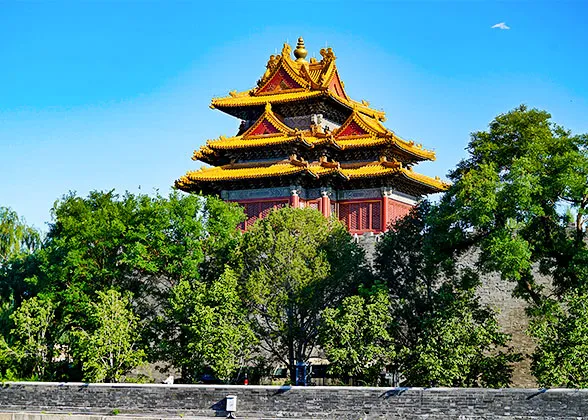
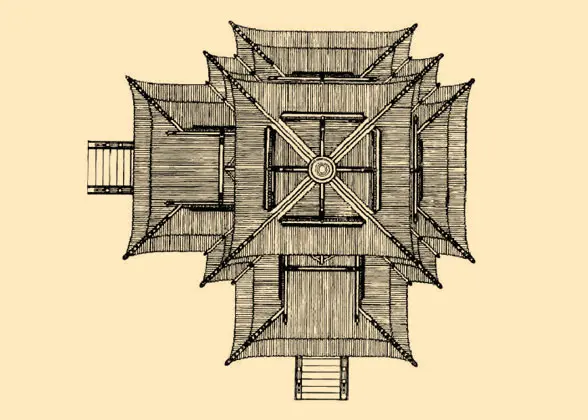
The most exquisite feature is the three-tiered, compound roof covered with yellow glazed tiles. The upper tier combines a four-angled pinnacle with a hip-and-gable roof, creating a cross-shaped ridge pattern. At its center sits a gilded copper finial. The middle tier features four hip-and-gable roofs, one on each side, with additional ridges at the corners, creating an interlocking, multi-angled surface. The lowest level features a half-sloped eave as the conclusion of the roof.
In total, the roof boasts 28 eave corners, 76 ridges, and 234 statues of immortals and mythical beasts. Beneath the eaves, blue and green paintings on the beams and brackets add to the tower's refined beauty.
Corner Tower Design Legend: The Cricket Cage
 |
| See the Tower on City Wall |
Legend has it that Emperor Yongle commissioned the towers with a highly specific requirement: they should have 9 beams, 18 columns, and 72 ridges, all multiples of 9, symbolizing supreme imperial power. This challenge stumped the officials and master craftsmen, who struggled for a solution despite numerous brainstorming sessions.
One day, they saw an old man selling an exquisitely woven Cricket cage. To their amazement, the cage perfectly matched the emperor's specifications with its 9 beams, 18 pillars, and 72 ridges. Inspired by the cage's design, the craftsmen figured out the structure, and successfully built the magnificent Corner Towers that stand today.
When & Why Built – Corner Tower History
 |
| Corner Tower Sunset |
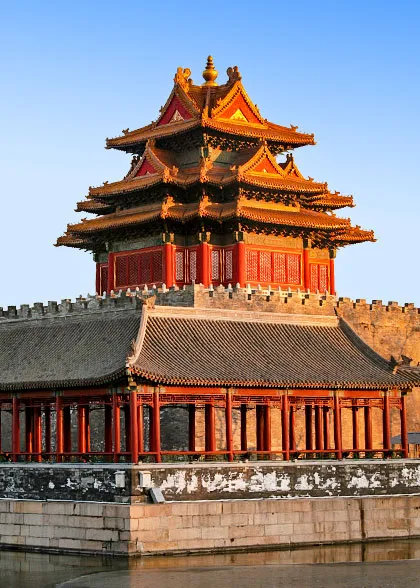
The Corner Towers were first constructed in 1420 and have preserved their original design through several renovations. A saying goes that Emperor Yongle (1360-1424) commissioned these towers to honor the divine Azure Dragon, believed to ward off disasters. In reality, the Corner Towers served far more practical purposes.
Their most fundamental function was to serve as observation posts, acting as the "eyes" of the Forbidden City's defense system. This role is clearly reflected in the towers' design: built atop 10-meter-high walls at the palace's corners, they provided an expansive view to keep watch for any potential threats approaching the royal palace. Each floor was equipped with multiple observation windows, allowing guards to survey the entire surrounding area.
Another crucial function was defense. The corners of a city wall are typically its most vulnerable points. The Corner Towers projected outwards like formidable fortresses, enabling defenders to fire upon attackers simultaneously from the front and flanks.
Travel Tips for the Corner Tower
Exteriors Available for Visit
 |
| Tourists Walking to Coner Tower along Moat |
Getting There
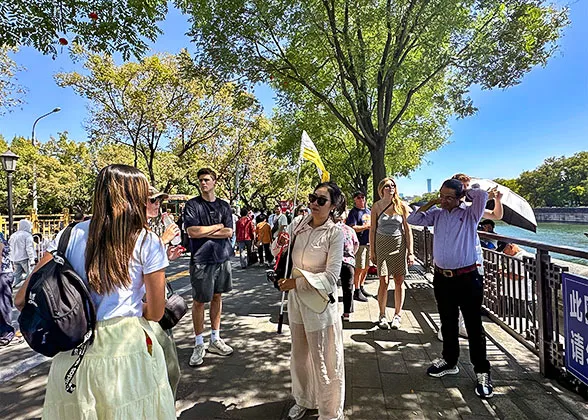
If you plan to view the Corner Towers after visiting the Forbidden City and exiting through the north Gate of Divine Prowess, which is located between the Northwest and Northeast Corner Towers, it's about a 5–10-minute walk to reach viewing points for both towers. If exiting from the East Prosperity Gate, turn right to reach the Southeast Corner Tower in 2 minutes or left for about 12 minutes to reach the Northeast Corner Tower.
Even without entering the Forbidden City, you can appreciate the towers from outside. You can take subway line 1 to Tiananmen East Station and walk along Nanchangzi Street for about 10 minutes to reach the Southeast Corner Tower.
Photography Tips
|
|


Built alongside the moat, the classic way to photograph the Corner Towers is from a waterside eye-level perspective. Position your camera at water level or slightly elevated on the moat bank and use a medium to long focal length lens to focus on the main body of the towers while capturing their reflections in the water for a symmetrical “real scene + reflection” composition.
Low-angle upward shots at the base of the towers can maximize their grandeur and sharp eaves. Use a wide-angle lens to extend architectural lines upwards, highlighting the intricate structure of nine beams and eighteen columns.
The Northwest Corner Tower is best photographed at sunset when it is illuminated by sunlight. And pay attention to the clouds: if they are in the east, shoot from the west side, and vice versa. This positioning increases your chances of capturing the beautiful effect of fiery clouds.
Best Time to Visit
 |
| Corner Tower in Spring |
Spring (April-May) and autumn (September-October) offer pleasant weather with willows or golden gingko leaves along the moat, making them ideal seasons for tourism.
During the day, sunrise (approximately 6:30-7:30) and sunset (16:00-17:30) are optimal times for admiring and photographing the towers with soft light. To avoid crowds, try to visit on weekdays rather than holidays or weekends.
 Further Reading:
How to visit the Forbidden City
- Last updated on Jan. 13, 2026 by Jally Zhang -