The wall is the most central and fundamental architectural element of the Great Wall’s entire defensive system. Simplistically defined, the Great Wall is a long, continuous defensive wall that meanders across mountain ranges, traverses arid deserts, stretches through vast grasslands, and clings to precipitous cliffs. Spanning over 20,000 kilometers (12,000 miles), it links hundreds of strategic passes and tens of thousands of watchtowers in a cohesive defensive network. The architectural forms, construction techniques, and structural designs of the Great Wall’s walls differ across dynasties; even walls built within the same dynasty exhibit localized variations tailored to terrain, each boasting unique characteristics in terms of architectural structure and form.
Defensive Wall Structure
The battlement wall is the most iconic structural feature that distinguishes the Great Wall from conventional city fortifications. Positioned along the outer side of the wall, it features a continuous series of recessed crenellations at its crest. Its primary function is to provide protective cover for defenders during enemy assaults. Certain strategically critical sections of the Great Wall, such as the
Jinshanling Great Wall, are equipped with battlement walls on both sides to maximize defensive efficacy.
In contrast, the parapet wall has a smooth, unbroken top edge devoid of protrusions or indentations. Typically situated on the inner side of the Great Wall, it stands shorter than the battlement wall, at approximately 1 meter (3 feet) in height, and serves to prevent soldiers from accidentally falling off the wall.
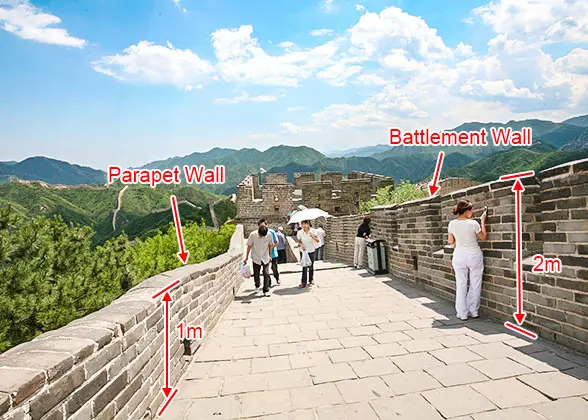 | | Defensive Wall Structure | | 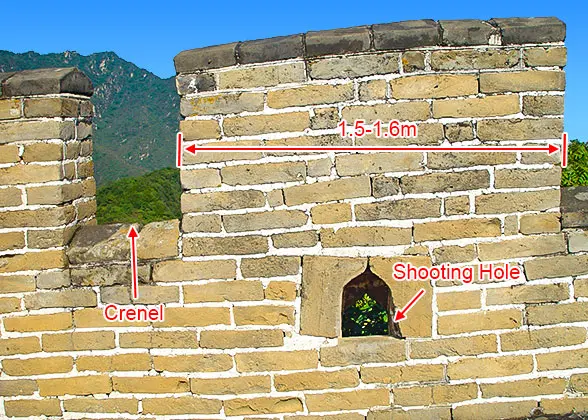 | | Battlement Wall | |
3. Top Surface of the Walls
A paved walkway lies between the battlement and parapet walls, serving as a functional corridor for military patrols, troop movement, and supply transportation. In key sections of the Great Wall, including Beijing’s
Badaling and
Mutianyu segments, the wall’s top surface measures 4 to 5 meters (13 to 16 feet) wide, sufficiently broad for ten soldiers to march abreast. On level terrain, the walkway is paved with three layers of square bricks, with lime mortar filling the joints to inhibit weed growth and structural deterioration. On steep inclines, stone steps are constructed to facilitate easier pedestrian movement for soldiers.
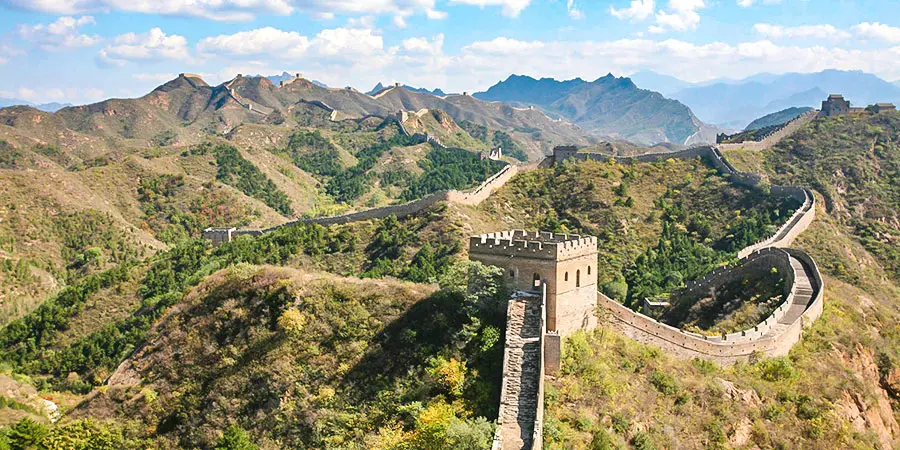 |
| Top Surface of the Wall |
On precipitous slopes, spatial constraints necessitate the construction of single-sided walls. These are built by laying stones directly against the mountainside to form a sheer vertical face, with the void between the inner wall face and the mountain slope filled with compacted loess and small stones. The resulting flat top surface is a mere 30 centimeters (1 foot) wide, accommodating only one person at a time.
Barrier walls are predominantly installed along the ascending sections of the Great Wall, erected at regular intervals perpendicular to the battlement wall and integrated with arrow slits for defensive fire. Their purpose is to provide cover for defenders to evade enemy attacks and launch flanking counterattacks if enemies breach the wall’s crest. Well-preserved barrier walls can still be observed along the stretch of the Great Wall connecting
Gubeikou to Jinshanling.
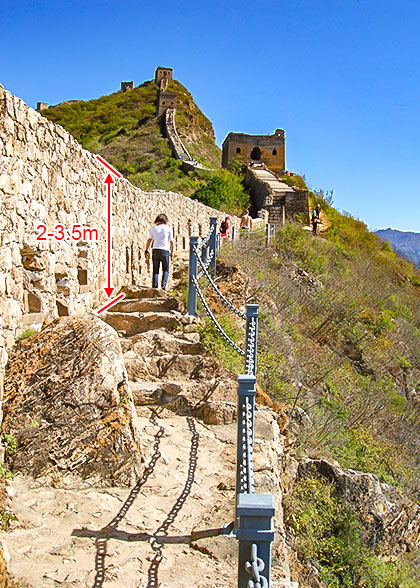 | | Single Wall | | 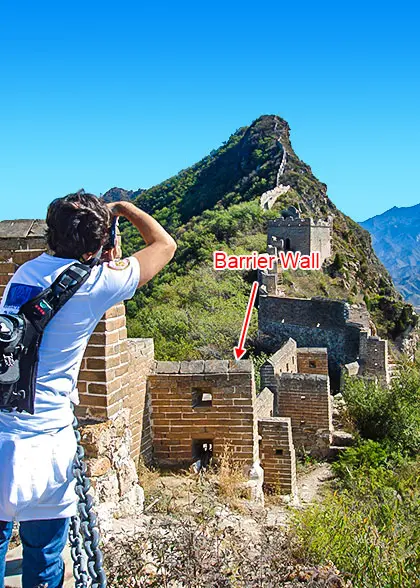 | | Barrier Wall | |
The average height of the Great Wall’s walls ranges from 6 to 7 meters (20 to 23 feet). In precipitous terrain, the walls are lower, standing at approximately 3 to 4 meters (10 to 13 feet), while they are built taller on relatively level ground. Notably, the inner side of the wall is consistently lower than the outer side.
Read more:
How tall is the Great Wall of China? The wall’s base averages roughly 6.5 meters (21 feet) in width, tapering to 5 meters (16 feet) at the top, forming a trapezoidal cross-section. This wide-base, narrow-top design enhances structural stability and resistance to collapse.
Read more:
How wide is the Great Wall of China? How Was the Great Wall Built?
The construction techniques of the Great Wall evolved progressively over history and adapted to diverse natural landscapes, giving rise to a diverse array of wall typologies. Each wall variant features distinct building methods dictated by its construction materials, which can be categorized into four primary techniques:
Earth, readily available and cost-effective, was the most ubiquitous building material in ancient China. Prior to the
Ming Dynasty (1368 - 1644), rammed earth was the predominant material for Great Wall construction. Despite its loose natural state, earth possesses exceptional cohesiveness and plasticity. Construction involved setting out the wall’s alignment and thickness, erecting wooden formwork on both sides, packing yellow loess into the framework, and compacting it layer upon layer with heavy rammers until solid. Wooden reinforcements or bricks were often embedded within the rammed earth to bolster structural integrity.
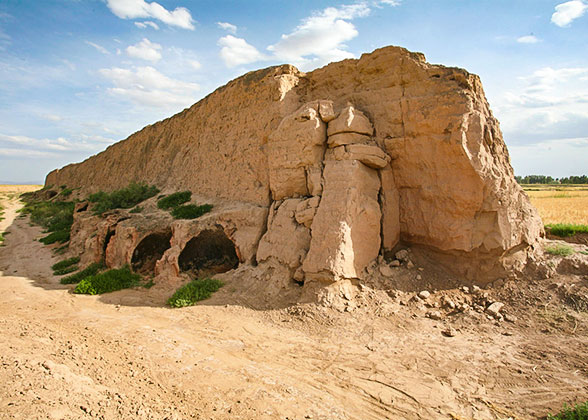 | | Rammed Earth Walls | | 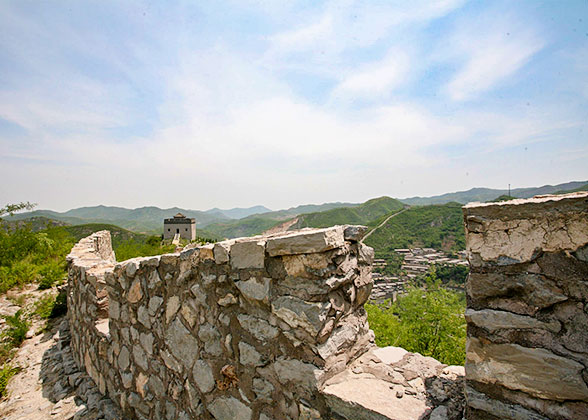 | | Stone-built Walls | |
In mountainous regions, the Great Wall’s walls were primarily constructed from quarried stone, with ancient quarry remnants still visible alongside many sections. Layered sedimentary stone slabs were stacked horizontally, while irregularly shaped stones were fitted and interlocked strategically to form a sturdy masonry structure.
Fired bricks, valued for their durability and precise laying, were an ideal building material for the Great Wall. However, due to higher production and transportation costs compared to local loess and stone, most brick structures are brick-clad walls: the core is filled with rammed earth or stones, while the exterior is faced with multiple layers of bricks. This brick cladding not only reinforces the wall but also shields it from rainwater erosion and weathering.
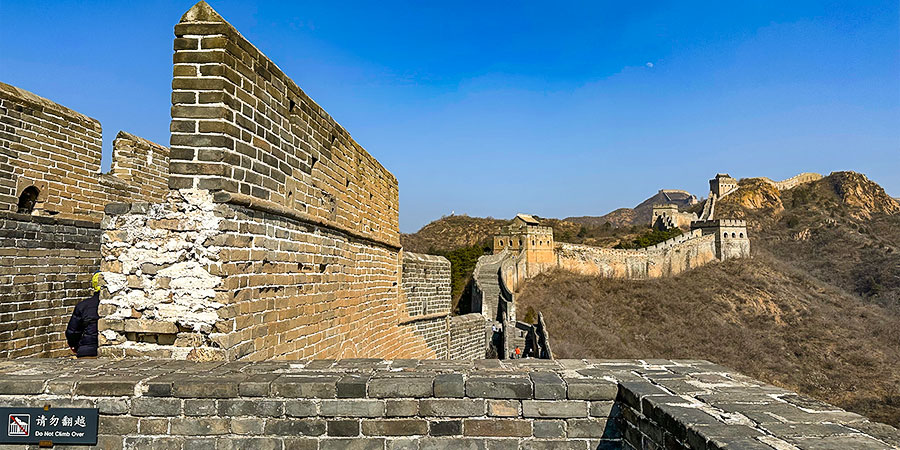 |
| Brick-clad Walls |
In the arid Gobi regions of northwest China, where stone and soil are scarce, desert vegetation such as reeds and red willows served as primary construction materials. Reeds were woven into rectangular frames filled with coarse sand and gravel, then stacked in successive layers to form a robust defensive wall.
You may like:
- Last updated on Apr. 01, 2026 by Sherry Xia -