Xi'an Attractions - Things to Do
Brilliance of thousand years endows Xi'an with enchanting temperament. The city is one of the birthplaces of the Chinese Civilization, the eastern starting point of the Silk Road, and the capital of 13 dynasties in China’s history. The continuous history has left Xi’an a great many historical sites and cultural relics, among which the Terracotta Army is the most famous. Every year, tens of millions of tourists come to Xi’an to admire this “8th wonder of the world”.
Besides, as a prosperous city in the central-northwest part of China, you can find numerous high-rises in the city. Ancient architecture and modern skyscrapers coexist here, giving a perfect fusion of the past and the present. Last but not least, folk customs and food of Xi’an are full of inclusiveness and diversity. All these attract domestic and international tourists to make their tours to Xi’an.
Besides, as a prosperous city in the central-northwest part of China, you can find numerous high-rises in the city. Ancient architecture and modern skyscrapers coexist here, giving a perfect fusion of the past and the present. Last but not least, folk customs and food of Xi’an are full of inclusiveness and diversity. All these attract domestic and international tourists to make their tours to Xi’an.
Top Attractions
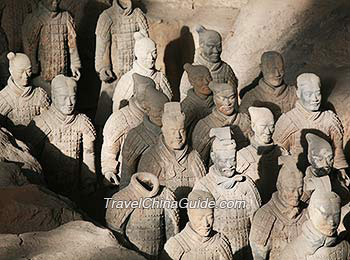
Terracotta Army
At the mention of the great number of Xi’an’s attractions, terracotta soldiers and horses always come as the first. After being buried in loess for over 2,200 years, the great archeological excavation of Qin Empire (221-207BC) unfolded a massive underground army of altogether 8,000 life-size pottery soldiers, horses, chariots and weapons arranged in battle formations symbolically, guarding the tomb of Emperor Qin Shi Huang who unified China. The Emperor Qinshihuang’s Mausoleum Site Museum has been built on the site to offer more spots to enrich your Xi'an vacation.
At the mention of the great number of Xi’an’s attractions, terracotta soldiers and horses always come as the first. After being buried in loess for over 2,200 years, the great archeological excavation of Qin Empire (221-207BC) unfolded a massive underground army of altogether 8,000 life-size pottery soldiers, horses, chariots and weapons arranged in battle formations symbolically, guarding the tomb of Emperor Qin Shi Huang who unified China. The Emperor Qinshihuang’s Mausoleum Site Museum has been built on the site to offer more spots to enrich your Xi'an vacation.
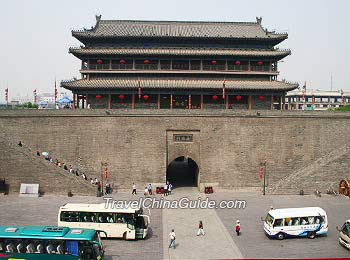
City Wall
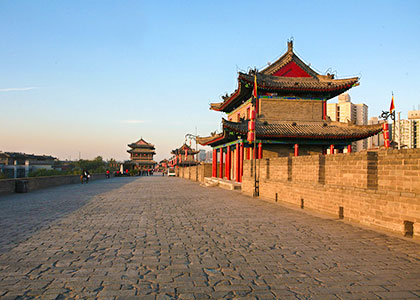
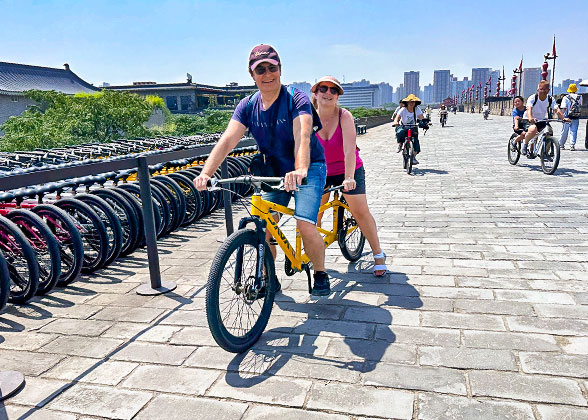
The rectangular City Wall surrounds the inner city of Xi’an. Built more than 650 years ago, it is the most complete city wall to survive in China, as well one of the largest ancient military defensive systems in the world. Along the 13.7-kilometer-long (8.5 miles) City Wall, there are 18 gates for people to come in and out of the inner city or ascend the high wall, among which the Yongning Gate in the south is the grandest and commonly chosen by tourists as the entrance to visit the wall. Up on the City Wall, cycling is one of the best things to do, and around Chinese New Year, a grand lantern fair is held, showcasing various lanterns in different shapes, colors and sizes.
The rectangular City Wall surrounds the inner city of Xi’an. Built more than 650 years ago, it is the most complete city wall to survive in China, as well one of the largest ancient military defensive systems in the world. Along the 13.7-kilometer-long (8.5 miles) City Wall, there are 18 gates for people to come in and out of the inner city or ascend the high wall, among which the Yongning Gate in the south is the grandest and commonly chosen by tourists as the entrance to visit the wall. Up on the City Wall, cycling is one of the best things to do, and around Chinese New Year, a grand lantern fair is held, showcasing various lanterns in different shapes, colors and sizes.
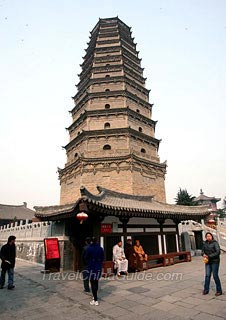
Giant Wild Goose Pagoda
Located in the southeast part of the city, this solemn ancient pagoda inside the Da Ci’en Temple was originally built in 652 to store the Buddhist relics and classics taken from India by the hierarch Xuanzang. This square brick pagoda is 7-floor, about 65 meters (213 feet) high, and tapers from bottom to top. The night view of the pagoda is fantastic, and you can watch a light show and a music fountain show on the north square. Adjacent to the pagoda to the south, is the Great Tang All Day Mall, a prosperous Tang style block where performances in traditional style are going on.
Located in the southeast part of the city, this solemn ancient pagoda inside the Da Ci’en Temple was originally built in 652 to store the Buddhist relics and classics taken from India by the hierarch Xuanzang. This square brick pagoda is 7-floor, about 65 meters (213 feet) high, and tapers from bottom to top. The night view of the pagoda is fantastic, and you can watch a light show and a music fountain show on the north square. Adjacent to the pagoda to the south, is the Great Tang All Day Mall, a prosperous Tang style block where performances in traditional style are going on.
Bell Tower
With a history of more than 600 year, the square Bell Tower plays absolutely as the central landmark of the city, from which four avenues stretch towards the east, west, south, and north. While in ancient times, it was used as a time teller. With a gilded pinnacle, a roof covered by dark-green tiles, brick-red columns, and a grey base, the Bell Tower shows a superb integration of colors. It looks more beautiful when illuminated at night.
With a history of more than 600 year, the square Bell Tower plays absolutely as the central landmark of the city, from which four avenues stretch towards the east, west, south, and north. While in ancient times, it was used as a time teller. With a gilded pinnacle, a roof covered by dark-green tiles, brick-red columns, and a grey base, the Bell Tower shows a superb integration of colors. It looks more beautiful when illuminated at night.
Shaanxi History Museum
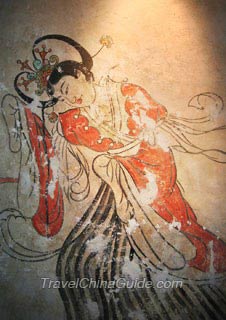
In addition to renowned historical sites and ancient buildings, Xi’an further boasts innumerable cultural relics, and the Shaanxi History Museum is the best place to admire them. There are more than 1,700,000 pieces of exhibits in the museum, spanning from more than one million years ago. Must-sees include a tiger-shaped tally with engravings for mobilizing troops, golden bowls with patterns of mandarin ducks and lotus petals, and a tri-color glazed camel carrying a musical band. Since the museum is so popular that it could be quite crowded, especially in public holidays of China, you’d better make a reservation as early as possible. If you fail to reserve the ticket to the museum, you may consider visiting its branch- Qin Han Museum of Shaanxi History Museum in the northwest of Xi’an downtown.
In addition to renowned historical sites and ancient buildings, Xi’an further boasts innumerable cultural relics, and the Shaanxi History Museum is the best place to admire them. There are more than 1,700,000 pieces of exhibits in the museum, spanning from more than one million years ago. Must-sees include a tiger-shaped tally with engravings for mobilizing troops, golden bowls with patterns of mandarin ducks and lotus petals, and a tri-color glazed camel carrying a musical band. Since the museum is so popular that it could be quite crowded, especially in public holidays of China, you’d better make a reservation as early as possible. If you fail to reserve the ticket to the museum, you may consider visiting its branch- Qin Han Museum of Shaanxi History Museum in the northwest of Xi’an downtown.
Huashan Mountain
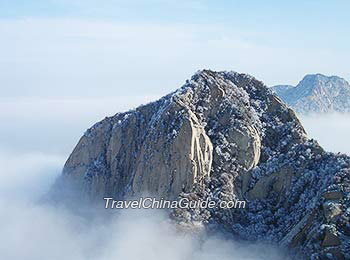
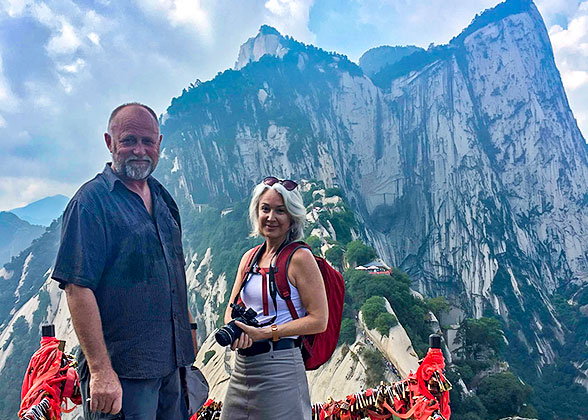
For those who seek for thrilling and adventurous experiences, Huashan Mountain to the east of Xi’an downtown is unmissable. Listed as one of the most dangerous mountains in China, it is famed for precipitous crags, and also narrow and steep paths. In some sections, one even needs to use hands and feet together to ensure a safe and stable climb. Many visitors choose to climb the mountain at night, so that they can reach the top in time for the stunning sunrise.
For those who seek for thrilling and adventurous experiences, Huashan Mountain to the east of Xi’an downtown is unmissable. Listed as one of the most dangerous mountains in China, it is famed for precipitous crags, and also narrow and steep paths. In some sections, one even needs to use hands and feet together to ensure a safe and stable climb. Many visitors choose to climb the mountain at night, so that they can reach the top in time for the stunning sunrise.
Recommended Tours
More Attractions in Downtown Xi’an
Looking across the entire urban area of Xi’an, you can find that the city’s charm as an ancient capital exudes everywhere. As another must to every Ming city, the Drum Tower stands nearby to the west of the Bell Tower. Time has passed along with the bell at dawn and the drum at dust. Right next to the Drum Tower, the Muslim Quarter is a foodie’s paradise. Some of the snacks and dishes have been popular for hundreds of years. The Great Mosque and the Gao’s Grand Courtyard are also located in this quarter.Many people know the Giant Wild Goose Pagoda, but there is also the Small Wild Goose Pagoda in Xi’an. If you prefer a less crowded tour, it can be a good choice. For calligraphy enthusiasts, the Stele Forest inside the South Gate of the City Wall is a must-go attraction as it collects valuable calligraphic works and steles. Moreover, a city walk along the Shuyuanmen Cultural Street, the Xiangzi Temple, and the Degu Lane to the west of the Stele Forest can be taken to view the quaint and vibrant streetscapes of the city.


More Attractions in East Suburb
Terracotta Army is the most attractive in the east suburb. A few kilometers' drive away, there is the Huaqing Palace at the north foot of Mount Li, which is favored for its palace complex and where the famous Concubine Yang in Tang Dynasty enjoyed hot spring bath. In addition, a related stage play called the Song of Everlasting Sorrow can be enjoyed. In this area, there is also the Banpo Museum built on the ancient human village relics of Neolithic Yangshao culture.


Attractions in West Suburb
About 25 kilometers (16 miles) northwest to Xi'an, there are many mausoleums of ancient emperors: Han Yang Ling Mausoleum, the grave of notable emperor Liu Qi in Western Han (206 BC-220AD); Qianling Mausoleum, the joint tomb of Emperor Gaozong and his empress Wu Zetian, who is also the only female emperor in Chinese history; Zhaoling Mausoleum, the tomb of the second emperor of Tang... Further west, Famen Temple is a noted Buddhist shrine for its collection of Sakyamuni's relics. For picturesque natural scenery, Taibai Mountain is worthwhile going.


Attractions in South Suburb
Qinling Wildlife Park is the best and the only place to see pandas in Xi’an. Located at the foot of Qinling Mountains, it also provides good living environment to crested ibises, golden monkeys, takins, flamingos, giraffes, and crocodiles; circus performances can be viewed here. The Shaanxi Archaeology Museum is China’s first archaeological museum and amazes tourists with cherished cultural relics and also archaeological tools and development history of the country. Not far away from the museum, stands the Xiangji Temple, also an important Buddhist shrine. The Cuihua Mountains features landslide formations and the Heavenly Lake is also in south suburb of Xi’an.


Attractions in North Suburb
Exploring further to the northeast, lies a small historic and cultural city Hancheng, known as the hometown of famous historian and litterateur of China, Sima Qian. You can find Sima Qian Temple, Dang Village and the Confucius Temple here. Moreover, Farmers’ Caves, a unique type of dwelling with exquisite decorative patterns on windows and doors, can be found while marching northward continuously. Well-designed structures and also thick and hard loess walls of the Farmers’ Caves make people generally feel cool in summer and warm in winter. Yan'an has the most typical and distinctive cave residences.
- Last updated on Aug. 01, 2025 by Alex Jin -