Ethnic Groups

Page:  1  2

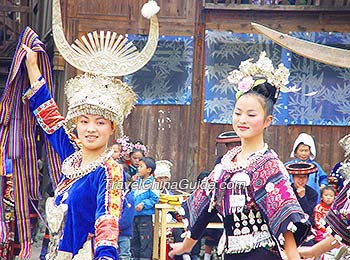
Miao Ethnic Minority girls in Guizhou ProvinceAs a large united multi-national state, China is composed of 56 ethnic groups. Among them Han Chinese account for 91.59% of the overall Chinese population and the other 55 make up the remaining 8.41% according to the Fifth National Population Census of 2000. As the combined population of these other ethnic groups is far fewer than that of the Han, they form the 55 ethnic minorities of China.

These numerous ethnic groups share China's vast lands but at the same time many live in their individual communities. The relationships between the different ethnic groups have been formed over many years.

Han Chinese

With a population of 1159.4 million, the Han Chinese can be found in almost every part of China. However, they mainly live in the middle and lower reaches of the Yellow River, Yangtze River and the Pearl River, and also in the Northeast Plain Region (Songliao Plain). They form the largest ethnic group within China and also the largest in the world.

The Han people have their own distinctive way of life. Please click to get more information about the Han.


55 Ethnic Minorities

Although they make up only a small proportion of the overall Chinese population, the 55 minority ethnic groups are distributed extensively throughout different regions of China. The regions where they are most concentrated are Southwest China, Northwest China and Northeast China. No matter whether it is Inner Mongolia, Xinjiang, Ningxia, Guangxi, Tibet, Yunnan, Guizhou, Qinghai or Sichuan, Gansu, Hubei, Hunan or another province, one can find Chinese ethnic minorities. From the areas listed above, the greatest number of minorities can be found in Yunnan Province (25 ethnic groups). Zhuang has the largest population (more than 16 million) of minority ethnic groups.
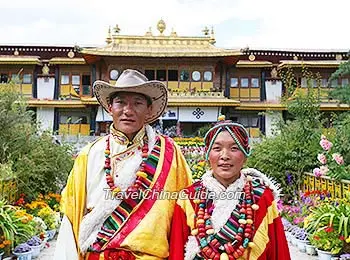
In order to ensure that the 56 Chinese ethnic groups live together in harmony, the Chinese government introduced a series of policies including ones to secure the equality and unity of ethnic groups, give regional autonomy to ethnic minorities and promote respect for the faith and customs of ethnic groups. Among these the policy of regional autonomy for ethnic minorities is the most fundamental. Under this policy, five autonomous regions; Inner Mongolia, Xinjiang, Guangxi, Ningxia and Tibet, as well as numerous autonomous prefectures, counties, nationality townships and towns have been set up. With guidance from the Chinese government, the ethnic minorities in areas that have been given regional autonomy are entitled to deal with their own affairs. Together with the Han people, the Chinese ethnic minorities are making great efforts to build a prosperous China.

Each of the minority ethnic groups has a distinctive and different character.

Achang :  one of the earliest people in Yunnan; famous for being good at growing rice and forging iron weapons such as cutting tools
Bai: the masters of artistic creativity and favor white clothes and decorations; creative in architecture, painting, music, sculpture and lacquer work
Blang:  live in Yunnan Province; mainly practice agriculture; good at planting tea trees and early rice; do many artistic practices such as literature and music
Bonan:  live in southwest of Gansu Province; mainly engage in handicraft industry; believe in Islam; play traditional woodwind or stringed instrument
Bouyei: inhabit in Guizhou Province as early as in the Stone Age; advanced in agriculture and forestry; good at brocade and embroidery
Chaoxian: dwell mainly in northeastern part of China; their ancestors are the immigrants from the Korean Peninsula; have similar festivals with Han People
Dai: distribute in southern part of Yunnan Province; a versatile nation who has made certain achievement in music; believe in Southern Buddhism
Daur:  a considerably smaller minority who said to be the descendants of Khitan tribe in Liao Dynasty; lay stress upon etiquette; have many taboos of their own
Deang:  a small minority distributed in Yunnan Province; they are skilled craftsman, and have profound tea culture; rice, wheat, corn and legume are the staple foods
Dong:  living in the border regions between Hunan, Hubei and Guizhou Provinces; skilled in handcrafts; rice, millet, wheat sorghum are the staple foods
Dongxiang:  mainly inhabit in Gansu Province, with farming and stocking as their mode of production; believe in Islam; enjoy drinking tea
Dulong: one of the smallest minority groups in China; believing that there are spirits who control everything; have two meals a day; carpet is their distinctive handicraft
Ewenki:  mostly live in the Inner Mongolia Autonomous Region; good at singing and dancing, horse-racing and wrestling; believe that Gods control their life
Gaoshan:  most live on Taiwan Island; like singing ballads and telling tales; have rituals for daily activities, such as sowing, harvesting, hunting and fishing
Gelao: an old ethnic minority good at the refinement of forging, blacksmith and stonecutting; believe in the bless from many Gods and their ancestors
Gin: most live in Guangxi Zhuang Autonomous Region; make a living on farming and fishing; most believe in Taoism; seafood and rice are their staple foods


More China Ethnic Minorities


Last updated: