Qin Crossbow - King of Cold Weapons
Since the excavation of the Terracotta Army pits, the Qin crossbow has stood out among the unearthed weapons for its sophisticated design and astonishing power, comparable to modern firearms, earning it the title "King of Cold Weapons." The well-preserved crossbow triggers, still working smoothly after more than 2,000 years, are powerful proof of the Qin state's advanced military-industrial system. As a key long-range weapon, it played a crucial role in the wars that united China under the first emperor, Qin Shi Huang.
|
|
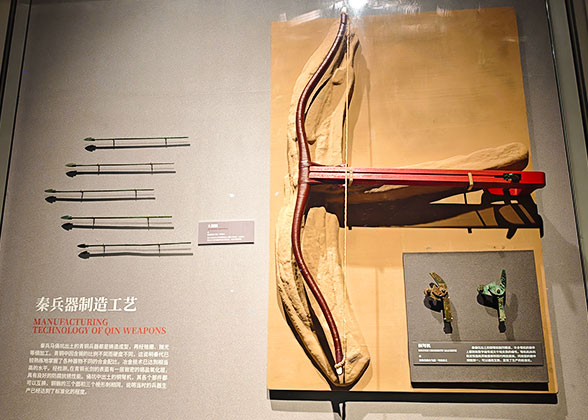
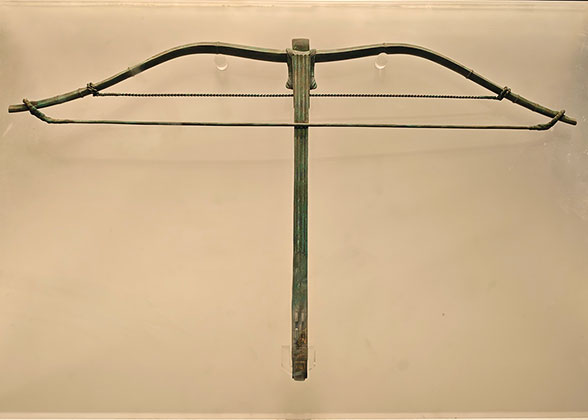
What Parts Made Up the Qin Bronze Crossbow?
1. The Crossbow Stock
The crossbow stock was like the backbone of the crossbow, similar to the stock of a modern rifle. Usually 60 to 75 centimeters (23 to 29 inches) long, it served as the main frame that held everything together. At the front, a special notch held the bow firmly in place, fastened with leather straps so it wouldn't move or come loose when shooting. On top, a carefully made groove held the bolt in the perfect position for firing, which made shooting much more accurate. To make sure the bolt shot out smoothly, the groove was polished very smoothly and sometimes even coated with lacquer or wax to reduce friction during release. These details show how thoughtfully the Qin crossbow was designed.
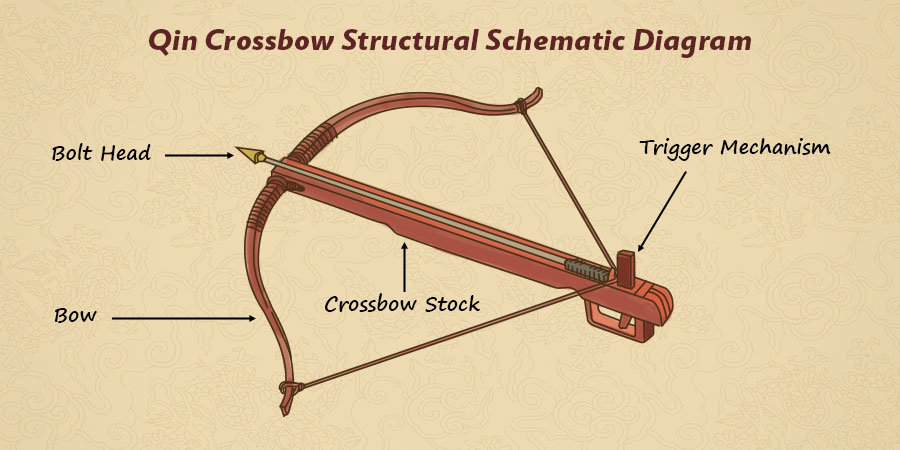 |
| Parts of Qin Crossbow |
2. The Bow
The bow was the power source of the Qin crossbow, responsible for propelling the bolt. It was shaped flat and oval, generally measuring between 130 and 145 cm (51 and 57 in) long. Its construction was highly deliberate, using mulberry wood for the core, which was then tightly bound with leather strips on the outside. This composite structure, combining the elasticity of wood with the toughness of leather, resulted in a durable component capable of storing more energy, thereby shooting bolts farther and with greater force. In short, the bow functioned like an engine, storing power when pulled back and releasing it to launch the bolt.
3. The Trigger Mechanism
The trigger mechanism was a set of precision components, consisting of the nut, sighting bar, trigger lever, and a linking piece, primarily used for aiming and firing. The nut hooked the string; the sighting bar, about 7 to 9 cm (2.7 to 3.5 in) high, was used for aiming; the trigger lever functioned as the modern trigger; and the seemingly minor linking piece served as the pivotal connector between the nut and the trigger lever. This ingenious design allowed soldiers to draw the bowstring with their full strength first, then take their time to aim carefully before firing. This was a major improvement over regular bows, which required aiming while holding the string back, often causing shaking and reducing accuracy.
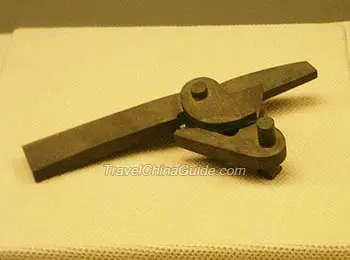 |
| Trigger Mechanism of the Crossbow |
4. The Bolt Heads
The bolt head, made of bronze, was the part that hit the target. The bolt heads discovered in the Terracotta Army pits can be categorized into small and large types, most commonly triangular pyramids. This design was highly effective at penetrating through targets, granting greater armor-piercing capability. Remarkably, some bolt heads are so perfectly shaped that their three sides are almost identical, giving them a smooth, streamlined form similar to a modern bullet. While common bolt heads of Qin crossbow weighed about 50 - 60 grams (about 2 ounces), there are also much larger, heavier ones, each weighing about 100 grams (4 ounces), which would have been incredibly powerful.
|
|
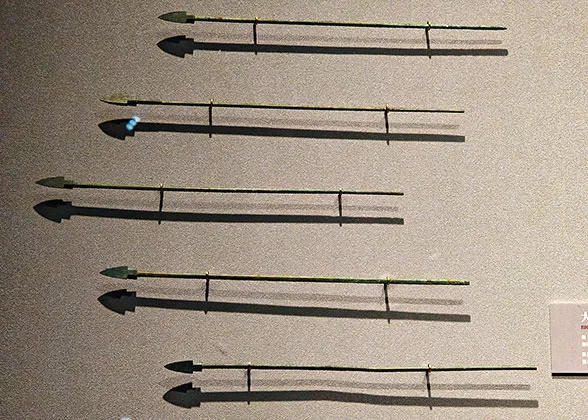
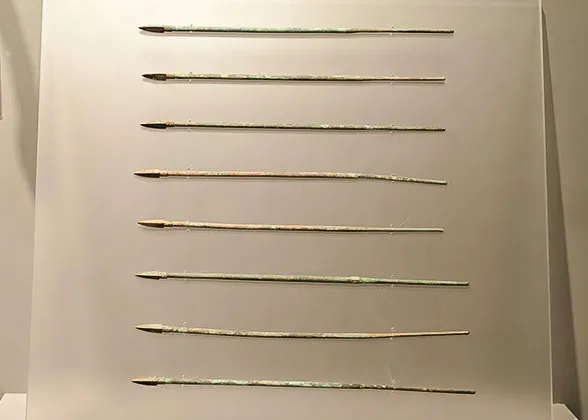
The Power of the Qin Bronze Crossbow
1. Long Range
The formidable power of the crossbow stems firstly from its range, which far exceeded that of ordinary bows. Although exact records are unclear, archaeological evidence and reconstruction experiments suggest it could hit targets effectively 150 - 250 meters (165 - 270 yards) away, and sometimes even beyond 300 meters (330 yards). This is mainly due to its unique composite bow design and spanning method, which helped soldiers pull the very tight string, giving the bolt greater initial energy. Additionally, the streamlined, three-sided shape of the bolt heads reduced air resistance, helping them fly farther. On the ancient battlefield, such a range meant Qin soldiers could attack their enemies from a safe distance before the enemy could get close enough to fight back.
2. Strong Penetration
The Qin crossbow's legendary penetration stemmed from two key factors. First, its powerful composite bow and efficient spanning method stored immense energy, launching the bolt with tremendous force. Second, the bolt heads were masterfully designed. Their sharp, triangular-pyramid shape concentrated this force onto a small, hard point, enabling them to punch through leather and even bronze armor. This combination of raw power and focused impact made the Qin crossbow a weapon capable of defeating armored opponents at a distance.
3. High Accuracy
Beyond its sheer power, the Qin crossbow also boasts accuracy far superior to ordinary bows. This was thanks to two main features. First, the groove on the crossbow stock held the bolt's position, ensuring a consistent launch trajectory each time. Second, the sighting bar on the trigger acted as a simple sight. Soldiers could use it to judge distance and adjust their aim to hit faraway targets. Furthermore, because the bolt was released by pressing a trigger lever instead of by hand, there was less shaking, making shots more stable and precise. In a sense, the Qin crossbow exhibited characteristics of an early sniping weapon.
How Was the Qin Bronze Crossbow Used?
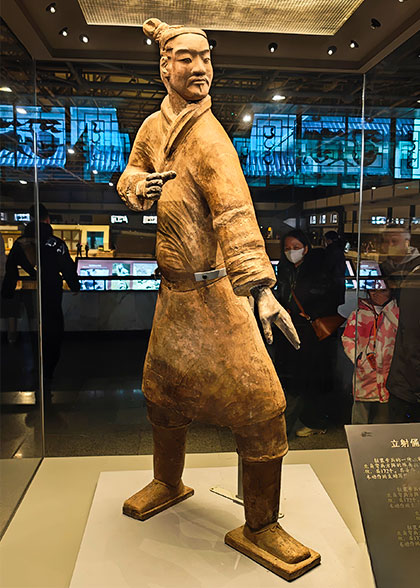 |
| Standing Archer of Pit 2 |
The soldiers were equipped with two types of crossbows, each with its own spanning method. The first was the "arm-drawn" crossbow, common and fast to operate. The archer simply pulled the heavy string back with both arms until it was placed on the nut. Then he would load a bolt and was ready to fire. The second was the "foot-drawn" crossbow, which was much more powerful. To span this heavier weapon, a soldier typically sat on the ground, braced his feet against the bow, and sometimes even held the crossbow stock between his knees. Then, using the full strength of his legs, back, and arms, he hauled the thick string all the way back to hook it securely onto the nut. This process demanded great effort but resulted in tremendous range and hitting power.
In a real battle, these crossbowmen did not fight alone. Before the fight began, they formed tight rows at a good spot in front of the main army, usually in several lines. The first line would shoot, then immediately crouch down to reload. The second line would shoot next, and so on, creating a continuous wave of bolts. It's important to note the safety rule they followed: while loaded and waiting to shoot, standing archers pointed their bolts down at the ground, and kneeling archers pointed theirs up at the sky, preventing accidents.
Why Was the Qin Bronze Crossbow Called the King of Cold Weapons?
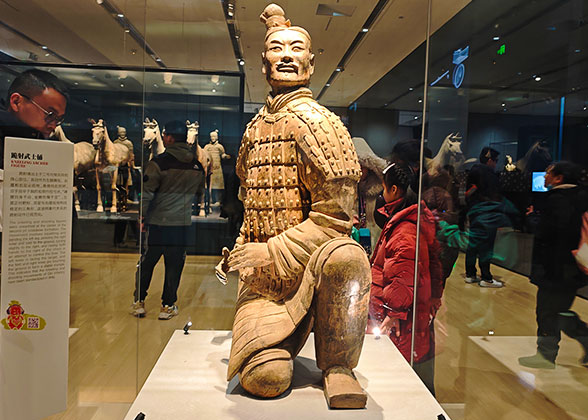 |
| Kneeling Archer from Pit 2 |
In addition, the crossbow's design was very user-friendly. For example, around the trigger, craftsmen added a protective ring made of bamboo strips to prevent soldiers from accidentally firing it. The lower sides of the crossbow stock were carved with grooves for a better, steadier grip. The longer crossbow stock also made pulling the string easier. These small, thoughtful details made the crossbow safer, steadier, and more accurate to use. They show not only the great skill of Qin craftsmen but also a surprisingly modern safety sense.
 Further Reading:
Recommended Tours

- Last updated on Feb. 11, 2026 by Doris Xue -