During the transitional period from winter to spring, Inner Mongolia weather in March is quite changeable. As a whole, the temperatures rise a lot: the west part becomes only slightly cold in most time and the east turns no more unbearably frigid. But visitors should pay attention to the particularly large temperature differences between day and night in this month. Strong winds also get frequent and bring some dusty days, especially in the west. Snow views remain available in some areas in the eastern parts.

See also:
Hohhot Weather in March Rising Temperatures but Still Cold
 |
| Dajue Zen Temple |
The obvious characteristics of Inner Mongolia climate in March are drastic temperature fluctuations and stark day-night temperature differences. If cold air passes by, you may feel like shifting from warm early spring to cold winter. It is also common to see people in western Inner Mongolia wearing only jackets at noon and putting on down coats at night.
To be specific, daily highs of the western Inner Mongolia are usually in the range of 6 - 19 degrees Celsius (43 - 66 degrees Fahrenheit) and the night lows lie between -5 and 4°C (23 - 39°F), which means most accumulated snow has melted completely. While, in the eastern parts, the max temperatures during daytime mostly fluctuate between -13 and 5°C (7 - 41°F) - a level that visitors still feel rather cold when conducting outdoor sightseeing, while the min values at night range from -26 to -7°C (-15 - 19°F).
Large temperature rise often occurs around middle March. By the second half month, the colder east sees most daytime high temperatures climbing above 0°C (32°F); that of some western cities like Wuhai and Baotou could even reach 23°C (73°F) around.
Occasional Rain and Snow
Among different areas, the precipitation in March varies from 9 to 18mm (0.35 - 0.71 in) on average and is randomly distributed over about 4 days. Though growing a little, it is listed as the scarce level when seen from the whole year. So, the climate of Inner Mongolia in March is quite dry.
In terms of the precipitation forms, both rainfall and snowfall are possible. In the west, it primarily falls as light rain, but snow drizzle also happens from now and then. While the east sees the contrary situation with snowfall being more possible. Normally, the scarce total amount doesn’t influence your outdoor visits a lot.
Onset of Sand Storm Season
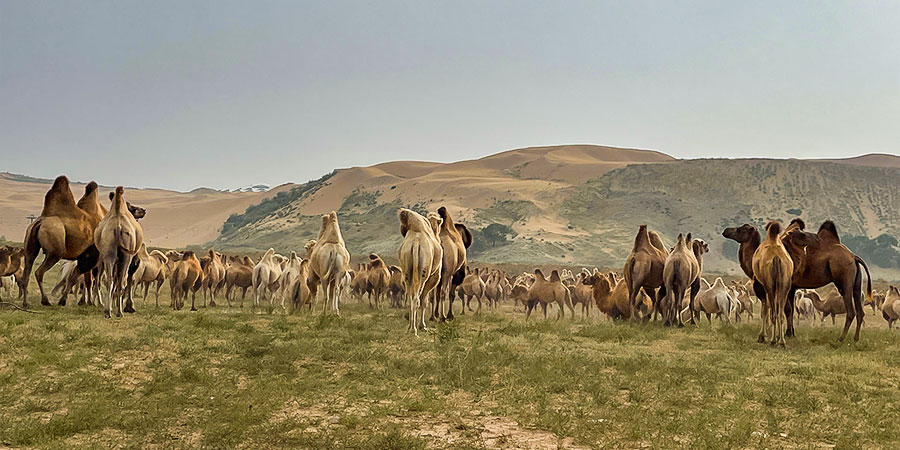
In this month, southward cold and northward warm air meet here and makes the weather of Inner Mongolia in March fairly windy. Due to the vast barren landscape without snow or plant cover especially in the central and western regions, March marks the onset of sand storm season in Inner Mongolia. Strong winds blowing up the dust could result in frequent dusty conditions even heavy sandstorms sometimes, which leads to low visibility and poor air quality. Usually, local sandstorm season lasts for about three months to May, but it never means that every day suffers from this terrible weather. If encountering no heavy winds, you can continue your trip as planned with full protection.
 |
| Dusty Days in March |
Sufficient Daytime, Bright Sunlight
From the beginning to end of March, the sun rises at 6:40 - 5:40 and sets at 17:40 - 18:30 in the eastern Inner Mongolia; the other part experiences sunrise and sunset about 1 hour later, respectively at 7:40 - 7:00 and 19:00 - 19:30 around. In consequence, the daylength extends to 11 - 13 hours, thus providing visitors adequate time to make thorough exploration. At the same time, you can enjoy plenty of sunshine, about 8 hours per day averagely. In March, ultraviolet rays in most areas have become strong and require you to take sunscreen measures.
What to Wear in Inner Mongolia in March?
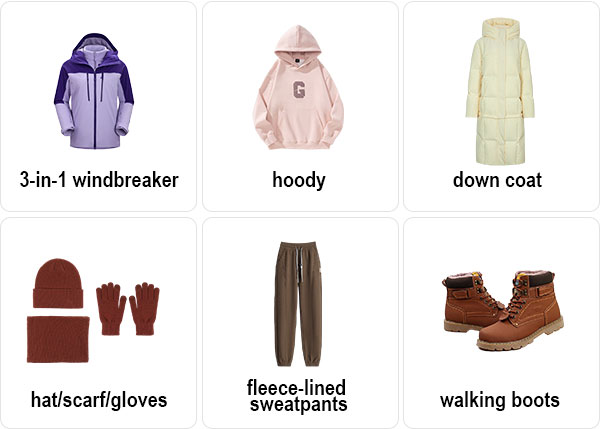
Clothes for Western Part: Hoodies, sweaters and knit wear are usually warm enough as the inner layer, but bottoming shirts should be prepared for highly possible temperature drops. You could choose outer layers from down jackets, 3-in-1 windbreakers and woolen coats according to temperatures. For bottoms, long johns with fleece-lined sweatpants or thick jeans are good matches.
Clothes for Eastern Part: Long down coats are quite necessary for the much lower temperatures mostly under 0°C (32°F); 3-in-1 windbreakers and padded leather coats could act as alternatives. You can wear thermal underwear with thick sweatshirts or heavy sweaters for inner layer. Woolen long johns topped with windproof trousers like jacket pants and padded jeans are suggested for lower body.
Shoes: Common sneakers work well in western Inner Mongolia. While for the east, prepare fleece-lined ones, padded walking boots even snow boots for snow activities.
Others: Hats and scarves remain important to prevent strong winds, and thicker ones and gloves should be packed for the east. In dusty weather, you also need protective glasses and masks to avoid the sand getting into your mouth and eyes. They also could shield you from UV damage. If you have already caught by respiratory diseases, remember to prepare relevant medicines. Besides, its dry climate makes lip pomades and moisturizing cream essential.
Travel Recommendations and Tips for Inner Mongolia Trip in March
 |
| Shiwei Town |
1. To visit Inner Mongolia in March 2027, Hulunbuir and Higgan in the northeastern part are highly recommended where all white landscape still can be seen and dusty days are less frequent. For natural scenery, you can visit
Arxan National Park which involves various landforms of volcano, pristine forests, mountains and lakes. For cultural and historical attractions, Shiwei, a town nearby the Russia, and Aoluguya with Ewenki people are good choices since you can experience distinctive cultures and customs, taste local food and appreciate traditional performances.
2. It is suggested to pay close attention on sand storm warning and prepare a plan B just in case. When sand storm hits, you should avoid outdoor visits and choose indoor attractions instead. If you have to go out during heavy dusty days, be sure to wear clothes of bright colors to make yourself more visible and make full protection on eyes, nose and mouth.
3. In late March, even in the eastmost cities of Inner Mongolia, the ice surfaces of lakes and rivers like
Hulun Lake are not thick enough for visitors to have fun on. Please do not have any try for sake of your safety.
- Last updated on Jun. 12, 2026 by Charlotte Qiu -