During January, Inner Mongolia experiences the coldest time of the year. Temperature differences between day and night are also very large. Considering the extensive span in east-west direction, the temperatures are also of regional variations, though severely cold overall. Inner Mongolia weather in January is rather dry, with only occasional snowfall, but vast snow view can be seen as snow doesn’t melt. Strong winds blow frequently in this month.
Temperature: Yearly Lowest
 |
| People in Heavy Clothing in January |
As the coldest month in the entire year, January sees the temperatures which seldomly climb above 0 degrees Celsius (32 degrees Fahrenheit) even during daytime and usually dip below -10°C (14°F) at night, a level that visitors feel like staying in the natural refrigerator. The harsh weather of Inner Mongolia in January causes certain challenges for long-time outdoor visits.
You should also know that there exist large temperature differences among regions. Take two representative cities as examples: in this month, the provincial capital
Hohhot in southwestern part experiences the daytime highs mostly between -5 and 3°C (23 - 37°F) and night lows between -18 and -11°C (0 - 12°F); while, in northeastern
Hulunbuir, even the high values range from -26 to -12°C (-15 - 10°F), let alone the low ones which swing between -38 and -20°C (-36 - -4°F).
It can be seen from the data that eastern Inner Mongolia is much more freezing than the west. Historically, in Genhe the northeastern Inner Mongolia, the temperature even plunged to -58°C (-72°F) once, and this place is widely recognized as the coldest place of China.
Precipitation: Scarce Snowfall
Inner Mongolia climate in January is pretty dry since precipitation lies in the lowest range year-round, only 3 - 6 mm (0.12 - 0.24 in) monthly on average from about 3 days. In view of the efficient heating system, visitors may be woken up by thirst and sore throat at night. Despite of occasional snow drizzles, you have the chances to see boundless snowy landscapes throughout Inner Mongolia in January because of the snow accumulations from past months. When it blows heavily, the accumulated snow floats in the air and leads to low visibility, causing some inconvenience for outdoor visits.
 |
| Snowy Landscape in January |
Relatively Short Daytime
In January, the daytime of Inner Mongolia ranges from 8.5 to 10 hours, which is a little short and somewhat insufficient for sightseeing. It varies among regions: the northeastern Hulunbuir has roughly 1-hour shorter daylength than the southwestern
Alxa League. Generally, from the beginning of the month to the end, the sun rises increasingly earlier and earlier at around 8:30 - 7:30 and sets later and later from 16:10 to 18:30.
But the sunshine remains abundant in most time and most areas, with sunlight duration of about 7 hours daily on average. It also means sunglasses are necessary to protect your eyes from sunlight reflected by snow which is visible almost everywhere in the wild.
Is January a Good Time to Visit Inner Mongolia?
It is hard to give a definite answer as it primarily depends on your major concerns.
If you attach great importance to pleasant weather conditions, it is generally not suggested to travel there since the climate of Inner Mongolia in January features severe coldness and extreme dryness. Some scenic spots close early in the day even the whole time during January like
Singing Sand Ravine in Ordos. When snow storm occurs, the roads to/from suburban attractions might be blocked.
 |
| Snow-covered Roads in Inner Mongolia |
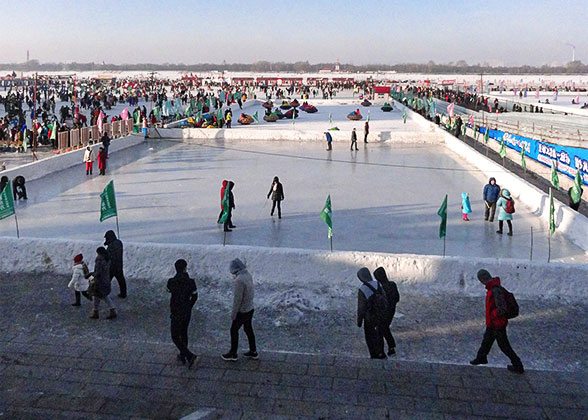
However, if you head for wonderful snow scenery, January is certainly a good time to visit Inner Mongolia. As the snow and ice cover has become thick enough, you can conduct various winter activities such as sledding, skiing, ice-fishing and so on in the white kingdom. What’s more, travelling there in this month saves a lot of budgets for visitors since the prices of accommodation and transportation are relatively low in the slack travel season.
What to Wear in Inner Mongolia in January?

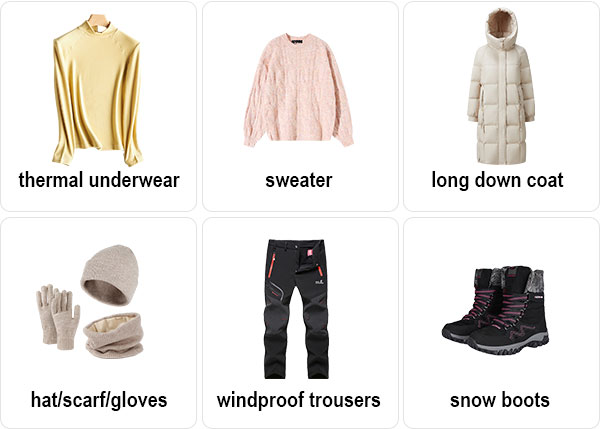
Clothes for Eastern Part: As the temperatures in eastern Inner Mongolia is particularly low, thermal underwear is indispensable for base layer, on top of which, you can put on fleece-lined shirts or heavy sweaters. If you are susceptible to coldness, wear a thin down coat or vest then. For the outermost layer, choose long down coats as thick as possible. For lower body, it is suggested to wear woolen long johns with windproof padded trousers even down pants.
Clothes for Western Part: With temperatures being over 10°C (50°F) higher than eastern parts, most visitors to western areas can wear relatively less clothes and normal winter dressing is warm enough. For instance, bottoming shirts topped with knit wear and down coats are good matches for upper body; it is also suitable to wear long johns with thick trousers.
Shoes: During Inner Mongolia trip in January, the basic demand for shoes is non-slip and waterproof for playing games on snow or ice. You are advised to wear high-top snow boots and hiking boots or sneakers with fleece lined. Ice cleats should also be prepared if your trips involve climbing mountains.
Others: Large scarves, woolen hats and thick masks are the musts to prevent winds and keep warm. You had better wear two kinds of gloves especially if visiting eastern Inner Mongolia, one pair being thick and water-proof for playing snow and another soft, warm and less bulky for daily use. Warm pastes are also useful. Moreover, remember to pack up moisturizers and snow goggles to protect your skin and eyes.
Travel Recommendations and Tips for Inner Mongolia Trip in January
 |
| Have Fun on the Frozen Lake |
1. For distinctive winter fun, it is more recommended to visit eastern Inner Mongolia. You can wander along the misty unfreezing river in
Arxan National Forest Park, have fun in Hailar Ski Resort or go ice-fishing on frozen
Hulun Lake …
2. To deal with its dry climate in January, you should choose hotels with humidifiers provided. If the demand fails to be met, you can hang wet towels in order to increase indoor humidity. Besides, open the window slightly to allow extra warmth to escape and prepare some water for midnight thirst.
3. Since most areas in Inner Mongolia are equipped with efficient heating appliances, the indoor temperature keeps usually over 20°C (68°F), so you are suggested to bring thin pajamas. Considering the large temperature differences between indoors and outdoors, flexible adjustment of dressing is quite essential.
See also:
Hohhot Weather in January
- Last updated on Jun. 12, 2026 by Charlotte Qiu -