As time passes by, Inner Mongolia weather in October is getting colder and colder. Yet it is featured by coldness in various degrees in different parts and large temperature drops tend to occur in late October. The precipitation in this month is pretty low and mainly falls as light rainfall, thus creating a dry climate. Strong winds also hit and result in several dusty days, especially in the west. Normally, the most stunning autumn views could last to middle October.

See also:
Hohhot Weather in October Coldness in Various Degrees
In October, the temperatures drop significantly, which is quite obvious in the late half. The decreasing trend is also accompanied by drastic fluctuations. Additionally, the already stark temperature differences between day and night are further enlarged in this month, so does the regional difference. Those unfavorable factors collectively make the weather of Inner Mongolia in October vary among different cities and in different periods.
 |
| Brown Landscape in October |
In the east, the daytime high temperatures decrease from 7 - 16 degrees Celsius (45 - 61 degrees Fahrenheit) in early October to 1 - 9°C (34 - 48°F) in the end; the night lows mostly keep below 0°C (32°F), ranging from -9 to 1°C (16 - 34°F). It can be concluded that the eastern Inner Mongolia becomes cold especially in late October.
While the west sees daily highs about 12 - 22°C (54 - 72°F) in the first half month, which fall to 8 - 13°C (46 - 55°F) in the second half and the low degrees fluctuating between -3 and 10°C (27 - 50°F). In a word, western Inner Mongolia climate in October turns from cool to chilly even cold.
Low Precipitation
 |
| Snow Peaks of Inner Mongolia |
Inner Mongolia in October receives a quite low precipitation, which averages roughly 10 - 30 mm (0.39 - 1.18 in) from about 6 days. It is distributed unevenly as the northeast sees the least and the southwest the most. Generally speaking, the whole region is fairly dry that your skin seems like to crack especially when the heating system starts working since middle or even early month.
Most of the time, the low precipitation falls as drizzles or brief showers, which leads to limited interruptions on your travel. While, in the northeastern cities like Hulunbuir, light snowfall is highly possible, especially towards late October. The snow in urban areas might melt soon, but those on mountain peaks remain.
Short Daytime, Ample Sunlight
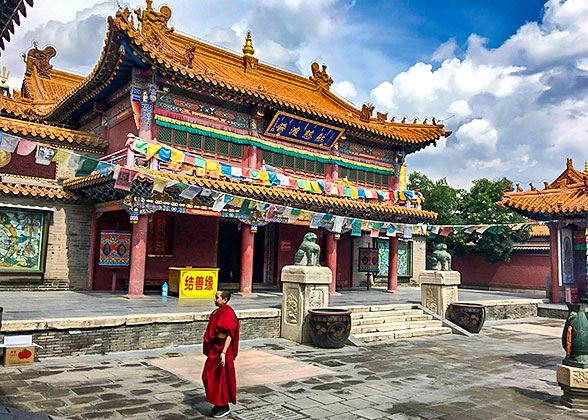 |
| Dazhao Temple |
From the beginning to the end of October, the sun rises increasingly later from 6:00 - 7:30 and sets earlier and earlier from 18:50 - 16:40 throughout the region. Correspondingly, the daytime shortens from about 11h40m to 10h and becomes less sufficient for daily sightseeing. To make full use of the daylight hours, visitors need to get up early or speed up the pace. Good news is that you can enjoy sunlight duration about 8 hours per day on average and the UV index is only at level 4. There are plenty of sunny days with blue sky and white clouds, consisting colorful pictures with the red walls and golden rooves of
Dazhao Temple in Hohhot as well as yellow leaves of
Ejina Populus Euphratica Forest in westmost Alxa and azure
Hulunbuir Lake in the northwest.
Frequent Strong Winds
During October, winds become frequent in Inner Mongolia and the intensity is relatively high. Strong winds at force 4 -5 are commonly seen and might reach force 7 - 8 sometimes especially on the vast and open grasslands like
Hulunbuir Prairie. Winds in the western Inner Mongolia usually have lower intensity than those in the east, but both bring some discomfort and inconvenience. It not only lowers the perceived temperatures and causes headache if without any protection, but also results in dusty days. Snowdrift formed by the wind is also possible in the east. In short, it is not suggested to conduct outdoor visits in such days with low visibility.
Is October a Good Time to Visit Inner Mongolia?
In general, October is a good time to enjoy the golden autumn views in Inner Mongolia despite that the climate is a little changeable. However, the golden views are of slight regional differences.
Early October is definitely a good time to visit both the eastern and western Inner Mongolia. During this period, the weather remains relatively mild and you can see golden landscape no matter in Ergun National Wetland Park or
Arxan National Forest Park. The yellow trees and clear lakes glittering under bright sunshine are big feasts to eyes.
 | | Autumn Views of Ergun Wetlands | |  | | Singing Sand Ravine | |
By the late half, the eastern Inner Mongolia turns considerably cold and the natural scenery becomes less charming. The grasslands have turned barren and the trees start to wither, then get gradually brown, which gives visitors the feeling of desolation. However, the west still boasts wonderful natural views except autumn scenery. You can go hiking on
Tengger Desert in Alxa or
Singing Sand Ravine in Ordos and appreciate lakes scattered in deserts. It’s also a good choice to visit national parks near Hohhot where fall foliage looks like golden blanket of the earth.
What to Wear in Inner Mongolia in October?
Clothes for Eastern Part: Layers of dressing should be adopted in this month. You can wear shirts as the base layer, topped with fleece vests; bottoming shirts with hoodies, knit wear or sweaters are also good matches. The outer layer should be windproof and you can choose from padded leather coats, 3-in-1 windbreakers and down coats. For bottoms, it is suggested to wear fleece-lined jeans or thick sweatpants with long johns.
Clothes for Western Part: Two layers are usually warm enough in most time. Long-sleeved T-shirts, blouses or knit wear are good choices for inner layer; then, you can put on thick outer coats such as woolen coats. You had better prepare down coats for suburban attractions. You are also advised to wear windproof trousers with long johns or change them into padded ones.
Shoes: Casual sneakers and hiking boots suit the western Inner Mongolia and fleece-lined ones are recommended for the colder east. You should also bring both thin and thick socks to deal with temperature fluctuations.
Others: Warm accessories like hats and scarves are necessary for both parts, but those for the east should be thicker, like woolen ones. Please wear masks to prevent strong winds or sand in dusty days. Skin-care products including hand cream and lip balms also become important to keep your skin moisturized. Sunglasses and sunblock are still suggested especially in the western part at the beginning of October.
Tips for Inner Mongolia Trip in October
1. China’s National Day holiday in 2026 lasts from October 1 to 7 which coincides with the good time for autumn scenery of Inner Mongolia. In consequence, tourist numbers, hotel prices and airfares all experience a surge. You are suggested to make reservations a month in advance to enjoy relatively low prices. However, if you prefer economical and serene trips, choose middle to late September instead or visit its western part after the holiday.
2. After middle October, some natural attractions are closed such as Huitengxile Grassland in Ulanqab and Wuliangsuhai Lake in Banyannur. Be sure to check the opening situation before you go.
- Last updated on Jun. 12, 2026 by Charlotte Qiu -