China Tourism
Entering the 21st century, propelled by continuous economic growth, the deepening of reform and opening up policy, and a substantial increase in residents’ income, China's tourism industry had witnessed unprecedented development. The massive inbound and outbound tourism markets had drawn global attention, and the domestic market had been steadily expanding. However, from 2020 to 2022, the COVID-19 pandemic brought China's tourism industry to a standstill for three years.
Fortunately, the industry has embarked on a gradual recovery path since 2023 in the post-pandemic era. Today, China's tourism industry has largely shaken off the impact of the pandemic and entered a new stage of all-round recovery and quality upgrading. Domestic tourism is maintaining steady growth, inbound tourism is gaining momentum, and outbound tourism is recovering at a measured pace. The holiday tourism market remains dynamic, alongside the emergence of an increasing number of innovative culture-tourism integrated models, signaling a robust overall development trend for the sector.
Inbound Tourism:
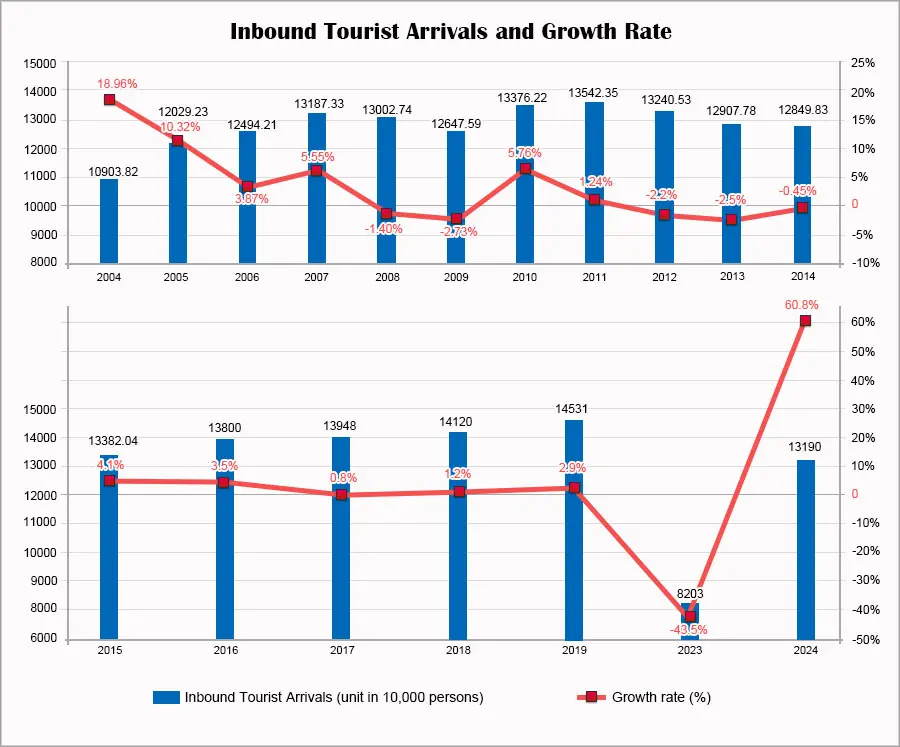 |
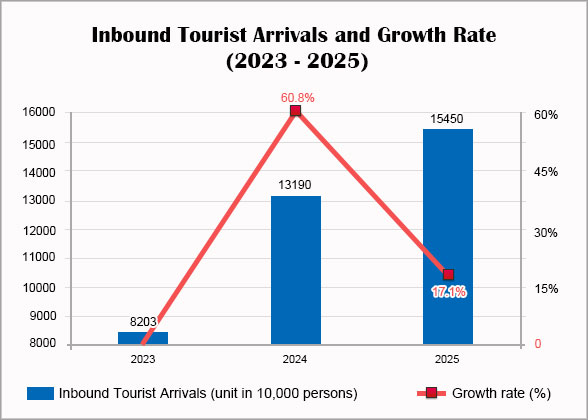
Starting from late 2023, with the gradual lifting of travel restrictions and continuous optimization of visa-free policies, inbound tourism has staged a remarkable rebound. Currently, bolstered by the sustained implementation of transit visa exemption and regional visa-free policies, international air routes have largely resumed operations, and the number of foreign tourists visiting China has steadily surpassed the 2019 level, showcasing strong recovery momentum and promising long-term development prospects.
 |
Inbound tourism is now backed by a host of favorable conditions. Visa policies have grown increasingly traveler-friendly, making entry into China far more easier for tourists from an expanding number of countries and regions. The topic of “China Travel” has trended prominently on overseas social media, capturing the curiosity of countless international visitors. China's rich cultural heritage and breathtaking natural landscapes possess inherent, timeless appeal. Moreover, longstanding barriers for foreign tourists, such as inconvenient payment methods and cumbersome ticket-booking processes, have been substantially addressed. The registration procedures for foreign users of Alipay and WeChat Pay have been streamlined, and international credit cards are now widely accepted across numerous venues in China. Most scenic spots’ ticketing systems now offer English or multilingual interfaces, greatly simplifying online ticket purchases. Tourism infrastructure has also been continuously upgraded, featuring a more extensive high-speed rail network and a growing cohort of proficient foreign-language-speaking tour guides. All in all, the overall travel experience for international visitors to China has improved dramatically in recent years.
 See China Inbound Tourism by Year:
 Top 10 Cities for Overseas Tourists:
| 1. Shanghai | 2. Shenzhen | 3. Guangzhou | 4. Beijing | 5. Chengdu |
| 6. Hangzhou | 7. Chongqing | 8. Zhuhai | 9. Xi’an | 10. Qingdao |
Top 10 Attractions among Inbound Tourists:
| Forbidden City | Mutianyu Great Wall |
| Terracotta Army | West Lake (Xi Hu) |
| Zhangjiajie National Forest Park | Jiuzhaigou National Park |
| Gulangyu Island | Yellow Mountain |
| The Bund & Huangpu River | Yalong Bay |
Outbound Tourism:
Hit hard by the COVID-19 pandemic, outbound tourism entered a three-year adjustment period. Following 2023, the outbound tourism market began a gradual recovery, and by now, it had entered a phase of orderly restoration and steady expansion. International flights have largely returned to pre-pandemic capacity, and numerous countries have rolled out proactive measures to attract Chinese tourists. Today's Chinese outbound tourists prioritize in-depth cultural experiences and high-quality travel, moving beyond the traditional model of rushed sightseeing. On the whole, the outbound tourism market is evolving in a positive and mature direction.
Top 10 Chinese Outbound Travel Destinations:
See China Outbound Tourism by Year:Domestic Tourism:
At present, domestic tourism has shifted beyond mere recovery in tourist numbers, entering a new era centered on quality enhancement and experience upgrading. Emerging travel formats, including weekend getaways, rural tourism, educational study tours, and wellness tourism, are gaining traction, and the integration of culture and tourism continues to deepen. Popular scenic spots are consistently packed with visitors during holiday periods, and tourism consumption has become a pivotal driver of domestic demand and local economic growth.
Competition within the domestic tourism market is intensifying by the day. To attract more tourists, regions across the country are actively enhancing the quality of tourism services, optimizing the tourism environment, and introducing diversified tourism products. These endeavors have not only enhanced tourists’ travel experiences but also spurred the prosperity and development of the domestic tourism market.
Despite facing numerous challenges, the domestic tourism market still has vast development potential. With the further increase in residents' income, the transformation of consumption concepts, and the continuous improvement of tourism infrastructure, the domestic tourism market is anticipated to maintain a growth trajectory in the future.
Top 10 Domestic Tourism Destinations:
List of China Tour Operators
(Members of China Association of Travel Services) Further Reading: History of China Tourism China Tours Top 10 China Destinations for First Time Travelers