Cloud Cultivating Pavilion (Yangyunxuan)
The Cloud Cultivating Pavilion, a serene courtyard on the north of the eastern end of the Long Corridor in the Summer Palace, was once a residence for royal women. Today, it is open to visitors with its structures and cultural relics.
The most distinctive feature of the Cloud Cultivating Pavilion is its courtyard gate, which resembles the exteriors of some 18th-century Western clocks presented to the Qing court, hence its nickname the "Clock Gate". Flanking the gate are two square pillars on carved stone bases. Each layer of the gate’s double-eaved roof features a small treasure vase at each corner, with a large vase positioned at the top center. The wooden door frame between the two pillars is octagonal and embellished with scroll patterns.
Stepping through the gate, you’ll enter a two-section courtyard divided by a low wall. The first section has small side rooms to the east and west. Climbing the central steps leads to the second yard, where the main hall, Cloud Cultivating Pavilion, stands with its double-sloped roof and intricate paintings under eaves. Flanking the hall are side chambers, connected to east and west wing halls by corridors.
Exiting the pavilion, you'll see a single-arch marble bridge, its sides lined with granite walls resembling tiger stripes. Below the bridge flows the Gourd River, named for its gourd-like shape. This artificial river serves to collect rainwater from the front hill, allowing sediment to settle before the water enters Kunming Lake, thus preventing silt accumulation.
Currently, the rooms of the courtyard serve as a space for studying Summer Palace artifacts. Visitors can explore the exterior of the buildings and view displayed artifacts through glass windows, such as glazed tiles, ridge beasts, and colorful paintings from various periods. The courtyard also hosts occasional events. For example, during the 2025 Double Ninth Festival (a Chinese festival honoring the elderly with a tradition of admiring chrysanthemums), over 100 pots of chrysanthemums are displayed here for visitors to enjoy from late October to early November.
Constructed in 1754, the Cloud Cultivating Pavilion initially served as a residence for royal concubines. Emperor Qianlong (1711-1799) named it "Cloud Cultivating", symbolizing the nurturing of clouds to bring timely rain for agriculture. The inscriptions on the lintel above the clock-shaped gate and the gate pillars are also related to rain.
In 1888, Emperor Guangxu (1871-1908) renovated the pavilion and added rooms to it. During Empress Dowager Cixi's (1835-1908) visits to the Summer Palace, other royal women accompanying her would reside here. By 1932, the pavilion was briefly rented out. Today, the dimensions and appearance of the pavilion remain largely unchanged, with only minor changes to the exterior decorations.
The most convenient way to reach the Cloud Cultivating Pavilion is through the East Palace Gate. After entering, walk westward along the Long Corridor to its eastern Gate of Inviting the Moon and cross the stone bridge on the right to arrive at the Cloud Cultivating Pavilion. The walk takes about 10 minutes.
The Cloud Cultivating Pavilion is closed on Mondays, except for major holidays. From April to October, it is open from 08:00 to 18:00, and from November to March, from 08:30 to 17:00. If you've got the Temple of Heaven entrance ticket, you can visit it for free without reservations.
As one of the few original structures in the Summer Palace, Cloud Cultivating Pavilion offers perfect spots for timeless photos.
Lattice Windows: Position your model against the traditional floral-patterned window on the east outer wall in the afternoon, especially in the afternoon when tree shadows cast intricate patterns on the wall.
Stone Bridge: Have your model stand on the bridge outside the gate for a layered shot, with the bridge railings in the foreground, the subject in the midground, and either the Long Corridor or the iconic clock-shaped gate as the backdrop.
What to See – Architectural Highlights & Temporary Exhibits
The most distinctive feature of the Cloud Cultivating Pavilion is its courtyard gate, which resembles the exteriors of some 18th-century Western clocks presented to the Qing court, hence its nickname the "Clock Gate". Flanking the gate are two square pillars on carved stone bases. Each layer of the gate’s double-eaved roof features a small treasure vase at each corner, with a large vase positioned at the top center. The wooden door frame between the two pillars is octagonal and embellished with scroll patterns.
Stepping through the gate, you’ll enter a two-section courtyard divided by a low wall. The first section has small side rooms to the east and west. Climbing the central steps leads to the second yard, where the main hall, Cloud Cultivating Pavilion, stands with its double-sloped roof and intricate paintings under eaves. Flanking the hall are side chambers, connected to east and west wing halls by corridors.
Exiting the pavilion, you'll see a single-arch marble bridge, its sides lined with granite walls resembling tiger stripes. Below the bridge flows the Gourd River, named for its gourd-like shape. This artificial river serves to collect rainwater from the front hill, allowing sediment to settle before the water enters Kunming Lake, thus preventing silt accumulation.
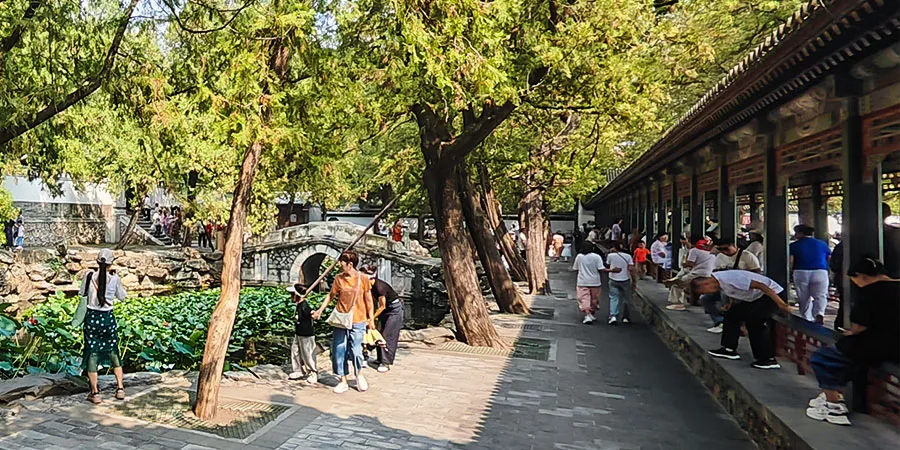 |
| Pond & Bridge Outside the Pavilion |
Currently, the rooms of the courtyard serve as a space for studying Summer Palace artifacts. Visitors can explore the exterior of the buildings and view displayed artifacts through glass windows, such as glazed tiles, ridge beasts, and colorful paintings from various periods. The courtyard also hosts occasional events. For example, during the 2025 Double Ninth Festival (a Chinese festival honoring the elderly with a tradition of admiring chrysanthemums), over 100 pots of chrysanthemums are displayed here for visitors to enjoy from late October to early November.
When & Why Built – Clouds Cultivating Pavilion History
Constructed in 1754, the Cloud Cultivating Pavilion initially served as a residence for royal concubines. Emperor Qianlong (1711-1799) named it "Cloud Cultivating", symbolizing the nurturing of clouds to bring timely rain for agriculture. The inscriptions on the lintel above the clock-shaped gate and the gate pillars are also related to rain.
In 1888, Emperor Guangxu (1871-1908) renovated the pavilion and added rooms to it. During Empress Dowager Cixi's (1835-1908) visits to the Summer Palace, other royal women accompanying her would reside here. By 1932, the pavilion was briefly rented out. Today, the dimensions and appearance of the pavilion remain largely unchanged, with only minor changes to the exterior decorations.
Getting There
|
|
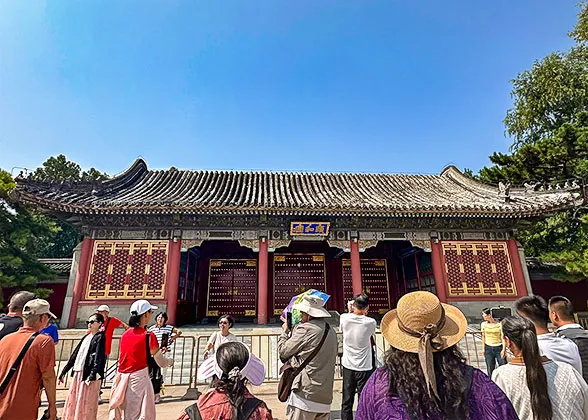
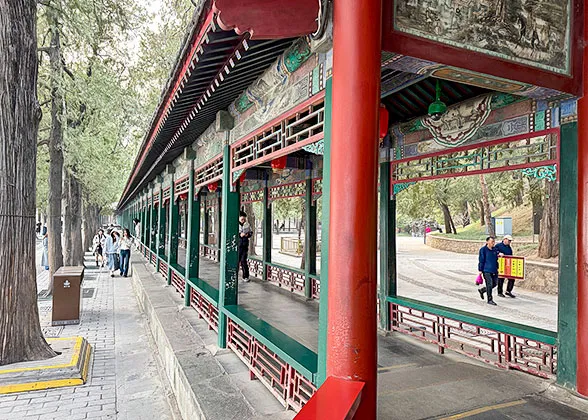
The most convenient way to reach the Cloud Cultivating Pavilion is through the East Palace Gate. After entering, walk westward along the Long Corridor to its eastern Gate of Inviting the Moon and cross the stone bridge on the right to arrive at the Cloud Cultivating Pavilion. The walk takes about 10 minutes.
Opening Hours
The Cloud Cultivating Pavilion is closed on Mondays, except for major holidays. From April to October, it is open from 08:00 to 18:00, and from November to March, from 08:30 to 17:00. If you've got the Temple of Heaven entrance ticket, you can visit it for free without reservations.
Photo Spots
As one of the few original structures in the Summer Palace, Cloud Cultivating Pavilion offers perfect spots for timeless photos.
Lattice Windows: Position your model against the traditional floral-patterned window on the east outer wall in the afternoon, especially in the afternoon when tree shadows cast intricate patterns on the wall.
Stone Bridge: Have your model stand on the bridge outside the gate for a layered shot, with the bridge railings in the foreground, the subject in the midground, and either the Long Corridor or the iconic clock-shaped gate as the backdrop.
- Last updated on Jun. 18, 2026 by Jally Zhang -