Bronze Ox
The Bronze Ox is a vividly crafted sculpture located on the eastern embankment of Kunming Lake in the Summer Palace. During the Qing Dynasty (1644~1911), it served not only as an ornamental piece but also played a role in flood control. Regarded as the most exquisite ancient bronze ox in China, it showcases the pinnacle of traditional metal-casting techniques and remains a popular photo spot for visitors.
The ox, cast in a dark gray hue, measures 1.8 meters (5.9 feet) in length and 1.2 meters (3.9 feet) in height. Modeled after the water buffalo commonly seen plowing rice fields in southern China, it has a sturdy yet gentle appearance. The sculpture rests on waves carved from white marble, its head slightly turned to the right with perked ears and eyes gazing across the vast Kunming Lake.
Cast in 1755, the ox was originally gilded in gold and referred to as the "Golden Ox". Emperor Qianlong (1711~1799) personally composed the "Golden Ox Inscription", engraved on its back.
In 1860, the gold leaf was destroyed during wartime turmoil at the Summer Palace. Two years later, a nearby resident sneaked into the palace at night, sawed off the ox’s tail, and sold it for profit. After being caught, the thief was branded on the face, beaten, and exiled.
Around 1900, during the reconstruction of the Summer Palace, the ox's tail was replaced, but the gold leaf was never restored, leaving the ox in its current state.
According to legend, the ox symbolizes flood-prevention powers. This belief traces back to Da Yu, the ancient Chinese flood control hero dating back about 4,000 years ago, who would cast iron oxen into riverbeds after taming floods, a practice later adapted by placing them on banks as guardians. Emperor Qianlong continued this tradition by commissioning this bronze ox in 1755 as a spiritual protector.
The bronze ox also serves a practical function as a water level marker for flood prevention. When the water level approaches its base, it indicates that Kunming Lake is nearing its capacity. To prevent the lake from overflowing, some of the water may need to be diverted into Beijing's urban canal system through sluice gates. This helps distribute the water and reduces the risk of flooding in any single area.
In addition, the ox carries romantic and imperial significance. In mythology, the Cowherd and the Weaver Girl were deeply in love but could meet only once a year on a magpie bridge, permitted by the Jade Emperor. Positioned on the east shore as the Cowherd, the ox gazes eternally toward the west "Farming and Weaving" complex (the Weaver Girl's domain), with the Seventeen-Arch Bridge as their bridge and the lake as the Milky Way. Through this arrangement, Emperor Qianlong expressed his romantic mood and reinforced his divine authority as the earthly equivalent of the Jade Emperor.
From the Newly Built Palace Gate: Upon entering, you'll see the bronze ox immediately to your left.
From the East Palace Gate: Walk straight through the palace area, turn left, and follow Kunming Lake towards the Seventeen-Arch Bridge. After about 15 minutes, you'll see the bronze ox.
Use the ox's horns as a framing device, and capture the bronze ox with the Buddhist Incense Tower in front of Longevity Hill. This angle creates a photo with a sense of historical and cultural depth, depicting the bronze ox in a timeless gaze with the tower.
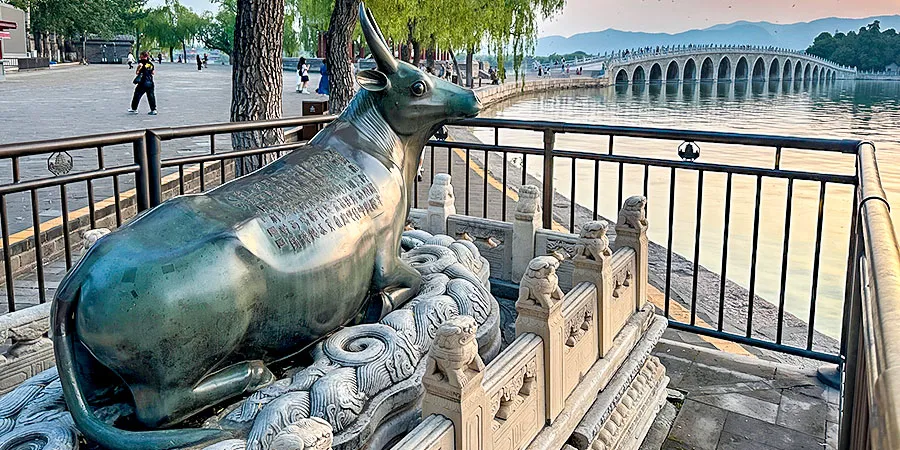 |
| Bronze Ox & Seventeen-Arch Bridge |
What does the Bronze Ox look like?
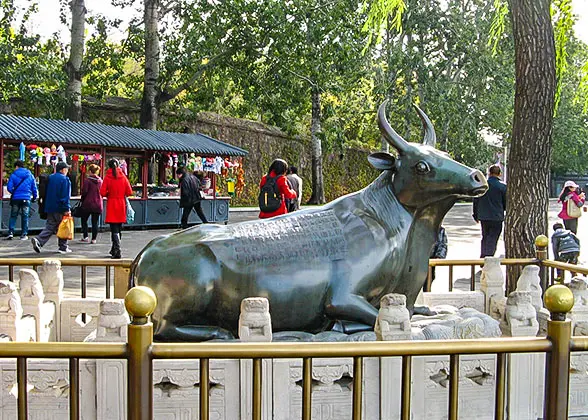 |
| Bronze Ox |
The ox, cast in a dark gray hue, measures 1.8 meters (5.9 feet) in length and 1.2 meters (3.9 feet) in height. Modeled after the water buffalo commonly seen plowing rice fields in southern China, it has a sturdy yet gentle appearance. The sculpture rests on waves carved from white marble, its head slightly turned to the right with perked ears and eyes gazing across the vast Kunming Lake.
History of the Bronze Ox
Cast in 1755, the ox was originally gilded in gold and referred to as the "Golden Ox". Emperor Qianlong (1711~1799) personally composed the "Golden Ox Inscription", engraved on its back.
In 1860, the gold leaf was destroyed during wartime turmoil at the Summer Palace. Two years later, a nearby resident sneaked into the palace at night, sawed off the ox’s tail, and sold it for profit. After being caught, the thief was branded on the face, beaten, and exiled.
Around 1900, during the reconstruction of the Summer Palace, the ox's tail was replaced, but the gold leaf was never restored, leaving the ox in its current state.
Why was the Bronze Ox placed here?
According to legend, the ox symbolizes flood-prevention powers. This belief traces back to Da Yu, the ancient Chinese flood control hero dating back about 4,000 years ago, who would cast iron oxen into riverbeds after taming floods, a practice later adapted by placing them on banks as guardians. Emperor Qianlong continued this tradition by commissioning this bronze ox in 1755 as a spiritual protector.
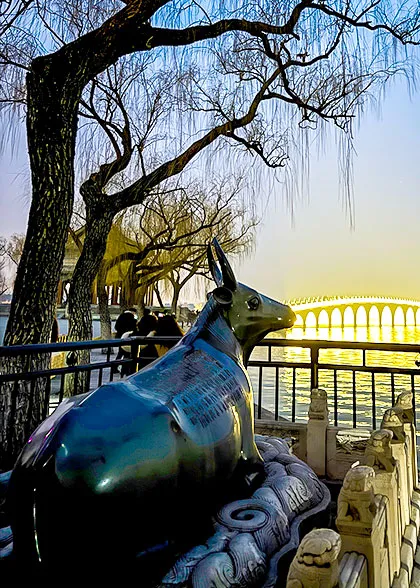 |
| Bronze Ox Night View |
The bronze ox also serves a practical function as a water level marker for flood prevention. When the water level approaches its base, it indicates that Kunming Lake is nearing its capacity. To prevent the lake from overflowing, some of the water may need to be diverted into Beijing's urban canal system through sluice gates. This helps distribute the water and reduces the risk of flooding in any single area.
In addition, the ox carries romantic and imperial significance. In mythology, the Cowherd and the Weaver Girl were deeply in love but could meet only once a year on a magpie bridge, permitted by the Jade Emperor. Positioned on the east shore as the Cowherd, the ox gazes eternally toward the west "Farming and Weaving" complex (the Weaver Girl's domain), with the Seventeen-Arch Bridge as their bridge and the lake as the Milky Way. Through this arrangement, Emperor Qianlong expressed his romantic mood and reinforced his divine authority as the earthly equivalent of the Jade Emperor.
Tips for Visiting the Bronze Ox
How to Get to the Bronze Ox
From the Newly Built Palace Gate: Upon entering, you'll see the bronze ox immediately to your left.
From the East Palace Gate: Walk straight through the palace area, turn left, and follow Kunming Lake towards the Seventeen-Arch Bridge. After about 15 minutes, you'll see the bronze ox.
Photography Tip
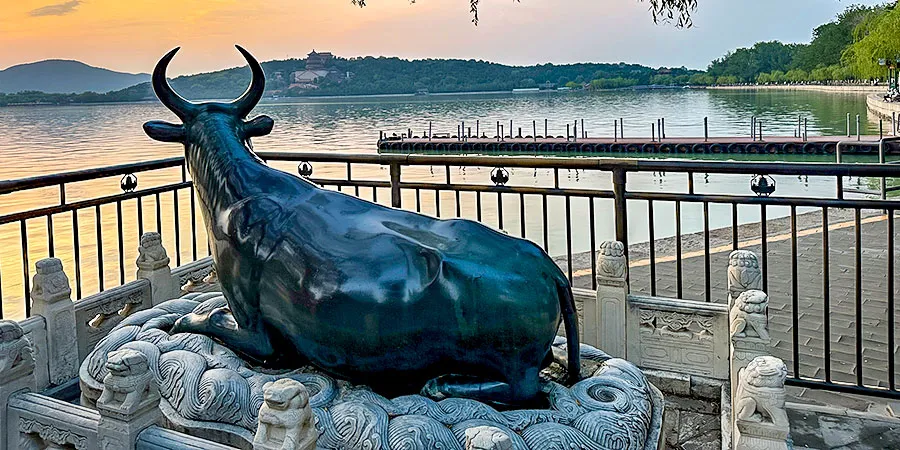 |
| Bronze Ox Facing Longevity Hill |
Use the ox's horns as a framing device, and capture the bronze ox with the Buddhist Incense Tower in front of Longevity Hill. This angle creates a photo with a sense of historical and cultural depth, depicting the bronze ox in a timeless gaze with the tower.
Recommended Tours

 Next: Marble Boat
 Related Link: Summer Palace Travel Tips
- Last updated on Apr. 30, 2026 by Gabby Li -