The Terracotta Army was mainly constructed to serve
Emperor Qin Shi Huang (259 BC - 210 BC), China's first emperor, in the afterlife. Reflecting his belief in maintaining his rule after death, this formidable force of terracotta warriors was meant to protect his tomb and demonstrate his military power and great achievements in the afterworld.
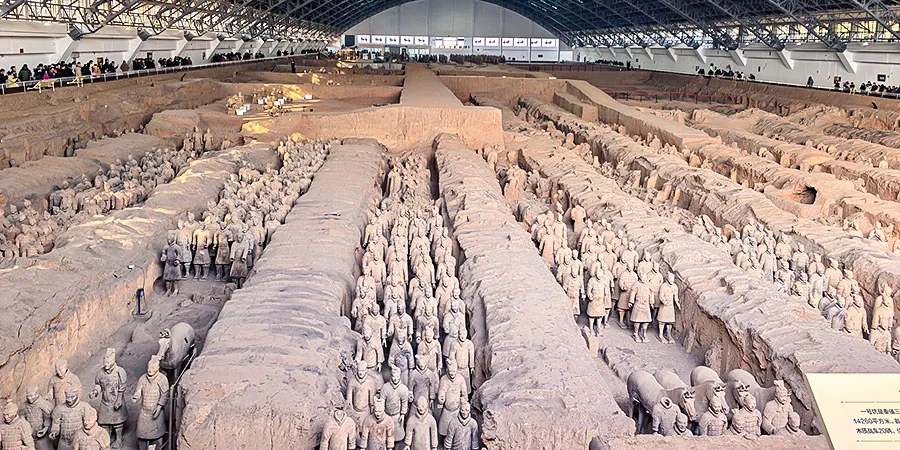 |
| Terracotta Army Pit 1 in Xi'an |
Main Reason: Qin Shihuang Wants to Continue Rule in His Afterlife
After ascending the throne, Qin Shihuang became increasingly obsessed with power and sought to rule the country forever, leading him to pursue immortality. However, after repeated failures, he gradually accepted that death was inevitable. He then turned his focus to ensuring his power would extend beyond death. He believed that the soul journeyed to another world after death, and to maintain his imperial authority there, he needed to bring his military strength with him. In accordance with the ancient principle of "treating the dead as if they were alive", he ordered the construction of the Terracotta Army. This powerful underground army was intended to protect his mausoleum, defend against potential threats from other states in the underworld, and enable him to continue his rule and territorial expansion after death.
Other Reasons:
1. To Highlight Qin's Military Power and Commemorate Qin Shihuang's Great Achievements
Qin Shihuang regarded himself as an unparalleled emperor in Chinese history due to his monumental achievements, such as conquering rival states to unify the whole country, and standardizing measurements, language, characters, and currencies. Among all the achievements, the most brilliant one is defeating other states to unite the country. He wanted future generations to remember his triumphs and the role his army played, so he ordered to build the Terracotta Army modelling on a real army of his to highlight his military power and commemorate his achievements.
As evidenced by the excavated terracotta army, the life-sized figures were meticulously arranged in battle formations, accurately representing the Qin army's organization and equipment. These terracotta warrior figures not only symbolize the imperial guards stationed near the capital but also, through their grand scale and realistic craftsmanship, showcase the formidable military power of the
Qin Dynasty (221 - 207 BC).
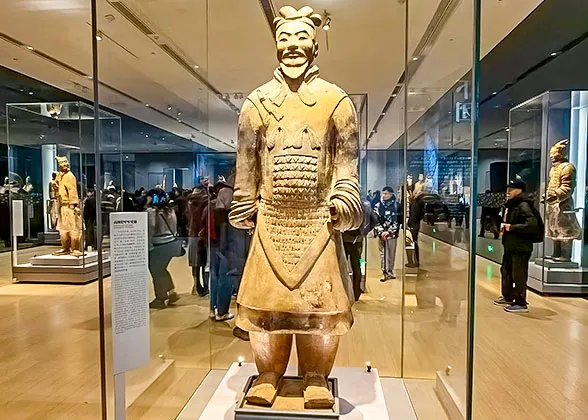 | | Tall and Powerful High-ranking Officer | | 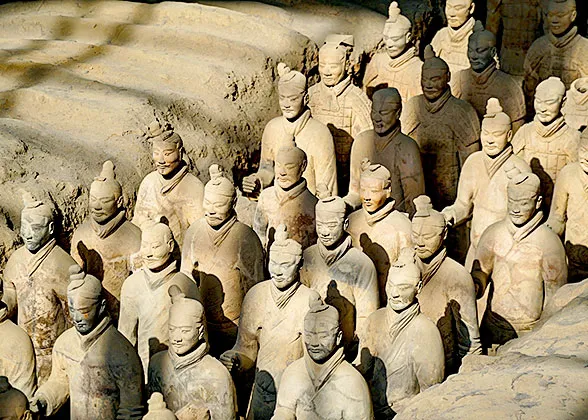 | | Infantry Warriors Arranged in Battle Formations | |
 You May Like:
2. To Use Terracotta Figures as Substitutes for Live Retinue Burials
Another important reason for the construction of the Terracotta Army was to follow the practice of replacing the live burial of servants and companions with terracotta figures. In the pre-Qin era, before the rise of the Qin dynasty, it was customary for members of the nobility to have living attendants, servants, and concubines interred with them upon death, so that these individuals could continue to serve them in the next life. However, by the late Warring States period (475 - 221 BC), constant conflicts made it vital to preserve human lives and labor, leading to the gradual abandonment of the practice of burying the living alongside the dead. Instead, terracotta or wooden figures began to be used as symbolic replacements for actual human companions in tombs.
Qin Shihuang lived during a transitional period when using terracotta or wooden figures as tomb retinues had become common, so he adopted this more humane approach by replacing real soldiers with over 8,000 terracotta figures in his burial complex.
 Further Reading: Who Built the Terracotta Warriors? How the Terracotta Warriors Were Made? Why are there partition walls in the pit of the Terracotta Army? How to Visit Terracotta Army - A Perfect One-Day Tour Plan
- Last updated on Feb. 14, 2026 by Gabby Li -