Mao’er Hutong: Beijing’s Most Aristocratic Old Alley
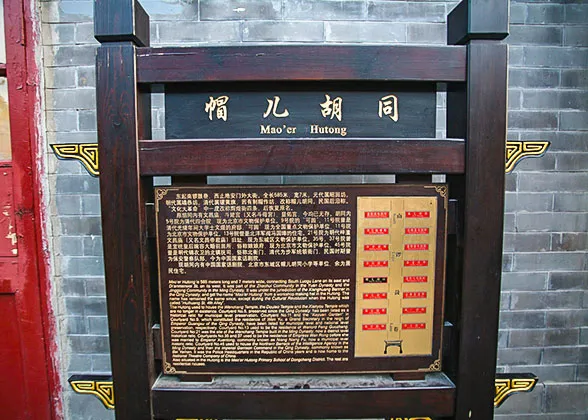
Mao'er Hutong stretches roughly 585 meters (640 yards) long and 7 meters (8 yards) wide between Nanluoguxiang (South Gong and Drum Lane) and Di'anmen, dating back over 700 years. This quiet, tree-lined lane is home to the former residence of Empress Wanrong, China's last empress, the exquisite Keyuan Garden, and the old home of Beiyang Government President Feng Guozhang. Regrettably, most of the celebrities' residences are not open to the public. But visitors can image their previous glory through the grand gates, delicate windows and high walls, and look into the daily life of local Beijingers.
During the Qing Dynasty (1644–1912), the western end of this lane began to be filled with hat-making workshops. They produced the full seasonal range of Qing headwear: the silk-brimmed summer court hats with red silk tassels and jeweled finial-buttons, the heavy fur-trimmed winter warm hats, and everyday felt caps for ordinary Beijingers who simply needed to keep their heads warm. The lane quietly became the capital's unofficial "Hat Street," and people started calling it Mao'er, literally the "hat" or "cap." By the Qianlong era (1735–1796), the name Mao'er Hutong was permanently marked on the city maps.
Another saying is that imperial officials used to stop here to straighten their robes and hats before entering the Forbidden City for a royal audience, hence the name.
Built in 1861, Keyuan is a masterpiece of classical private gardening. While most Beijing gardens are grand and symmetrical, Keyuan blends northern architecture with the delicate, watery elegance of Suzhou, a beautiful city in south China renowned for gardening.
This compound was the childhood home of Wanrong, the last empress of the Qing Dynasty (1644-1911). Before her 1922 wedding to Emperor Puyi, the house was just a common residence. To make the house "fit for the dignity of an Empress," the main gate was widened to accommodate the imperial empress palanquin and other renovations were also adopted. Interestingly, the renovations were so expensive that the cash-strapped imperial court had to mortgage 41 crates of gold and silver vessels to a British bank to pay for the work. Today, the compound remains a quiet residential site, its grand scale is a silent reminder of the Qing Dynasty’s final chapters.
This compound once housed the Ming Dynasty's Northern Bureau of the Embroidered Uniform Guard and later served as the Qing Dynasty's infantry command, better known as the Nine-Gate Commandant's Office, which controlled Beijing's nine inner city gates and policed the capital. The original office structures were mostly torn down in the late 20th century; only a pair of Ming-dynasty stone lions remain. Today the site is a complex of residential apartments, which are the highest buildings along Mao'er Hutong.
This sprawling compound was assembled by Feng Guozhang (1859–1919), acting president of the Republic of China. After taking office, he purchased several neighboring courtyards and combined them into one grand mansion. Forced to resign in 1918, Feng lived out his final days here. Today the compound serves as government office space.
Beyond the ancient architecture, the real charm of Mao'er Hutong is its rich living atmosphere. As you walk down, you'll see elderly residents chatting under centuries-old scholar trees, stone door pedestals with intricate carvings. What's more, you can see a neighborhood primary school and local grocery shops that haven't changed in decades.
1. While you can appreciate the architecture from the street, most historic courtyards are private residences or protected. Please respect the "No Entry" signs on the gates.
2. Allow 30-60 minutes for the full stroll. For the best experience, visit in the morning around 10:00 when the alley is waking up, or late afternoon after 16:00 before the evening rush, and avoid busy and noisy weekends and holidays.
East Entrance: A 5-minute walk north from Exit A, Nanluoguxiang Subway Station of Line 6 and Line 8.
West Entrance: A 10-minute walk from Exit C, Shichahai Station of Subway Line 8.
The best way to tour Mao'er Hutong is to include it as a part of a large walking loop. Start at the bustling South Gong and Drum Lane. Walk north, then turn left into the Alley. Follow it all the way west till it opens up at Di'anmen Outer Street. From there, you are just a few steps away from the Drum Tower and the Houhai Lake.
Why Is It Called Mao'er Hutong?
 |
| Mao'er Hutong |
Another saying is that imperial officials used to stop here to straighten their robes and hats before entering the Forbidden City for a royal audience, hence the name.
Key Highlights Along the Alley
No. 9 & 11: Keyuan Garden
No. 35 & 37: Former Residence of Empress Wanrong
No.45: Former Nine City Gate Commandant's Office
No. 7, 9, 11, 13 & 15: Former Residence of Feng Guozhang
Everyday Life: The Hutong's Soul
Visit Tips
2. Allow 30-60 minutes for the full stroll. For the best experience, visit in the morning around 10:00 when the alley is waking up, or late afternoon after 16:00 before the evening rush, and avoid busy and noisy weekends and holidays.
How to Get There
West Entrance: A 10-minute walk from Exit C, Shichahai Station of Subway Line 8.
A Recommended Walking Route
- Last updated on Jun. 24, 2026 by Jally Zhang -