
Historic China with Tibet
11 Days Beijing - Xi'an - Lhasa - Shanghai

Trip HighlightsCode: SG16-PrivateCode: SG16
- Must-see sights in China: Mutianyu Great Wall, Forbidden City, Terracotta Army.
- Learn shadowboxing under Xi’an City Wall and walk leisurely on the 600-year-old wall.
- Immersive cultural experiences: Beijing Hutong family visit, acrobatics show, and Tang Dynasty Music & Dance show.
- Full insight into the sacred Potala Palace and the pure land of Tibet.
- Cruise along the Huangpu River to feel the modern pulse and admire the classic garden to unveil the dual nature of Shanghai.
Book with Confidence: Free inquiry, only 10% deposit to confirm, full refund for cancellations up to 15 days prior.
Book with Confidence: Free inquiry, only 10% deposit to confirm, full refund for cancellations up to 30 days prior.
- Itinerary
- Prices
- Accommodation


1 / 16
Expand All
Collapse All
Day 1 Arrival in Beijing
View More Videos
Welcome to your first stop in China, Beijing! Upon your arrival at either Beijing Capital Airport (PEK) or Daxing Airport (PKX), your guide and driver will pick you up and escort you to your hotel.
► Free-time Inspiration:
After settling down, you can relax at your hotel or venture out to catch a first glimpse of this magnificent city on your own. Consider hailing a taxi (25 minutes, USD 4) to Jingshan Park. Ascend a few minutes to its hilltop, which provides an unobstructed view of the entire Forbidden City bathing in the golden sunset. Though the Forbidden City is right in front of the park, it is not advisable to visit it on your own, since it is quite large and rich in history, and tomorrow’s itinerary includes a comprehensive guided tour inside the palace.
Day 2 Beijing
Visit Tiananmen Square and Forbidden City; have a local-style lunch and continue to Temple of Heaven; watch an exciting Acrobatic Show; enjoy an a la carte welcome dinner with authentic Peking Roast Duck. (B+L+D)
After meeting your guide at your hotel lobby, let’s start from Tiananmen Square, one of China’s most significant landmarks, renowned for hosting major national events, such as the military parade on National Day. Successively passing by the Monument to the People’s Heroes and Memorial Hall of Chairman Mao, we’ll finally arrive at the grand Tiananmen Tower.
Passing through the tower gate, we’ll enter the Forbidden City, the world’s largest royal palace, covering an area equivalent to 100 football fields. It was home to 24 emperors from 1368 to 1911. You’ll first arrive at the Outer Court, which served political functions, such as coronations, court sessions, and military campaign mobilizations. Continuing north along the central axis, you’ll reach the Inner Court, the living quarters of the emperor and his consorts. The most important building here is not on the central axis but to the west: the Hall of Mental Cultivation. This was where Empress Dowager Cixi (1835-1908 AD) ruled behind the curtain during the late Qing Dynasty (1840-1912 AD). Since court etiquette did not allow an empress dowager to meet directly with ministers, she had a yellow curtain hung behind the throne. The emperor would sit on the throne discussing state affairs with ministers while Cixi listened and issued orders from behind the curtain. Don’t forget that the Forbidden City is also a vast museum, housing over 1.86 million cultural relics from imperial furniture, court paintings, and calligraphy to jade and bronze ritual objects. Try to uncover the stories hidden behind these pieces. After lunch, let’s head to the Temple of Heaven, China’s largest surviving altar complex. Learn about traditional Chinese heaven‑worship ceremonies while viewing its triple‑eaved Hall of Prayer for Good Harvests and the white‑marble Circular Mound Altar.
2. Enjoy an A La Carte Dinner: After the performance, your guide will treat you to a welcome dinner at an upscale restaurant, valued twice the local average. Unlike others’ ordinary group meals, you can order freely according to your taste. Peking Roast Duck is a must. Its crispy, reddish‑brown skin and tender, juicy meat are wrapped in a paper-thin pancake with sweet bean sauce, cucumber strips, and spring onion slivers, making for a true feast for the palate. Other local snacks, such as Noodles with Soybean Paste, Pea Flour Cake, and Millet‑flour Porridge, are also worth trying.
After satisfying your appetite, your guide and driver will escort you back to our hotel.
Meals: Western buffet breakfast, lunch, a la carte welcome dinner with Peking Duck

Passing through the tower gate, we’ll enter the Forbidden City, the world’s largest royal palace, covering an area equivalent to 100 football fields. It was home to 24 emperors from 1368 to 1911. You’ll first arrive at the Outer Court, which served political functions, such as coronations, court sessions, and military campaign mobilizations. Continuing north along the central axis, you’ll reach the Inner Court, the living quarters of the emperor and his consorts. The most important building here is not on the central axis but to the west: the Hall of Mental Cultivation. This was where Empress Dowager Cixi (1835-1908 AD) ruled behind the curtain during the late Qing Dynasty (1840-1912 AD). Since court etiquette did not allow an empress dowager to meet directly with ministers, she had a yellow curtain hung behind the throne. The emperor would sit on the throne discussing state affairs with ministers while Cixi listened and issued orders from behind the curtain. Don’t forget that the Forbidden City is also a vast museum, housing over 1.86 million cultural relics from imperial furniture, court paintings, and calligraphy to jade and bronze ritual objects. Try to uncover the stories hidden behind these pieces.
Tiananmen Square, Beijing
Forbidden City, Beijing
★ Beijing Welcome Night: Thrills on Stage & Flavors on Palate
1. Watch Chinese Acrobatic Spectacle: Head to the Red Theater to enjoy a traditional acrobatic show. You’ll see performers leaping through fire hoops, walking tightropes, and doing handstands on stacks of chairs. Each act leaves you breathless. Acrobatics is a physical language that needs no translation, bringing everyday Chinese life onto the stage: plate spinning mimics busy scenes in the kitchen, while jar balancing comes from market street shows. Here, thrilling stunts open a window into the wisdom of Chinese folk culture.2. Enjoy an A La Carte Dinner: After the performance, your guide will treat you to a welcome dinner at an upscale restaurant, valued twice the local average. Unlike others’ ordinary group meals, you can order freely according to your taste. Peking Roast Duck is a must. Its crispy, reddish‑brown skin and tender, juicy meat are wrapped in a paper-thin pancake with sweet bean sauce, cucumber strips, and spring onion slivers, making for a true feast for the palate. Other local snacks, such as Noodles with Soybean Paste, Pea Flour Cake, and Millet‑flour Porridge, are also worth trying.
After satisfying your appetite, your guide and driver will escort you back to our hotel.
Meals: Western buffet breakfast, lunch, a la carte welcome dinner with Peking Duck
Forbidden City, Beijing
Our Guests in Temple of Heaven
Day 3 Beijing
Visit Mutianyu Great Wall by round-trip cable car or chairlift up & toboggan down; toast to the Great Wall challenge with red wine and enjoy a buffet lunch; drive by Olympic venue Bird's Nest; take a rickshaw ride through Hutong alleys and visit a local family in a traditional courtyard. (B+L).
After breakfast, your guide and driver will pick you up from your hotel and escort you to the Mutianyu Great Wall, one of the best‑preserved sections of this engineering wonder. A round‑trip cable car is included. For a more exciting experience, you can try the chairlift up and toboggan down instead of the cable car rides. The cable car will lift you to Watchtower No. 14, from where you can enjoy generous time hiking along the rampart. As you walk on the wall, touching the ancient grey bricks and gazing into the distance, the Great Wall stretches like a giant dragon crouching on the rolling ridges. However, the dragon didn’t grow out of the mountain itself; it is the result of countless common people’s and soldiers’ relentless hard labor. Under the scorching sun, freezing cold, and blowing sand, they carried huge stones and bricks up the mountain step by step. Some of them were even buried beneath the wall when they died from overwork, becoming a handful of soil, and truly living with the wall forever.
After a buffet lunch at the foot of the mountain, we’ll return to downtown Beijing. On the way, make a brief stop at Olympic Park to view the Water Cube and the huge steel Bird’s Nest. From the square, you can also see the Olympic Tower in the distance.
After today’s sightseeing, your guide and driver will escort you back to your hotel.
Meals: Western buffet breakfast, buffet lunch

★ Clink Glasses on Great Wall:
Your guide will prepare red wine for you. After the hike, let’s raise glasses together to celebrate your successful conquest of this engineering marvel.After a buffet lunch at the foot of the mountain, we’ll return to downtown Beijing. On the way, make a brief stop at Olympic Park to view the Water Cube and the huge steel Bird’s Nest. From the square, you can also see the Olympic Tower in the distance.
★ Rickshaw Whispers: A Glimpse of Hutong Alleys & Local Life
Today’s final stop is Beijing’s Hutong alleys. Board a rickshaw and delve deep into the true pulse hidden beneath the skin of this modern metropolis. In the Hutongs, some old‑school Beijingers whose families have lived here for generations still reside in small houses and rely on public toilets. At the same time, young entrepreneurs, artists, and returnees from overseas, are gradually moving in, running cultural shops, handicraft studios, cafes, and stylish bars, injecting new vitality into the old neighborhoods. Step into a traditional courtyard home, sit in the yard, and listen to the homeowner explain the layout of a traditional dwelling and the authentic Beijing culture and local wisdom it embodies.After today’s sightseeing, your guide and driver will escort you back to your hotel.
Meals: Western buffet breakfast, buffet lunch
Our Guests on Mutianyu Great Wall
Mutianyu Great Wall
Day 4 Beijing to Xi'an by High-speed Train
Visit Summer Palace; taste local flavors for lunch; take a high-speed train to Xi'an and transfer to your hotel. (B+L)
Before leaving Beijing, we’ll visit the Summer Palace. Emperor Qianlong (1711-1799 AD) traveled south of the Yangtze River and fell in love with the gardens there. After returning to the capital, he recreated those landscapes and built this grand royal garden. With its harmonious blend of mountains, lakes, pavilions, corridors, and towers, it feels more like an imperial amusement park.
After lunch, head to the railway station for a high-speed train from Beijing to Xian. Your guide will accompany you to the platform and arrange a porter to help with your luggage. Once you board the high‑speed train widely praised on TikTok, you’ll understand why it has become such a shining symbol of China on the world stage. Racing at an average speed of 350 km/h (217 mph), it outpaces Japan’s Shinkansen and Germany’s ICE. A 1,200-km (745-mi) distance from Beijing to Xian takes only about 4.5 to 5 hours to finish. Thanks to the high-speed trains, many people live a cross‑city life: enjoying breakfast in Beijing and strolling through a night market in Xi’an the same evening.
Upon arrival, your Xi’an guide and driver will meet you for an escort to your hotel. The rest of the day is yours to arrange as you like.
Meals: Western buffet breakfast, lunch
Family Visit in Old Beijing Hutongs
Kunming Lake in Summer Palace
Day 5 Xi’an
Visit Terracotta Army and its discoverer’s home; enjoy lunch and a hands-on experience to make your own mini clay warrior; visit Giant Wild Goose Pagoda, and then feast on a dumpling dinner and watch a fantastic Tang Dynasty Music and Dance Show. (B+L+D)
View More Videos
Our Guests Making Minature Terracotta Figures
★ Exceptional Experiences: Meet the Discoverer & Craft Your Own Warrior
1. Visit the Discoverer of Terracotta Army: How was such a vast terracotta army discovered? Your guide will show you the home of Mr. Yang, the discoverer, to learn the story. You can hear his family recount the discovery and see the farming tools used at that time, such as a hoe and a wheelbarrow, as well as a replica of the very first warrior unearthed.2. Make a Unique Clay Figure: Then, step into a local handicraft workshop to create your own miniature warrior using molds and carving knives under the guidance of skilled artisans. Once finished, carve your name on the base, and you’ll have a one‑of‑a‑kind souvenir.

Terracotta Army Museum, Xi'an

Make Mini Terracotta Figures
★ An Evening of Tang Elegance: Dumpling Banquet & Dance Show
First, treat your stomach to a dumpling banquet. Xi’an is dubbed the “Capital of Carbs,” where flour is turned into magic. The dumplings come in various shapes, their fillings change with the seasons, and each bite is a delightful surprise. During the meal, musicians in ancient costumes will perform live on traditional Chinese instruments, transporting you back to an imperial banquet 1,200 years ago. After dinner, the Tang Dynasty Music and Dance Show will begin. Dancers tell the story of Wu Zetian (624-705 AD), China’s only female emperor, from her days as a palace maid to her rise to the throne. During the performance, you’ll hear the melodious panpipe. Legend has it that at an investiture ceremony, a flock of orioles happened to fly by, their song resembling the panpipe’s sound, which was seen as an auspicious sign. The emperor then ordered a piece of music to be composed in their honor. It is said that those who hear this music will be blessed with good fortune.After the show, your guide and driver will escort you on a smooth transfer back to your hotel.
Meals: Western buffet breakfast, lunch, dumpling dinner

Giant Wild Goose Pagoda, Xi'an

Photo with Artists of Tang Dynasty Dance Show
Day 6 Xi'an to Lhasa by Flight
Fly to Lhasa and transfer to your hotel; have a good rest to acclimatize to the high altitude. (B)
After breakfast, your guide and driver will escort you to Xi’an Airport for a flight to Lhasa, a city of faith nestled on the Tibetan Plateau. Upon landing, your local guide and driver will meet you at the Lhasa Airport and assist with hotel check‑in. We recommend resting at your hotel to fully acclimatize to the high‑altitude environment at 3,650 meters (11,975 feet).
► Tips for High-Altitude Travel:
1. Lhasa is one of the highest cities in the world. You may experience mild altitude sickness upon arrival. Please avoid strenuous activities, drink plenty of water, and get enough sleep to ease any discomfort. If you feel unwell during sightseeing, notify your guide immediately.
2. UV rays are intense in Lhasa, so apply sunscreen. Thick, warm jackets are also necessary due to the significant temperature variation between day and night.
Meals: Western buffet breakfast
Day 7 Lhasa
Visit Drepung Monastery, Norbulingka Park, and Sera Monastery. (B+L)
Today, our exploration of this holy land begins at Drepung Monastery, the largest of Lhasa’s three great monasteries. “Drepung” in Tibetan means “a heap of white rice.” From a distance, the layered white buildings spread across the mountainside like a giant pile of rice. Entering the Main Assembly Hall, the monastery’s largest hall, which can accommodate 7,000 to 8,000 monks chanting scriptures at the same time, you can see hundreds of exquisite 600‑year‑old thangkas, as well as a life‑sized copper statue of the eight‑year‑old Jamba Buddha. It is said that a single glance at this statue can erase all pains and sins, preventing one from falling into hell. If you visit during the Shoton Festival around late August, you’ll witness the grand “Unveiling of the Buddha” ceremony: a giant thangka of Sakyamuni Buddha is slowly unfurled on a high stone terrace, drawing crowds of pilgrims, truly a spectacular scene.
Afterwards, let’s head to Norbulingka Park, a typical Tibetan garden. White walls, golden roofs, red curtains, and pillars painted with religious motifs stand in sharp contrast to the blue sky, earning it the nickname “Summer Palace of Tibet.”
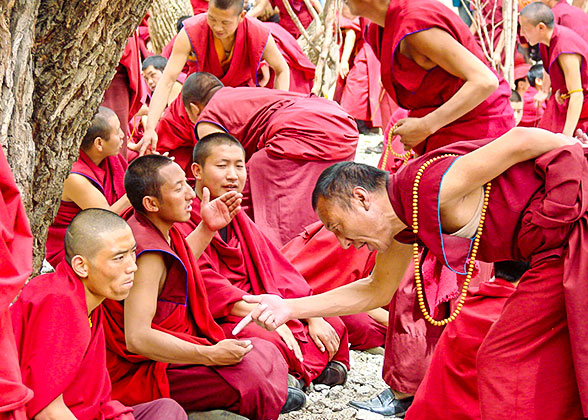
Leaving the park, continue your pilgrimage to Sera Monastery, known as the “Harvard” of Tibetan Buddhism, famous for its “monk debates.” Debating is how monks study scriptures and take examinations. Standing in the debate courtyard, you’ll be captivated by the monks’ dramatic gestures: some raise their right hand and clap it sharply with the left; others flick their prayer beads while rapid‑fire questions fill the air. Even if you don’t understand Tibetan, you can clearly feel the vitality of faith and the charm of intellectual inquiry.
At the end of the day, we’ll escort you back to your hotel.
Meals: Western buffet breakfast, lunch
Afterwards, let’s head to Norbulingka Park, a typical Tibetan garden. White walls, golden roofs, red curtains, and pillars painted with religious motifs stand in sharp contrast to the blue sky, earning it the nickname “Summer Palace of Tibet.”
Leaving the park, continue your pilgrimage to Sera Monastery, known as the “Harvard” of Tibetan Buddhism, famous for its “monk debates.” Debating is how monks study scriptures and take examinations. Standing in the debate courtyard, you’ll be captivated by the monks’ dramatic gestures: some raise their right hand and clap it sharply with the left; others flick their prayer beads while rapid‑fire questions fill the air. Even if you don’t understand Tibetan, you can clearly feel the vitality of faith and the charm of intellectual inquiry.
At the end of the day, we’ll escort you back to your hotel.
Meals: Western buffet breakfast, lunch
Drepung Monastery, Lhasa
Monks Debating at Sera Monastery
Day 8 Lhasa
Visit Potala Palace, Dragon King Pool Park, Jokhang Temple, and Barkhor Street, and enjoy a tea break at a sweet tea house. (B+L)
View More Videos
Potala Palace, Lhasa
► Tip: Out of respect, please observe Tibetan Buddhist taboos: no hats, no photography, and no overstaying inside the palace.
Next, let’s walk to Dragon King Pool Park at the foot of the rear mountain of the Potala Palace. Here, you can capture a perfect reflection of the palace in the water while enjoying the authentic local life - Tibetan people often dance in a circle to create a lively atmosphere.
After lunch, we’ll explore the Jokhang Temple, another important monastery in Lhasa. Since the 7th century, it has been the spiritual heart of Tibetan Buddhism. Inside, the life‑sized statue of Sakyamuni Buddha has witnessed the devout prostrations of countless Tibetan pilgrims for over 1,300 years. The Barkhor Street encircling the temple is Lhasa’s liveliest pilgrimage circuit. Every day, devout worshipers holding prayer wheels perform full‑body prostrations and circumambulate the street while chanting scriptures. Along both sides of the street are stalls filled with thangkas, Tibetan incense, silverware, and coral beads. You may also encounter Tibetan children holding little lambs. Shyly, they invite tourists to take photos with the lambs for a small fee to help with family expenses or to save up for their next semester’s books and supplies.
★ Special Treat: Sweet Tea Break
Conclude the day at a century-old Tibetan teahouse, sampling sweet tea and Tibetan noodles, while watching the locals sitting together and chatting. With the translation help of your guide, join in their lively discussions and immerse yourself in this laid-back lifestyle. Finally, your guide will escort you back to your hotel.Meals: Western buffet breakfast, lunch

Potala Palace, Landmark of Tibet

Jokhang Temple, Lhasa
Day 9 Lhasa to Shanghai by Flight
Fly to Shanghai and transfer to your hotel; relax during the rest of the day. (B)
This morning, your guide and driver will escort you to the airport for a 5‑hour flight to Shanghai, the most vibrant international metropolis in China. Upon arrival, your Shanghai guide will greet you at the airport and escort you to your hotel. For the rest of the day, take a good rest to recharge your energy.
Meals: Western buffet breakfast
Meals: Western buffet breakfast
Day 10 Shanghai
Visit Yu Garden and Shanghai Museum; stroll along the Bund and enjoy a Huangpu River cruise. (B)
After meeting your guide in your hotel lobby, we’ll head to Yu Garden, a 460‑year‑old classical garden hidden among Shanghai’s skyscrapers. Aside from admiring the pavilions, terraces, and other traditional structures, don’t miss the elaborately designed windows. For ancient Chinese, windows were not just sources of light but living picture frames. Strolling through the garden feels like viewing a flowing gallery of nature. You’ll see how the vegetation tints the transparent glass an emerald green, while a few hydrangeas are perfectly framed with the wooden lattice, forming a hanging Chinese painting. Upon exiting the garden, you’ll find the Yuyuan Bazaar. Here you can browse rows of souvenir shops and sample authentic Shanghai flavors at your own expense, for example, the pan-fried buns at Dahuchun and the unique palmier at Lv Bo Lang Restaurant.
After lunch, let’s continue to the Shanghai Museum. Unlike other museums that focus on national or local history, Shanghai Museum reads more like a chronicle of Chinese art. Across its galleries, you can admire bronzes, ceramics, jades, sculptures, and other treasures spanning more than 4,000 years. In the Money Gallery, you’ll learn about the full evolution of China’s currency, from shell money and bronze coins dating back to before 221 BC to paper money, silver, and contemporary electronic currency. Behind different forms of money lie the social and fiscal systems of their eras. Stepping into the Bronze Gallery, you’ll also see a Cowrie Container with Eight Yaks from over 2,200 years ago, whose exquisite appearance tells stories of ancient wealth and the aesthetics of its time.
After that, we’ll head to the Bund, known as the “Oriental Wall Street.” This 1.5‑km (1‑mile) waterfront records China’s journey from modern times to the present day. When British Prime Minister Keir Starmer strolled along the Bund, looking at the exotic buildings on the west bank and the financial district across the Huangpu River, he praised it as “an open history book.”
After disembarking, your guide and driver will escort you back to your hotel, or you may choose to linger at the Bund for its iconic night views and finally return on your own.
Meals: Western buffet breakfast

After lunch, let’s continue to the Shanghai Museum. Unlike other museums that focus on national or local history, Shanghai Museum reads more like a chronicle of Chinese art. Across its galleries, you can admire bronzes, ceramics, jades, sculptures, and other treasures spanning more than 4,000 years. In the Money Gallery, you’ll learn about the full evolution of China’s currency, from shell money and bronze coins dating back to before 221 BC to paper money, silver, and contemporary electronic currency. Behind different forms of money lie the social and fiscal systems of their eras. Stepping into the Bronze Gallery, you’ll also see a Cowrie Container with Eight Yaks from over 2,200 years ago, whose exquisite appearance tells stories of ancient wealth and the aesthetics of its time.
After that, we’ll head to the Bund, known as the “Oriental Wall Street.” This 1.5‑km (1‑mile) waterfront records China’s journey from modern times to the present day. When British Prime Minister Keir Starmer strolled along the Bund, looking at the exotic buildings on the west bank and the financial district across the Huangpu River, he praised it as “an open history book.”
★ Huangpu River Cruise: Two Shores, Two Worlds
At the end of the promenade, your guide will accompany you aboard a sightseeing boat for a journey on the Huangpu River. If the Hudson River is like an American cultural salon, where elegance whispers through historic buildings, then the Huangpu River is a vibrant eastern rising star, painting a magical modern canvas. From mid‑river, you can take in the 52 Western‑style buildings on one side and the glass‑curtain skyscrapers piercing the clouds on the other. These two contrasting landscapes mirror two types of Shanghai people. Old Shanghainese speak pure dialect, uphold traditions, and lead a slow, unhurried life, as old‑fashioned as the western buildings. The new Shanghainese, coming from all over China, are energetic and ambitious, racing through a fast‑paced modern life, just like the glittering skyscrapers on the east bank.After disembarking, your guide and driver will escort you back to your hotel, or you may choose to linger at the Bund for its iconic night views and finally return on your own.
Meals: Western buffet breakfast
Yu Garden, Shanghai
Shanghai Pudong Area Seen from the Bund
Day 11 Departure from Shanghai
Please check out before 12:00. We provide a private airport transfer for our private tour guests, while group tour guests need to arrange your own transportation to the airport. Wish you a pleasant journey home! (B)
Today, bid farewell to China. For private tour guests, your guide and driver will pick you up at your hotel and provide a seamless transfer to the airport. For group guests, please head to the airport on your own. Since there are two airports in Shanghai - Pudong Airport (PVG) and Hongqiao Airport (SHA) - please confirm your departure airport to avoid missing the flight. We wish you a smooth journey home!
► Transport Reference:
1. To Pudong Airport (PVG): If you have large luggage, taxi is recommended. The trip takes about 1 hour and costs USD 30. You can ask your hotel front desk to hail a taxi or use the DiDi ride‑hailing app. Taking metro costs only USD 1 and takes about 1.5 hours, and requires several transfers: walk 8 minutes from your hotel to the International Cruise Terminal Station, take Line 12 to Dalian Road, transfer to the inner loop of Line 4, and then transfer at Century Avenue to Line 2 to the airport.
2. To Hongqiao Airport (SHA): A taxi takes 40-60 minutes and costs USD 15. By metro, the journey takes 1 hour but costs only 70 US cents: from the International Cruise Terminal Station, take Line 12 to Tiantong Road, transfer to Line 10, and then get off at the airport.
Meals: Western buffet breakfast
B - Breakfast L - Lunch D - Dinner
Expand All
Collapse All
Christmas, 2027 & 2028 Specials: 12% off - Book before Dec 31, 2026
| Prices with 4 Stars Hotels | Prices with 5 Stars Hotels | ||
|---|---|---|---|
| 2-3 travelers | 4-5 travelers | 2-3 travelers | 4-5 travelers |
USD3339
USD2938
|
USD2879
USD2533
|
USD3789
USD3334
|
USD3299
USD2903
|
| Prices with 4 Stars Hotels | |
|---|---|
| 2-3 travelers | 4-5 travelers |
USD3339
USD2938
|
USD2879
USD2533
|
| Prices with 5 Stars Hotels | |
|---|---|
| 2-3 travelers | 4-5 travelers |
USD3789
USD3334
|
USD3299
USD2903
|
- Prices are per person based on twin sharing.
- A more favorable price is available for a party of 6+ people.Currency Converter
Destinations
4 Stars Hotels
5 Stars Hotels
Beijing
Mercure Beijing City Centre
Sofitel Hotel Beijing
Xian
Four Points By Sheraton Xi'an Bell Tower
Wyndham Grand Xian South
Lhasa
Thangka Hotel
Shangri-La Hotel Lhasa
Shanghai
Sunrise On The Bund
Radisson Blu Hotel Shanghai New World
Beijing
Mercure Beijing City Centre
Xian
Four Points By Sheraton Xi'an Bell Tower
Lhasa
Thangka Hotel
Shanghai
Sunrise On The Bund
Beijing
Sofitel Hotel Beijing
Xian
Wyndham Grand Xian South
Lhasa
Shangri-La Hotel Lhasa
Shanghai
Radisson Blu Hotel Shanghai New World
Similar Tour Options
11 Days Beijing - Xi'an - Zhangjiajie - Shanghai
View Details
From
USD2419
USD2128
11 Days Beijing - Xi'an - Guilin - Yangshuo - Guilin - Shanghai
View Details
From
USD1879
USD1653
14 Days Beijing - Xi'an - Guilin - Yangshuo - Guilin - Zhangjiajie - Shanghai
View Details
From
USD2959
USD2603
Similar Tour Options
11 Days Beijing - Xi'an - Zhangjiajie - Shanghai View Details
From
USD2419
USD2128
11 Days Beijing - Xi'an - Guilin - Yangshuo - Guilin - Shanghai View Details
From
USD1879
USD1653
14 Days Beijing - Xi'an - Guilin - Yangshuo - Guilin - Zhangjiajie - Shanghai View Details
From
USD2959
USD2603
Price Includes
- Domestic airfares & train fares
- Hotel accommodation with breakfasts
- Meals arranged as itinerary specifies
- Professional English-speaking guides
- Drivers & air-conditioned vehicles
- Entrance fees to tourist sites
- Tibet Travel Permit
Price Excludes
- International airfares
- China visa fee if applicable
