Shanghai Maglev Train (SMT)
SMT Facts:
Total Length: 30 kilometers (19 miles)
Highest Speed: 300km/h (168.4 mi/h)
Duration per Single Journey: 8 minutes
Frequency: 15-40 minutes
Route: Longyang Rd. – Pudong International Airport (PVG)
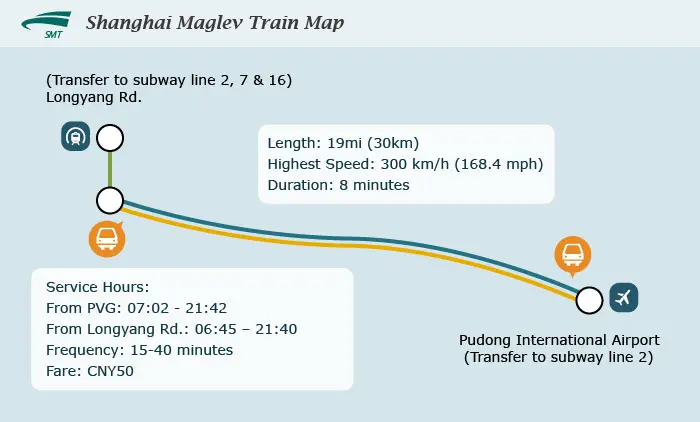 |
| Shanghai Maglev Train Map |
Shanghai maglev train is suggested if you are just arriving at Pudong International Airport of the city. You will be impressed by the amazingly fast speed of the train and have an exciting first experience in the city.
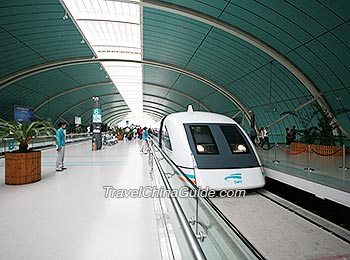
Build with the technological help from Germany, SMT has been operated since the end of 2002. It is the world's first and only commercialized maglev train line in operation. It runs from Pudong International Airport to Longyang Rd. Station located at the intersection of Longyang Road and Baiyang Road in Pudong New Area.
 Hotline: 021-64370000
The following is a guide to facilitate your trip on SMT, including introduction to Maglev Train stations, speed, schedule, ticket, transfer and some useful tips.
 |
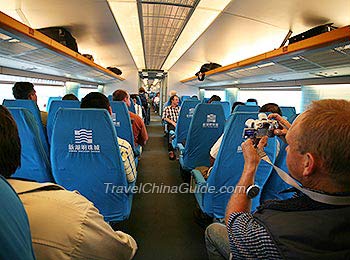 |
| Comfortable Carriage of Maglev |
Train Stations
Surroundings: New International Exhibition Center (SNIEC), Century Park, Longyang Road, Baiyang Road
2. Pudong International Airport Station
Surroundings: Pudong International Airport, Lingkong Agriculture Garden, Les Charmes Outlet Boutiques, Yingbin Avenue
Service Hours
Timetable| Station | First Train | Last Train | ||
|---|---|---|---|---|
| To Pudong International Airport | To Longyang Rd. | To Pudong International Airport | To Longyang Rd. | |
| Longyang Rd. | 06:45 | — | 21:40 | — |
| Pudong International Airport | — | 07:02 | — | 21:42 |
Interval
| Period of Time | Interval | |
|---|---|---|
| Longyang Rd. Station | Pudong International Airport Station | |
| 06:45 | — | 15 min. |
| 07:00 - 21:00 | 07:02 - 21:02 | 30 min. |
| 21:00 | 21:02 | 40 min. |
 Tips:
Tips:1. The ticket has date printed on it. Please be sure to get to the ticket examiner in the stations at least five minutes before the departure time of the train you plan to take on the day.
2. If you are curious about the train, you can go to Shanghai Maglev Transportation Science and Technology Museum at the bottom of Longyang Rd. Station in Pudong New Area. The museum opened in the summer of 2007 is built to exhibit the history, actuality and future of the SMT technology as well as the advantages of the train.
Further Reading: 8 Unique Things to Do in Shanghai Only
Bus / Metro Search
Select a City:
- Last updated on Aug. 14, 2025 by Demi Li -