For travelers, flights and the Qinghai-Tibet Railway remain the two primary gateways into Tibet. Flights arrive at Lhasa Gonggar International Airport (LXA), the largest and busiest airport in Tibet, with daily services from Beijing, Chengdu, Chongqing, Xi'an, Guangzhou and Shanghai, plus weekly international flights from Kathmandu of Nepal. The Qinghai-Tibet Railway terminates at Lhasa Railway Station. Within Tibet, rail lines currently extend only from Lhasa to Shigatse and Nyingchi. But a road network supports movement across Tibet, even to remote sites.
How to Get to Tibet
By Plane - Most Efficient Way
Direct flights to Lhasa from major Chinese cities take 2.5 to 6 hours. Even from cities without direct service, same-day arrival on the “roof of the world” is easily achievable via connecting flights through hubs like Chengdu or Xi'an.
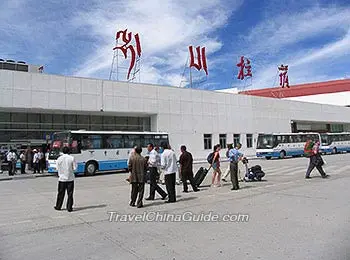 | | Lhasa Gonggar Airport | | 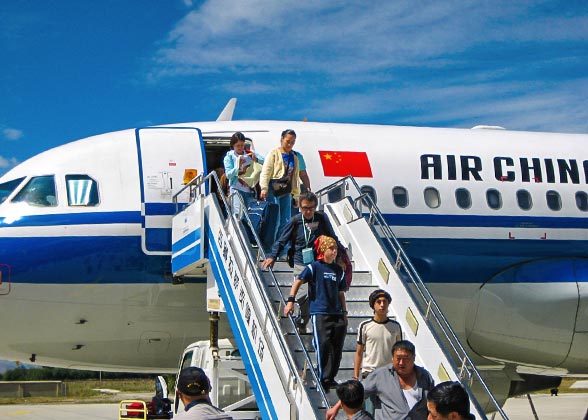 | | Passengers at Gonggar Airport | |
Lhasa Gonggar Airport (LXA) is located in Gonggar County, approximately 60 km (37 miles) south of downtown Lhasa. The drive to the city center takes about 1 hour via the airport expressway.
| From | Frequency | Flight Time |
| Chengdu Shuangliu | 17 flights/day | 2h15m |
| Chengdu Tianfu | 25 flights/day | 2h15m |
| Xining Caojiabao | 15 flights/day | 2h20m – 2h30m |
| Chongqing Jiangbei | 14 flights/day | 2h30m |
| Xi'an Xianyang | 9 flights/day | 3h15m – 3h40m |
| Kunming Changshui | 5–6 flights/day | 2h20m – 2h30m |
| Beijing Capital | 3-4 flights/day | 4h15m – 4h30m |
| Guangzhou Baiyun | 3–4 flights/day | 5h 50m |
| Shanghai Pudong | 1 direct flight/day | 4h30m |
| Shanghai Hongqiao | 1 daily with a stopover in Chengdu | 6h35m |
| Shenzhen Bao'an | 1 daily with Mianyang stopover | 4h – 5h |
| Kathmandu Tribhuvan, Nepal | 4 flights/week | 1h20m – 1h35m |
Air travel is the most time-efficient way to the plateau, catering to travelers on tight schedules. Flights also deliver a unique aerial angle. The Qinghai–Tibet Plateau unfolds beneath the wing, with panoramic views of endless snow-capped mountain ranges, something land routes cannot offer.
Despite its efficiency, flying has trade-offs. Ticket prices fluctuate sharply in peak season, pushing up overall cost, especially when your trip falls during July-August and the National Day Holiday in the first seven days of October. Additionally, Lhasa Gonggar Airport, one of the highest airports in the world, sits at 3,570 m (11,713 ft) above sea level. The rapid ascent from low altitude to over 3,500 meters in just a few hours makes altitude sickness more likely compared to the gradual climb offered by train travel.
By Train - Slow Unfolding of the Plateau & Gentler Altitude Adaptation
Train travel is very time-consuming but much cheaper than flight, catering to railway enthusiasts and budget travelers with sufficient time. During Tibet's peak travel season from April to October, train tickets to Lhasa are in very high demand and often sold out weeks in advance; booking early is strongly advised.
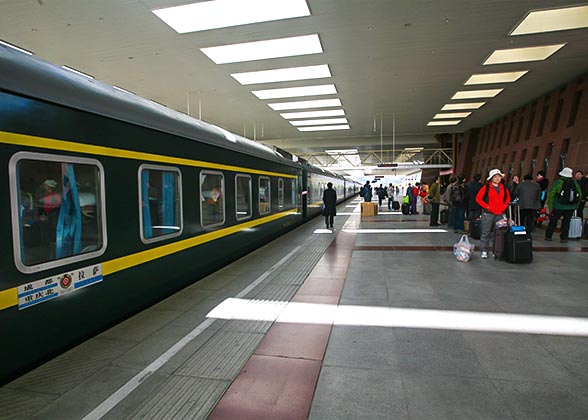 | | Train from Chengdu to Lhasa | | 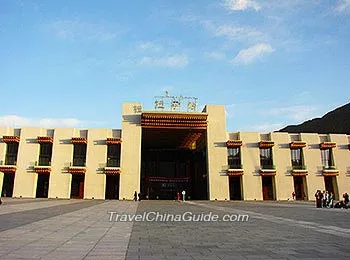 | | Lhasa Railway Station | |
Lhasa Railway Station is located right within the city proper, on the south bank of the Lhasa River, about 8 km (5 mi) from the Potala Palace.
| From | Departure Time | Journey Time |
| Xining | 5–10 trains daily at 20:50 / 22:00 / 12:50 etc. | 20h–22h30m |
| Xi'an | 2 trains daily at 07:53 / 09:27 | 30h9m–31h |
| Beijing West | 1 train daily at 19:48 | 39h58m |
| Shanghai | 1 train daily at 18:33 | 45h3m |
| Guangzhou | 1 train daily at 09:26 | 53h27m |
| Chengdu | 1 train every other day at 20:46 | 34h38m |
The Qinghai–Tibet Railway, the only railway linking Tibet with mainland China, remains the most scenic approach onto the plateau. As you travel, the journey unfolds like a moving postcard: you'll cross the vast, hauntingly beautiful Hoh Xil land, glide past the turquoise waters of Cuona Lake, and traverse the majestic Tanggula mountain range. Wild Tibetan antelopes and yaks often wander right alongside the tracks.
See more: Scenes Along the Tibet Railway
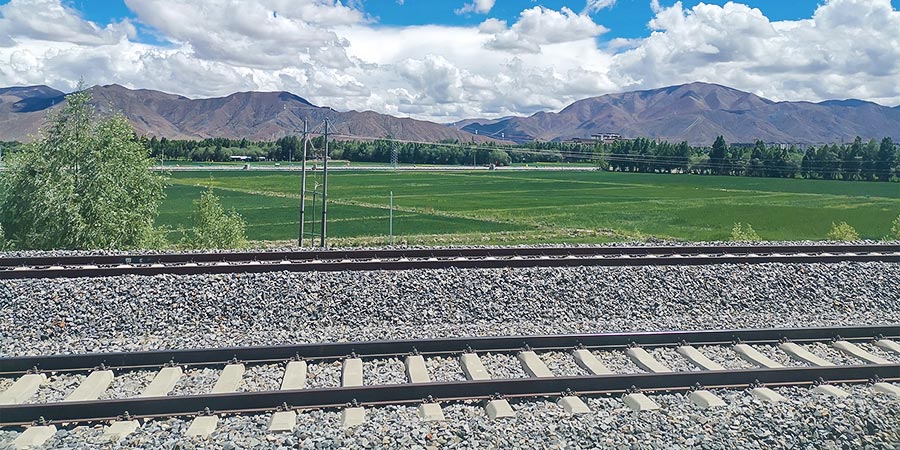 |
| The Scene Along Qinghai-Tibet Railway |
The conventional trains, at a maximum speed of 160 km/h (100 mph) and an average speed of around 95 km/h (59 mph), take approximately 20–22 hours to run from Xining at about 2,270 m (7,448 ft) to Lhasa at 3,650 m (11,975 ft). This gradual ascent gives your body time to adjust to the thinning air step by step, which helps minimize altitude sickness compared to flying. However, this doesn’t mean you will definitely not suffer from mountain sickness. On the way, the train climbs over Tanggula Pass as high as 5,072 m (16,640 ft) above the sea level. Also combined with long hours of travel, potential sleep disruption, and physical fatigue, some passengers still experience discomfort.
See more: Mountain Sickness in Tibet
 Tip - Prepare Tibet Travel Permit before Traveling
Foreign and Taiwan travelers can't enter Tibet independently. You must join a qualified agency's tour, and that agency should apply for Tibet Travel Permit on your behalf. Since Mar 2026, both flight and train check-in require the original permit.
See more: Tibet Travel Permit
By Road – Possible, but Not Recommended for Foreign Travelers
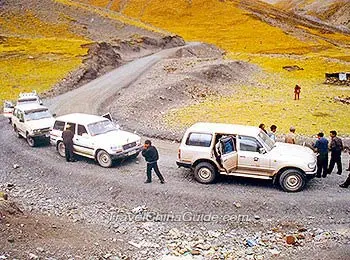 |
| Jeeps on the Rugged Road to Tibet |
First, independent entry by road is not permitted. Foreign travelers must enter as part of a licensed agency's organized tour with a guide and vehicle arranged. Second, the journey demands significant time, typically five to twelve days of riding, very exhausting, and you need tolerance for unpredictable road conditions, including landslides, washouts, gravel sections, sudden snow, and occasional military convoy delays.
The main roads reaching Tibet are listed for reference:
 G318 Sichuan–Tibet South Route: Chengdu → Lhasa, 2,140 km (1,330 mi); the most scenic and popular, typically 8–12 days by car.
G317 Sichuan–Tibet North Route: Chengdu → Lhasa, 2,300 km (1,429 mi); more rugged, fewer supply points, mixed paved and unpaved sections, typically 8–12+ days.
G109 Qinghai–Tibet Highway: Xining → Lhasa, 1,950 km (1,212 mi); the highest route, averaging above 4,000 m (13,123 ft) with the Tanggula Pass at 5,231 m (17,162 ft), typically 5–7 days.
G214 Yunnan–Tibet Route: Kunming/ Dali → Mangkang → joins G318; merges with the south route toward Lhasa, typically 6–8 days from Dali.
How to Get Around Tibet
Trains from Lhasa to Other Tibetan Cities
Lhasa Railway Station is the hub of the Qinghai–Tibet, Lhasa–Nyingchi and Lhasa–Shigatse railways. Modern intercity trains connect Lhasa with:
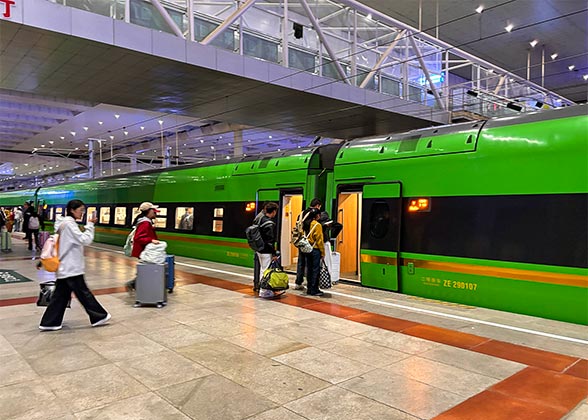 | | Tibetan Train Linking Lhasa to Shigatse | | 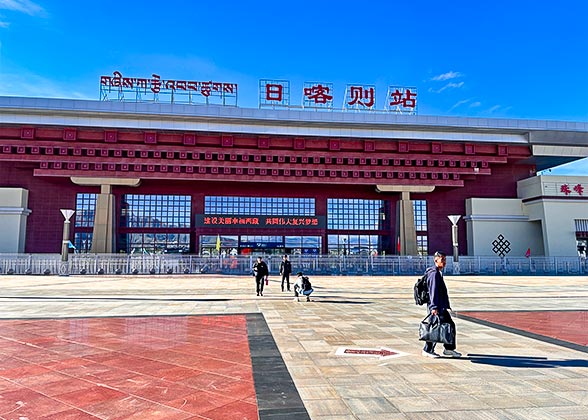 | | Shigatse Railway Station, Tibet | |
Shigatse — Multiple departures daily from 08:40 to 18:57, with a journey time of about 2 to 2.5 hours. A second-class seat costs CNY 64, first-class CNY 103, and business class CNY 225.
Nyingchi — 2 or 3 trains depart daily from 08:10 to 16:25, with a trip time of nearly 4 hours. Fares are CNY 129 for second class seat, CNY 206 for first class, and CNY 452 for business class.
Shannan — Located about 1 hour from Lhasa, Shannan is served as an intermediate stop on trains bound for Shigatse and Nyingchi, with around 2 departures daily from 08:10 to 16:25. A second-class seat costs approximately CNY 32.
Road Transport in Tibet
Roads are the most commonly used means of transport between different parts of Tibet. Even remote scenic areas are connected by road networks. As of now, the total length of highways in Tibet has reached 125,200 kilometers (77,800 miles). Distances and travel times from Lhasa to major cities and scenic spots are as follows:
| Destination | Distance from Lhasa | One-Way Driving Time |
| Namtso | 240 km (150 mi) | 4–5 hours |
| Yamdrok Lake | 90 km (55 mi) | 1.5 hours |
| Mt. Everest Base Camp | 550km (340 mi) | 8.5 hours |
| Shigatse | 360 km (225 mi) | 5–6 hours |
| Gyantse | 250 km (155 mi) | 4 hours |
| Nyingchi | 480 km (300 mi) | 6–7 hours |
| Shannan | 150 km (90 mi) | 2–2.5 hours |
| Pumoyangtso | 260 km (160 mi) | 5.5 hours |
Local Transport in Tibet's Major Cities
Major cities in Tibet, such as Lhasa, now have internal transport systems much like those in Beijing or other large Chinese cities, except that there is no metro. The roads here are flat and wide, bustling with traffic.
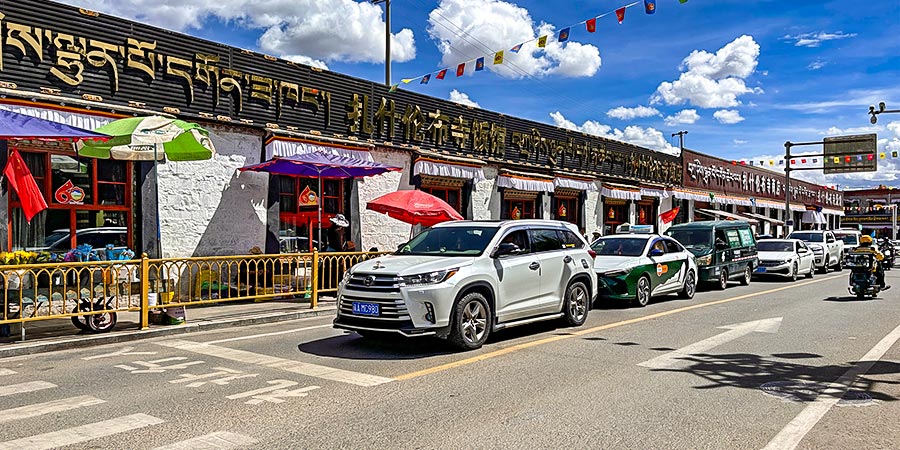 |
| Local Road in Tibet |
- Last updated on Jul. 31, 2026 by Jally Zhang -