Pavilion of Treasure Clouds (Baoyunge)
In the west of the Tower of Buddhist Incense on Longevity Hill of the Summer Palace, you’ll see the Pavilion of Treasure Clouds, a building used for Buddhist rituals in Qing Dynasty (1644~1911).
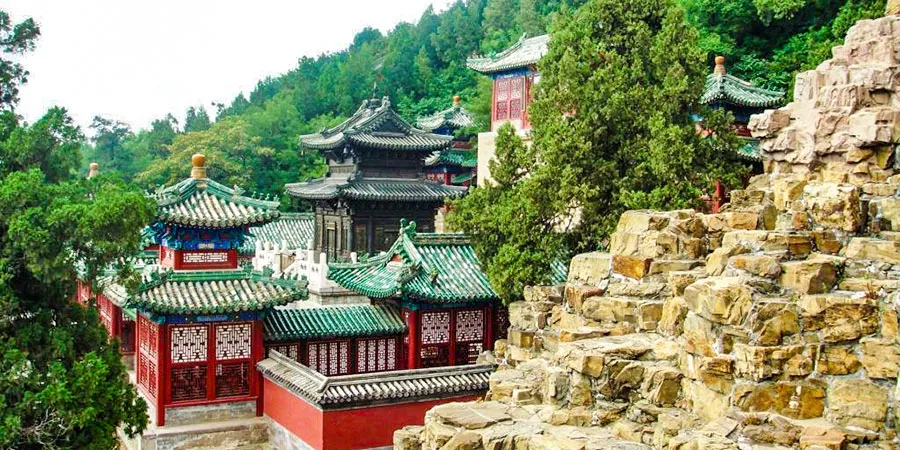 |
| Pavilion of Treasure Clouds |
Architectural Highlights of Treasure Clouds Pavilion
Standing on a white marble base, this square double-layered structure is nicknamed "Bronze Pavilion" for a good reason. Though every element—from its grey-green pillars, beams, and bracket sets to the roof tiles, wind bells, ridge ornaments, windows, doors, and even lintels—appears to be wood, all 207 tons of material are actually bronze. Few dragon motifs symbolizing imperial authority adorn the structure. The most striking is the nine dragons carved in swirling clouds along the frame of the first-floor plaque. Even every front surface of its roof tiles feature exquisite reliefs of dragons chasing pearls. Beyond dragons, the pavilion brims with auspicious decorations. Peonies and lotus blossoms adorn the lower walls, symbolizing wealth and harmony, while a treasure vase crowns the rooftop, promising eternal prosperity.
The reason why the bulky bronze could be transformed into pieces as intricate as the wooden ones is the application of the "lost-wax casting", one of the three greatest casting methods in ancient China that came into existence in the Spring and Autumn Period (770~476BC). During the casting process, artisans cast all the components of the pavilion separately, big and small, and then integrated them. It is such a costly method that even the bronze cuttings accumulated to polish the surface amounted to 2,500kg (5,511 pounds) as documented.
How to View Treasure Clouds Pavilion Today
The Pavilion is currently not accessible for interior visits or close-up viewing, but it can still be admired from a distance at the following three vantage points.
From Tower of Buddhist Incense West Corridor
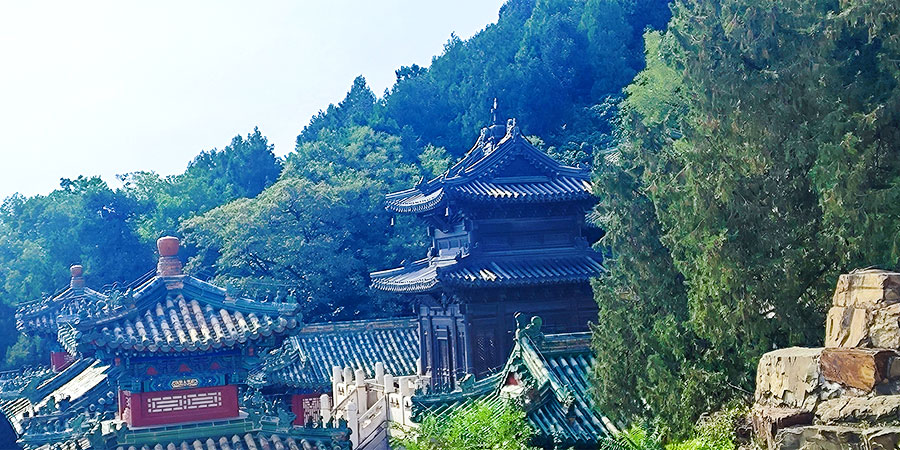 |
| See Bronze Pavilion From West Corridor |
Stand by the wooden window grilles on the west side of the circular corridor. Look down through the windows to see the pavilion standing among cypress trees on a white marble platform.
From the Steps Below Tower of Buddhist Incense
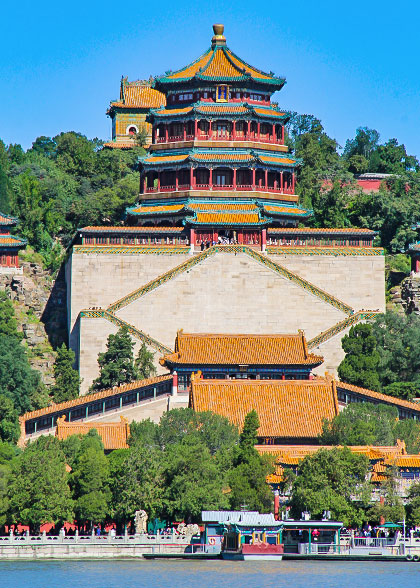 |
| Inverted V Steps, Buddhist Incense Tower |
Below the tower, two flights of stone steps spread outward in an inverted V shape. From the west-side steps, look westward to see the Pavilion against the green slopes of Longevity Hill, overlooking Kunming Lake.
Closer (Yet Still Distant) View via Yunsongchao
Enter the Summer Palace, walk along the Long Corridor to Gate of Dispelling Clouds, then head west about 150 meters to Autumn Water Pavilion, the third pavilion counted from west to east. From its north side, take the uphill path until you see stone steps leading to Yunsongchao (Cloud-Pine Retreat). Follow the steps upward to find a clear, yet still somewhat distant, vantage point of the pavilion.
Note:
 Access toTower of Buddhist Incense requires a separate ticket (CNY10) or a combination ticket (CNY50–60). All routes offer distant views only and involve uphill walking, so wear comfortable shoes.
When & Why Built – History of Treasure Clouds Pavilion
The Pavilion of Treasure Clouds was built in 1755. Upon its completion, it became an exclusive venue to conduct Buddhist rituals. It originally housed numerous bronze Buddha statues and ritual objects. On the 1st and 15th of each lunar month, Tibetan Buddhist lamas would chant sutras here, offering prayers for the imperial household. Now behind the pavilion, you can still find a trace of the ritual, where a rectangular niche carved into a stone wall, once served as the hanging place for thangka scrolls during ceremonies.
In the 1860 fire in the Summer Palace, this pavilion remained intact due to its bronze material. Nevertheless, the furnishings inside the pavilion were all destroyed, leaving a bronze table alone.
Mystery of 10 Stolen Windows
The Pavilion of Treasure Clouds holds one of the Summer Palace's unsolved mysteries. In October 1908, during a routine inspection, palace eunuchs discovered that ten massive bronze window frames weighing a total of 1,000 kilograms (2,205 pounds) had mysteriously disappeared from the structure.
What makes this theft particularly astonishing is the incredible difficulty of removing such heavy artifacts. The pavilion stands on Longevity Hill, accessible only by steep and narrow mountain paths that would have made transporting the windows extremely challenging. What’s more, records show these bronze treasures later appeared overseas, having somehow completed an improbable journey across the seas.
The question of how and by whom the bronze windows were moved out has sparked widespread speculation. Some suspect collusion between royals or court officials and antique dealers, while others attribute the theft to foreign troops during wartime. Yet with no evident theft signs or eyewitness accounts, the case remains unsolved.
In 1970s, the lost bronze windows were found. A wealthy American businessman purchased and donated them to the Summer Palace. On December 2, 1993, the windows were finally returned and assembled to the Pavilion of Treasure Clouds.
Other Returned Components
The Pavilion of Treasure Clouds was once adorned with 12 bronze doors, 20 windows, and 70 grilles. In the early 20th century, 10 windows and 31 grilles went missing. After 10 windows were returned in 1993 a retired French art appraiser, donated one missing grille to the Summer Palace two years later. On January 10, 2024, three Chinese collectors presented another overseas-found grille to this Bronze Pavilion.
 Next: Through the Wonderland
 Further Reading: Summer Palace Travel Tips
Recommended Tours

- Last updated on Jun. 18, 2026 by Jally Zhang -