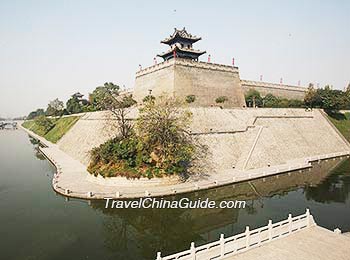
Xi'an City Wall, also known as the Fortifications of Xi'an, is the most complete city wall that has survived in China, as well being one of the largest ancient military defensive systems in the world. As a landmark of Xi’an, the City Wall is in an appropriately rectangular shape from an aerial view, with quaint and modern scenery on its both sides, and also surrounds the city center.
Xi’an City Wall Facts
How Long is the City Wall of Xi’an: 13.74 kilometers (8.5 miles) When Was the Xi'an City Wall Built: 1370-1378 Number of Gates: 18, with 4 main ones in cardinal directions Ways of Visit: Walking Tour, Cycling Tour Further reading: 8 Amazing Facts about Xi’an City Wall
The construction of Xi’an City Wall we see today was inspired by a hermit, who had admonished Zhu Yuanzhang before he became the first emperor of China’s Ming Dynasty (1368-1644), that he should “build high walls, store abundant food supplies, and take time to be an Emperor”. After the establishment of the Ming dynasty, the emperor followed his advice and began to enlarge the imperial city wall of Sui (581-618) and Tang (618-907) Dynasties, and thus today's scale of Xi'an City Wall is formed.
How Was the Xi’an City Wall Built?
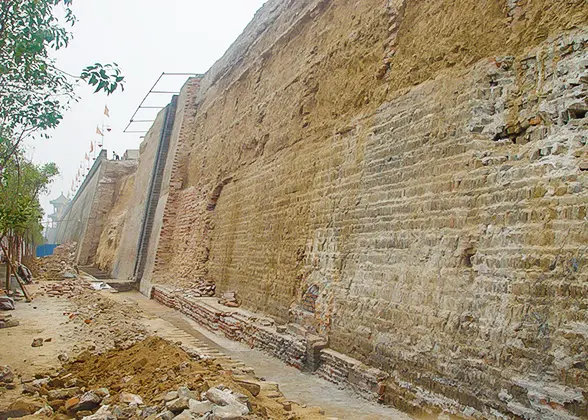
Initially, the wall was built with layers of dirt, with the base layer including also lime and glutinous rice extract. Throughout the time the wall has been restored three times. In 1568, Zhang Zhi, the government officer of that period, was in charge to rebuild the wall with bricks. In 1781, another officer, Bi Yuan, refitted the wall and the gate towers. More recently since 1983, the Shaanxi Provincial Government restored the wall again. The peripheral City Wall Park has been built along the high wall and the deep moat. The thriving trees and flowers decorate the classical Chinese architecture of the wall, adding natural beauty to the city of Xi'an.
After the expansion, the wall stands 12 meters (40 feet) tall, 12-14 meters (13-15 yards) wide at the top and 15-18 meters (16-20 yards) thick at the bottom. This design makes the City Wall a solid fortification in the ancient times to protect people living in the city and also resist attacks by enemies.
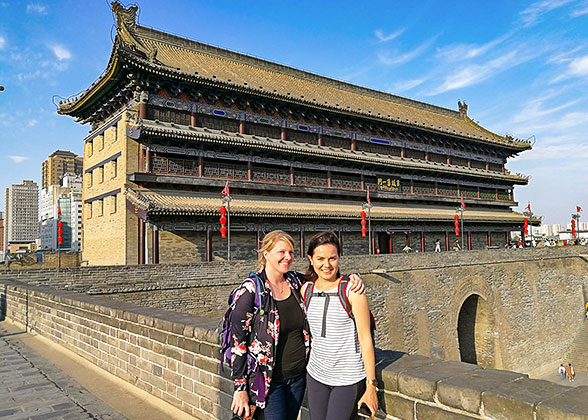
In addition to great thickness and length, the complete defensive system of City Wall makes it even stronger. The first defensive line is a wide and deep moat at its outermost part, above which is the only passage to the city - a drawbridge. The drawbridge tower behind with windows controls the rising and lowering of the drawbridge and enables soldiers to look out for any danger and counterattack the enemy in time. The arrow tower with totally 66 windows in the front and flanks allows soldiers to make all-out attacks. The main tower behind the arrow tower is the command center in a war. The area between the arrow tower and the main tower is a barbican, for trapping enemies and attacking them form a higher position.
Every 120 meters, there is a rampart which extends out from the city wall. Altogether, there are 98 ramparts, which are built to defend against the enemy climbing up. On each rampart is a watchtower, in which the soldiers can protect the city without exposing themselves to the enemy. On the outer side of the wall, there are 5,984 crenellations, namely battlements, through which the soldiers can outlook and shoot at the enemy. On the inner side, parapets are built to protect the soldiers from falling off.
Illuminated Fortifications of Xi'an at Night
Four Main City Gates
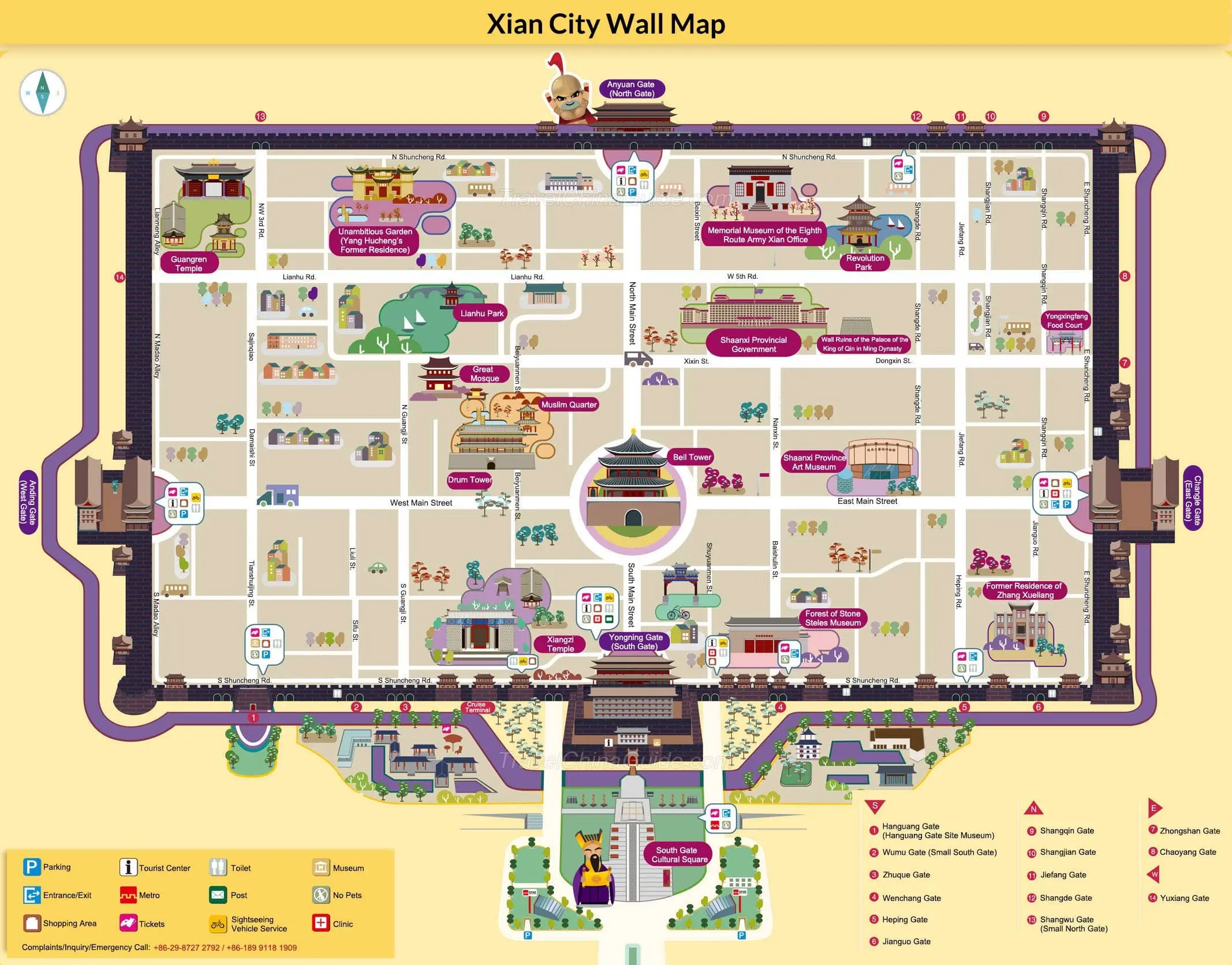
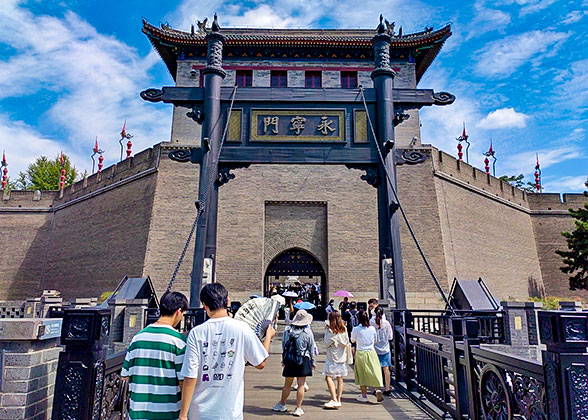
Since the ancient weapons don’t have the power to break through the City Wall, the only way for enemies to enter the city is to attack the gate of the city wall. This is why 4 complicated and sturdy gate structures are built within the wall, and they are respectively named as: Changle, meaning eternal joy, in the east; Anding, stability, in the west; Yongning, lasting peace, in the south; and Anyuan, stability of distant areas, in the north. Among them, the South Gate has become the main entrance for tourists ascending the wall.
The reason why the South Gate is the most recommended is that it’s the only gate with the most complete defensive buildings including the moat and drawbridge in the outermost and the barbican and main tower in the innermost. With a good location near the Bell Tower, centrally located landmark of Xi’an, the South Gate is convenient to reach either by metro or by bus. What’s more, wonderful performances are hosted in the South Gate region. Video of the Warrior Formation Performance at South Gate
South Gate of Xi'an City Wall
Performance in Barbican of Yongning Gate
The Moat around the Xi'an City Wall
The moat is an artificial waterway that encircles the Xi’an City Wall, stretching a total length of 14.6 kilometers (9 miles). First dug in the late Tang Dynasty as a 9-meter-wide (10-yard) and 4-meter-deep (13-foot) trench, it served as the first line of defense against invading forces. It was not until the Ming Dynasty that the moat was expanded and filled with water, resulting in the scale we see today.
In the 1950s, urban construction projects led to a section of the moat being buried underground, and the water in the remaining waterway also suffered from severe pollution - a genuine pity for this historic site. Fortunately, starting in the early 21st century, concerted efforts have been made to restore the moat. Contamination control and ecological improvement initiatives have been rolled out progressively. To date, the last underground segment of the moat has been completely reconnected, bringing back the picturesque view of clear water embracing the ancient city.
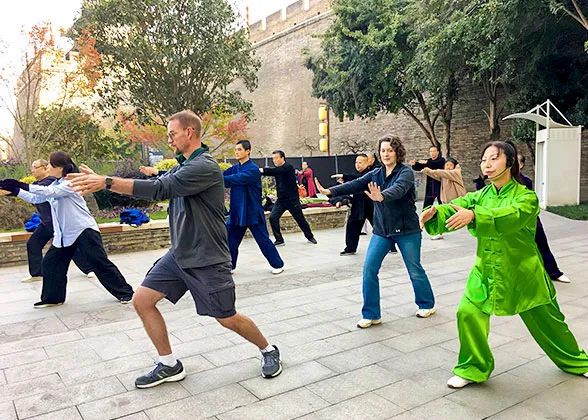
Nowadays, the area surrounding the moat has evolved into a beloved leisure destination for Xi’an locals. Here, one can spot residents indulging in various pastimes: walking their pet birds, taking leisurely strolls, or practicing Tai Chi. What’s more, boat cruises on the moat offer visitors a unique vantage point to admire the grandeur of the Xi’an City Wall. When night falls, the moat and the ancient walls, bathed in soft illumination, complement each other perfectly, creating a truly enchanting scene.
Play Tai Chi in Xi'an City Wall Park
Night Scene of Xi'an City Wall Moat
Why is the Xi'an City Wall So Well-Preserved?
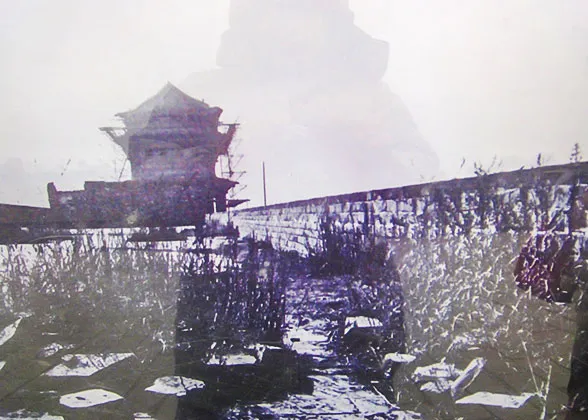
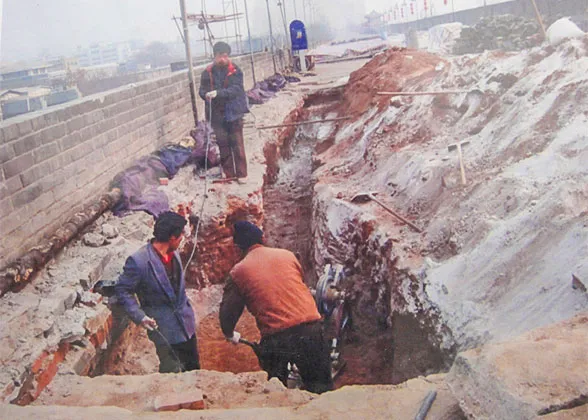
From 1958 onward, the start of preparedness for war prompted the construction of numerous air-raid shelters within the city wall, inflicting severe damage upon it. In the subsequent two decades, faced with a housing shortage, local residents dismantled bricks from the city wall to build makeshift houses on either side. This led to a squalid and disorderly environment, with garbage accumulating in the moat. As a consequence, the city wall was on the verge of disappearing.
By 1984, the Xi'an City Wall had become an impediment to urban traffic and marred the city's appearance, prompting many people to propose its demolition. This echoed similar fates of city walls in Beijing, Chengdu, Jinan, and other cities in China, which were successively torn down.
However, Zhang Tiemin, then mayor of Xi'an, recognized the irreplaceable value of the city wall. He emphasized that while demolishing it would be a straightforward task, reconstruction would be an arduous, near-impossible feat. Driven by a strong commitment to cultural heritage preservation, Mayor Zhang spearheaded a city-wide restoration effort.
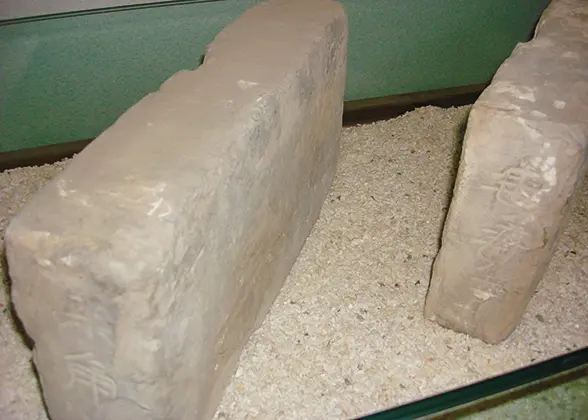
The project faced significant financial constraints, as the restoration required substantial funding. To overcome this hurdle, the mayor called on citizens and students to volunteer for the reinforcement work. Meanwhile, he encouraged local brick factories around Xi'an to produce specialized bricks for the restoration. The factories responded eagerly, and each fired brick was inscribed with the production date and the factory's name as a lasting tribute to those who contributed to the city wall's revival. These inscribed bricks remain an integral part of the structure today.
Thanks to these collective efforts, the City Wall has been preserved and now stands as a magnificent testament to Xi'an's rich history, continuing to awe visitors with its grandeur.
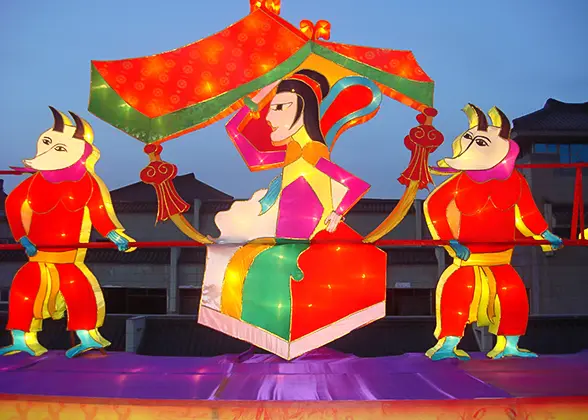
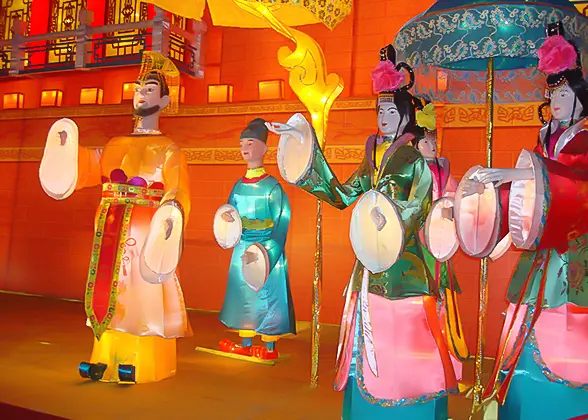
Around the Chinese New Year Holiday each year, the grand Xi’an City Wall Lantern Festival is held to welcome the new year and present colorful lanterns in various styles. The festival 2026 lasts from January 1 to March 22, and will show you large-sized soaring-dragon-shaped lanterns and multiple lanterns based on the Horse, Chinese Zodiac Animal this year. During the festival, wonderful music and dance performances will also be given.
To view as much as impressive military buildings and city views in and around City Wall, the most suggested way is to rent a bicycle from one of nine rental spots on the City Wall. It takes about 2 to 3 hours to finish the cycling, and it would be an unparalleled travel experience to cycle on such an ancient and majestic architecture.
Cycle on Xi'an City Wall
Ride a Tandem on the Wall
Further Information about Xi’an City Wall Bike Ride:
Bicycle Types
Single-person Bicycle
Tandem Bicycle
Deposit
CNY 100 each
CNY 100 each
Rental Fee
CNY 45 for 3 hours, and each additional 10 minutes costs CNY 5.
CNY 90 for 3 hours, and each additional 10 minutes costs CNY 10.
Service Time of Rental Spots
8:00-21:00 for renting and returning, and 21:00-22:00 for only returning. For specific locations of rental spots, see Cycling on Xi’an City Wall.
2. Take a Walking Tour
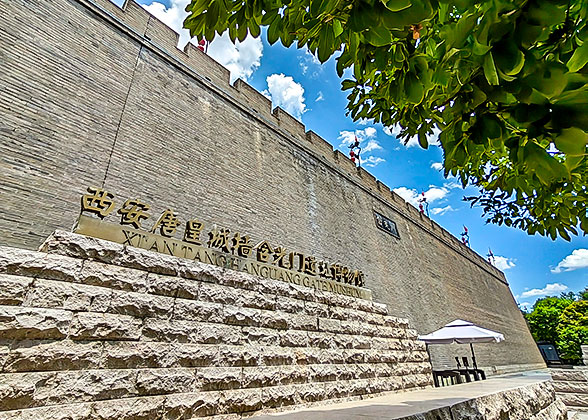
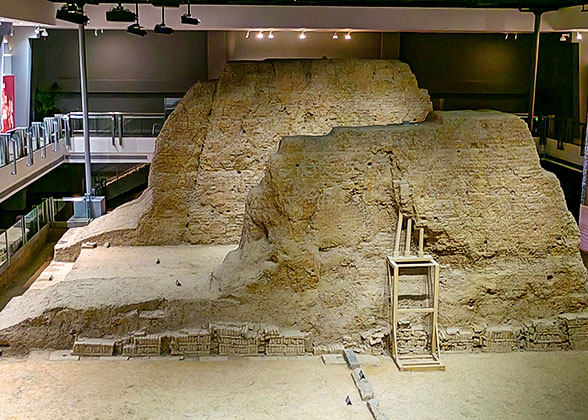
If you want to take your time to enjoy the attractive views, you can choose to wander around the City Wall. After admiring buildings of South Gate, some people choose to walk westward for about 25 minutes to visit Hanguang Gate Relic Museum, displaying relics of city wall section and also the ancient Hanguang Gate passages in the city wall body, while some walk eastward and northward for about 1 hour, and then descend the City Wall from Zhongshan Gate to taste Xi’an delicacies in the Yongxingfang Block. Here is a hiking itinerary around the wall starting from the South Gate for your reference.
Hanguang Gate Relic Museum
Relics of Hanguang Gate Passages
Xi’an City Wall Entrance Fee & Opening Hours
Entrance Fee
CNY 54 for per adult. CNY 27 for a person aged between 7 and 18. Free for a child aged under 7 and the elderly aged 65 and above.
Opening Hours
08:00-22:00. Between 22:00 and 08:00, one can only exit the City Wall attraction through the following gates: (1) North Entrance to South Gate (2) North Gate (3) West Gate (4) East Gate (5) Small East Gate / Zhongshan Gate
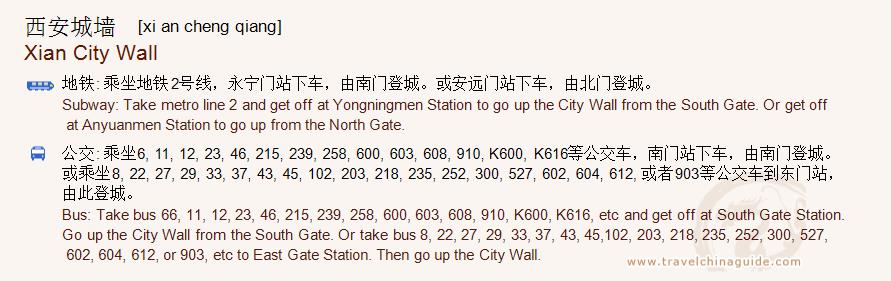
To the South Gate chosen by most tourists: Take Metro Line 2, get off at Yongning Gate Station, and get out from Exit A1/D1. From the exit, you can see the welcome avenue of the South Gate. Walking along it to the north for about 5 minutes, and you can reach the south entrance to South Gate.
Take Bus No. 12, 184, 193, 208, 221, 600, or 603 and get off at Nanmenli Station, walk southward for about 6 minutes to reach North Entrance to South Gate. Or take Bus No. 11, 12, 16, 184, 187, 193, 203, 204, or 208 and get off at Nanmenwai Station, walk northward for about 9 minutes to reach South Entrance to South Gate.
Nearby Attractions
Stele Forest: Located inside the Wenchang Gate to the east of the South Gate, it collects steles of different dynasties which offer a feast for Chinese history and calligraphy fans.
 How Long is the City Wall of Xi’an: 13.74 kilometers (8.5 miles)
 Video of the Warrior Formation Performance at South Gate