Up to now, the death of Emperor Qin Shi Huang remains a mystery. It is widely accepted that he died in 210 BC at the Shaqiu Palace, located in present-day Guangzong County, Xingtai City, Hebei Province, but there are no detailed historical records explaining the exact cause. Over the years, various theories have emerged attempting to unravel the truth. Currently, three main explanations are most frequently discussed.
1. He died from illness caused by overwork and exhaustion.
Some people believe that Emperor Qin Shi Huang's declining health was closely linked to chronic overwork and exhaustion. As the first emperor in Chinese history to establish a centralized imperial system, he personally oversaw all state affairs, no matter how minor, and reviewed a vast number of memorials every day. This enormous workload severely drained his physical health. Additionally, during his reign, he undertook five major inspection tours within just 12 years. Although he traveled on the most advanced highways at that time, called "Chi Dao," the constant jarring on rough roads made these journeys extremely difficult. His final tour began in the cold winter and lasted until the peak of summer; such drastic seasonal changes could easily have triggered illness. Historical records also suggest he may have suffered from chronic conditions like bronchitis, which would have weakened his health. To make things worse, his indulgence in a harem of many concubines likely further harmed his health.
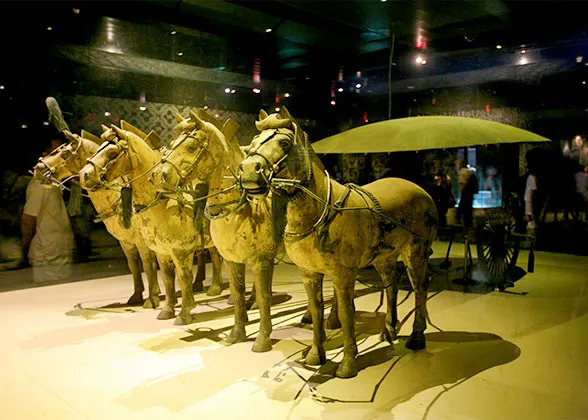 | | Bronze Chariot and Horses for Emperor's Inspection | |  | | Expressway in Qin Dynasty | |
2. He was assassinated by his close associates in a conspiracy.
Some also claim that Emperor Qin Shi Huang was murdered. This theory focuses on a conspiracy involving his youngest son,
Hu Hai, and his close associates Zhao Gao and Li Si. Some argue that Hu Hai was dissatisfied with Qin Shi Huang's decision to appoint his elder brother, Fu Su, as heir, and therefore plotted to kill his father. However, the possibility of him carrying out this act alone is extremely small. The imperial edict and jade seal at that time were held by Zhao Gao, the emperor's most trusted official. Even if Hu Hai had killed his father, he could not have seized the throne without Zhao Gao's help. Therefore, some scholars think Hu Hai and Zhao Gao conspired to kill the emperor.
Specifically, during his last inspection tour, Qin Shi Huang suddenly suffered an epileptic seizure, hit his head, and lost consciousness. Taking advantage of this moment, Zhao Gao and Hu Hai drove a long iron nail into his right ear, ultimately causing his death. Zhao Gao's motivation was driven by his fear that Fu Su's rise would threaten his own power or lead to his execution. To protect their control, they covered up the emperor's death and forged an imperial decree. Li Si, the Qin chancellor, was also involved. While he may not have directly participated in the killing, he aligned himself with Zhao Gao and Hu Hai afterward to safeguard his political position. This sequence of unusual events, covering up the emperor's death, altering the imperial edict, and Hu Hai's rapid enthronement, adds more suspicion to the idea that this was an assassination.
3. He died from poisoning due to long-term use of elixirs of immortality.
Qin Shi Huang was deeply obsessed with achieving immortality. As he aged and his health declined, his fear of death grew stronger, leading him to put his hopes in so-called "elixirs of life." He believed these pills could extend his life or even grant him eternal youth. He repeatedly sent alchemists like Xu Fu on expeditions to search for elixirs of life, while he himself regularly took such elixirs over a long period. Unfortunately, most of these so-called immortality elixirs were actually made from various minerals, herbs, and metals, often containing trace amounts of toxic heavy metals. Prolonged consumption could cause chronic poisoning, damaging the nervous system and internal organs. History records that several emperors died from elixir poisoning. It is said that, right before his final tour, Qin Shi Huang likely took a newly refined batch of elixirs, possibly even more toxic, which led to severe poisoning and ultimately caused his sudden death on the journey.
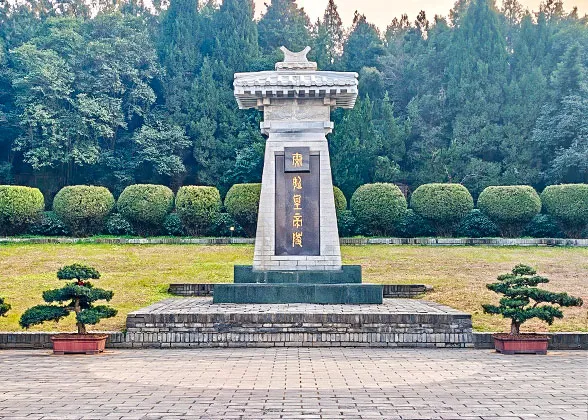 | | Tombstone of Emperor Qin Shi Huang | | 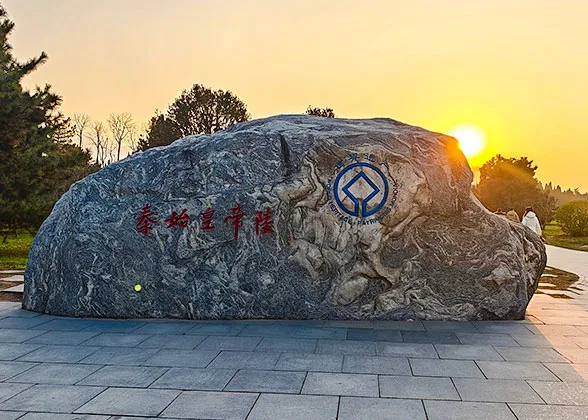 | | Stone Tablet in Qin Shi Huang's Mausoleum | |
 Further Reading:
 Qin Shi Huang Mausoleum
Underground Palace of Qin Shi Huang Mausoleum
Epang Palace Site
Hu Hai – 18th Son of Emperor Qin Shi Huang
Fu Su – Emperor Qin Shi Huang's Eldest Son
Why Does Qin Shi Huang's Mausoleum Remain Unexcavated?
- Last updated on Jun. 03, 2026 by Sherry Xia -