Terracotta Infantry Warriors
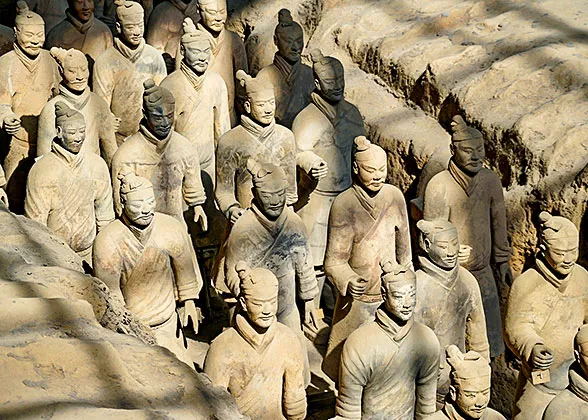
In 1974, the infantry warriors were first discovered in Pit 1 of the Terracotta Army in Xi'an. To date, over 7,000 life-sized terracotta infantry figures have been unearthed across three main pits, making them the largest group among all warriors. They formed the main body of the Qin military formation, responsible for frontline combat and battlefield attacks and defenses. Standing about 1.8 meters (5.9 feet) tall, slightly taller than real people of the Qin Dynasty (221 - 207 BC), each warrior originally held real bronze weapons. However, after more than two thousand years underground, the wooden parts of those weapons decayed, leaving the warriors' hands shaped as half-closed fists. The infantry figures appear in a wide range of individual poses, such as standing and kneeling postures.
Based on rank and status, the infantry warriors can be divided into two main categories: military officers and common soldiers. Today, visitors can see the largest number of infantry warriors in Pit 1, while most military officers are displayed in glass cases in Pit 2, allowing people to view their details up close.
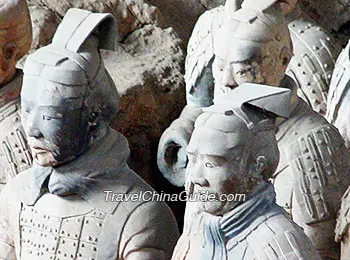 |
| Infantry Warriors in Pit 1 |
Military Officers
1. High-ranking Officer
According to research, high-ranking officers commanded entire formations or multiple formations and did not directly engage in combat. Fewer than ten such terracotta figures have been unearthed, making them extremely rare. Generally standing about 2 meters (6.5 feet) tall, the tallest of all warriors, they wear a pheasant-feather crown on their heads. Their bodies are covered in colorful fish-scale armor with decorative knots on the chest and back. Their bellies slightly protrude, a detail that likely reflects their high status, good nutrition, and a lifestyle of commanding from the rear. On their feet are square-toed boots, and their hands rest over their stomachs, originally holding a long sword. With broad faces, wide foreheads, slightly furrowed brows, and tightly closed lips, their expressions are steady, calm, and commanding.
2. Middle-ranking Officer
Middle-ranking officers assisted the high-ranking officers and commanded individual combat units. Some stand beside high-ranking officers as deputies, while others are positioned within the ranks of common soldiers as frontline leaders. On their heads, they wear a double-plate long crown that resembles an upright plank. Their hair is tied up in simpler hairstyles. For armor, they usually wear fish-scale armor or breastplates, with the edges of the armor plates decorated in colorful lace and some painted with geometric patterns. Below the waist, they wear long pants and square-toed boots.
Typically, one of their hands remains half-closed as if giving an order, while the other hand hangs down or rests on the belt. Their faces are thinner with prominent cheekbones, and their focused eyes and slightly downturned mouths give them a serious and capable appearance.
Typically, one of their hands remains half-closed as if giving an order, while the other hand hangs down or rests on the belt. Their faces are thinner with prominent cheekbones, and their focused eyes and slightly downturned mouths give them a serious and capable appearance.
3. Lower-ranking Officer
Lower-ranking officers led small teams of soldiers directly into battle as frontline commanders. Although more numerous than higher-ranking officers, they still represent a small minority. They wear either a small single-plate crown, a long, narrow board-like crown without complex decorations. Their hair bun is tucked inside the crown, not exposed as a side bun. Their armor is straight-edged, meaning the plates have neat borders without fish-scale overlapping, and it protects only the chest and shoulders, leaving the back more exposed. One hand holds a long weapon such as a dagger-axe or spear, while the other hangs naturally at the side, and their bodies lean slightly forward. Their eyes are wide open, their lips slightly parted, and their faces show alertness, as if watching for enemy movements.
 See details in Headgears of Terracotta Warriors
Common Soldiers
1. Robed Infantry Warriors
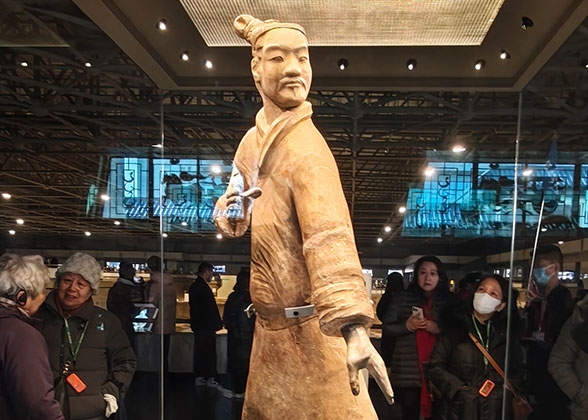
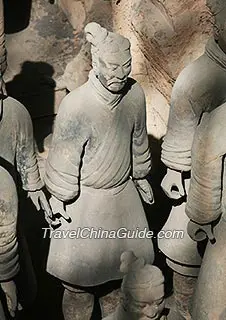
Among the robed infantry warriors, the standing archers are particularly notable. These figures, standing about 1.78 meters (5.84 feet) tall, have their hair tied up and wear no armor. They wear a short, crossed-collar robe, a leather belt, and leg wraps. Their posture captures a shooting motion: one foot steps slightly forward, one arm is raised to the side, and the other arm is bent across the chest. Their heads and bodies turn slightly, with eyes gazing toward the left front. Together with the kneeling archers, they formed the crossbowmen units of the Qin army, providing flexible and mobile firepower on the battlefield.
|
|
2. Armored Warriors
These soldiers wear armors and display several different hairstyles. Some have a round bun tied on the right side of the head, others have a flat bun at the back, and still others wear a soft, hat-like head covering that evolved from a headscarf into a cap. They are all equipped with long weapons or crossbows. These heavily armored soldiers formed the main body of the infantry warriors and were the core fighting force on the battlefield.
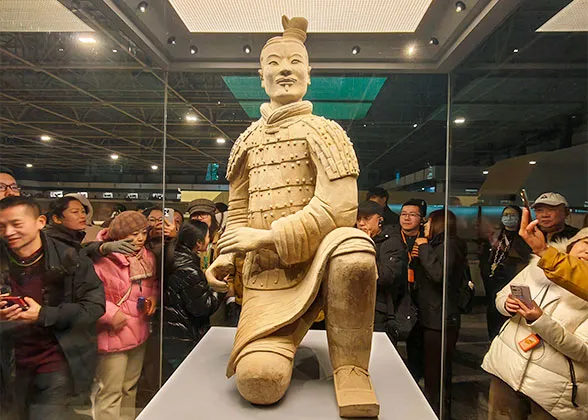
A distinctive type within the armored group is the kneeling archer, who also belonged to the crossbow unit. The kneeling archers are posed on their right knee, with the left leg bent. Their hair is tied in a bun on the left side, and they wear a long robe under their armor. Their hands are positioned at waist level, shaped as if holding a crossbow ready to shoot, while their eyes gaze forward intently. Due to their lower height and the stability of the kneeling posture, these figures have been exceptionally well-preserved, suffering less damage when the pit ceilings collapsed over time.
A distinctive type within the armored group is the kneeling archer, who also belonged to the crossbow unit. The kneeling archers are posed on their right knee, with the left leg bent. Their hair is tied in a bun on the left side, and they wear a long robe under their armor. Their hands are positioned at waist level, shaped as if holding a crossbow ready to shoot, while their eyes gaze forward intently. Due to their lower height and the stability of the kneeling posture, these figures have been exceptionally well-preserved, suffering less damage when the pit ceilings collapsed over time.
|
|
 Further Reading:
Recommended Tours
- Last updated on Apr. 15, 2026 by Doris Xue -