 |
| Terracotta Standing Archer |
Among the vast
terracotta army guarding
Emperor Qin Shi Huang's mausoleum, one distinct group of warriors gains particular attention. These are the standing archers, who served as light
infantry soldiers equipped with crossbows. Archaeologists have unearthed 173 such figures so far, with the vast majority discovered in
Terracotta Army Pit 2, and only one found in
Pit 1. Each figure stands about 1.78 meters (5.8 feet) tall, roughly life-size. Originally, these archers held wooden crossbows in their hands, but the wood has long since decayed, leaving only the bronze trigger mechanisms. Yet even without the weapons, the archers themselves, through their unique poses and attire, remain a vivid testament to the Qin army's discipline and artistry.
Distinctive Posture of the Terracotta Standing Archers
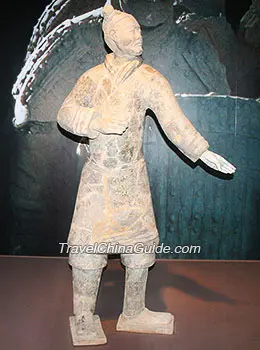
The most striking feature of a standing archer is his pose, which immortalizes a precise moment immediately preceding the release of an arrow. Look closely: every detail of the posture is meticulously crafted. His right foot is planted firmly flat on the ground, while the left foot steps half a pace forward and shifts slightly to the left, forming a right angle between the two feet. His left leg bends gently forward at the knee, and the right leg stretches straight back to maintain balance and stability. His left arm is raised to the side with the hand fully open and the thumb pointing directly forward. His right arm bends across the chest with the palm facing down toward the body. His head and upper body turn a little to the left. His gaze is fixed on the left front direction, and his lips are pressed tightly together, conveying unwavering focus and solemn concentration.
This carefully crafted posture is not a product of the craftsmen's arbitrary imagination. It finds clear validation in an ancient Chinese military text, which specifies the standard and correct stance for an archer: the left foot should be placed forward and the right foot kept level; the left hand positions as if holding a branch and the right hand as if embracing a small child. The standing archer's posture matches this ancient description with remarkable precision, showing that as early as the
Qin Dynasty (221 - 207BC), crossbow shooting had been standardized into a strict set of movements.
Clothing of the Terracotta Standing Archers
As light infantry troops, the standing archers are not outfitted with any form of armor. Their attire prioritizes speed, agility, and unimpeded movement on the battlefield. Their hair is neatly tied into a simple topknot on the crown of the head. They wear a knee-length cross-collared robe, often covered by a short suit, and secured firmly around the waist with a leather belt. For added protection, their lower legs are wrapped with cloth gaiters. Their feet are shod in simple square-toed low-cut shoes, which allow for quick and steady movement. To enhance mobility and fighting flexibility, the archers are equipped with light, well-fitting tops and pants beneath the robe, a practical and common military garment for ordinary soldiers during the Qin dynasty.
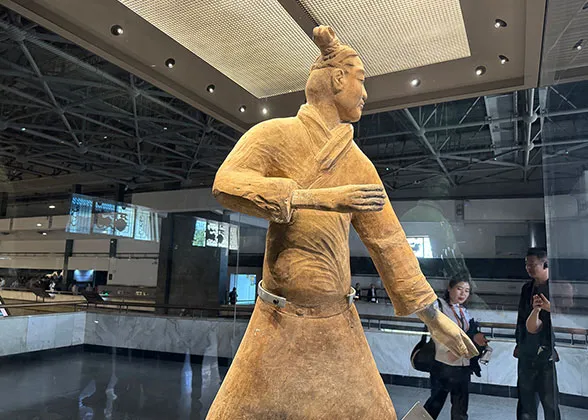 | | Long Robe of Standing Archer | | 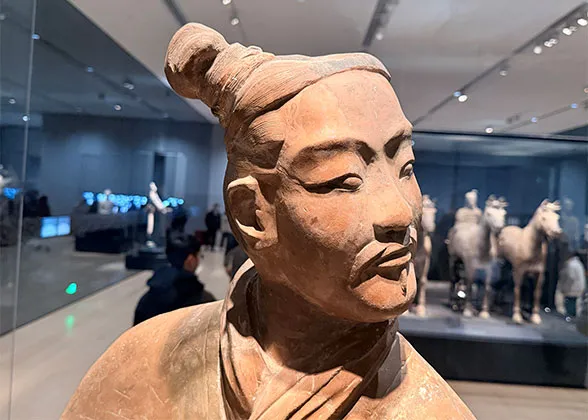 | | Hairstyle of Standing Archer | |
You may like:
What Are the Terracotta Warriors Wearing? Tactical Role of Standing Archers in the Battle Formation
Why did the standing archers take this particular pose and lightweight attire? The answer lies in their specific tactical role on the ancient battlefield. Within the crossbowmen formation in Pit 2, the standing archers are positioned along the outer front edge. Another group of figures, the kneeling archers, occupy the central area of the formation. Together, they form a highly effective classic alternating military tactic.
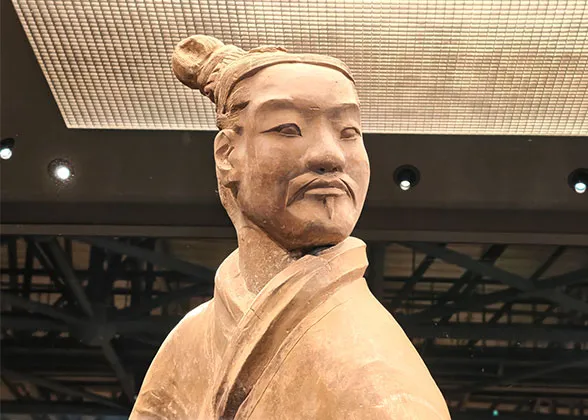 | | Standing Archer with Alert Expression | | 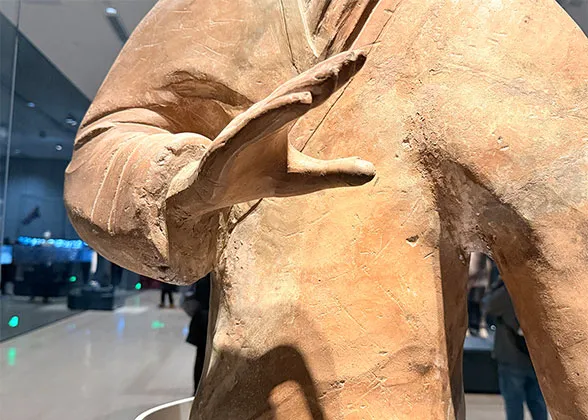 | | Hand of Standing Archer | |
As enemy forces advanced within range, the standing archers on the front line launch the first volley. They then crouch down to reload, while the kneeling archers behind them stand up and fire the next volley. Once the kneeling archers finish shooting, the standing archers rise again for another round. This continuous alternation creates an unbroken hail of bolts toward the enemy.
This tactic solves a major weakness of crossbowmen, which was slow reloading. An ancient saying notes that a crossbowman could only shoot three times before the enemy reached him. By alternating between standing and kneeling positions, the Qin army shortens the gaps between volleys and maintained sustained firepower. This reflects the high discipline and practical training of the Qin forces and servs as a vivid example of ancient Chinese strategic wisdom.
 Further Reading:
- Last updated on Apr. 22, 2026 by Doris Xue -