 |
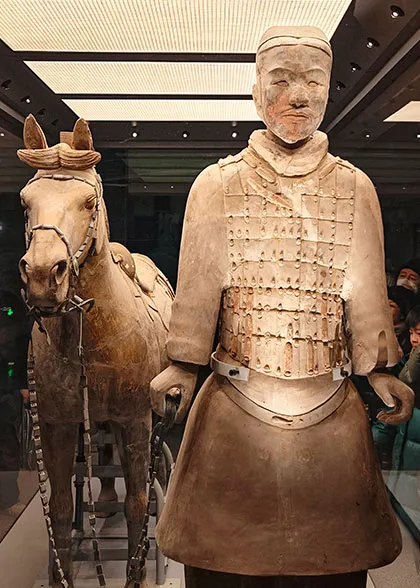
| Cavalry Warrior in Pit 2 |
Pit 2 of the
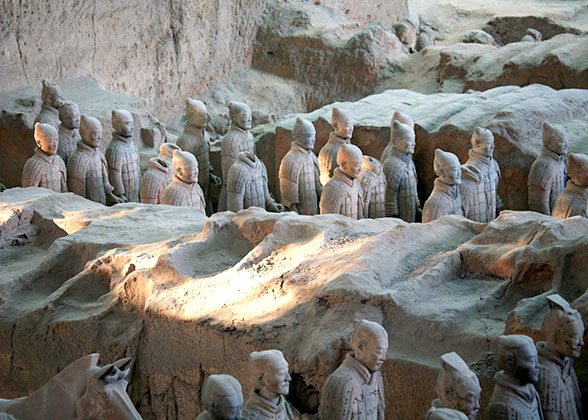
Terracotta Army is an L-shaped military formation that mixes chariots, infantry warriors, cavalry warriors, and crossbowmen. Within this array, the cavalry represents a new striking force. To date, 116 cavalry warriors have been unearthed from this pit, each standing beside a saddle horse. These figures are finely carved and lifelike: the cavalry warriors appear agile and tough, while the saddle horses look strong and powerful, matching the real sizes of humans and horses in the
Qin Dynasty (221 - 207 BC).
According to historians, these warriors are made by resembling the real cavalry of the Qin army. Moreover, such a large group of cavalry figures is extremely rare in the world and remains the earliest and largest group of ancient cavalry statues ever found in Chinese archaeological history.
How were the cavalrymen selected, and what did they look like?
The Qin army selected its cavalrymen according to strict standards. Ancient military texts record that a cavalryman recruit should be under 40 years old, at least 1.73 meters (about 5.7 feet) tall, strong and agile, able to shoot accurately while riding, turn left and right, advance and retreat, and cross ditches and climb hills.
If you look closely, you will see that one hand of the cavalry warrior holds the reins, while the other is raised as if gripping a bow, a pose that captures the essence of mounted archery. Each cavalryman wears a small round leather cap with a strap tied under the chin, and has no complicated hairstyle. His jacket is short and narrow-sleeved, with a cross-collar closing on the right. Over this, he wears a light armor vest that reaches only to his waist, leaving the shoulders bare. Why no shoulder armor? Because a cavalryman needs to draw a bow and shoot freely from horseback, and heavy shoulder protection would only get in the way. Below the waist, he has tight long trousers and short leather boots, making it easy to mount, ride, and dismount quickly. Clearly, every piece of the cavalryman's clothing was designed for speed and mobility.
Such an outfit originated with the northern nomads. In 307 BC, the king of Zhao introduced this style of clothing and riding to make his soldiers more agile on horseback. The Qin later adopted the same practical design, reflecting a pragmatic mindset: if a foreign custom offered a real advantage on the battlefield, they were willing to embrace it.
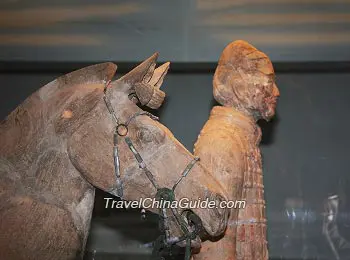 | | Cavalry Warrior and Horse | | 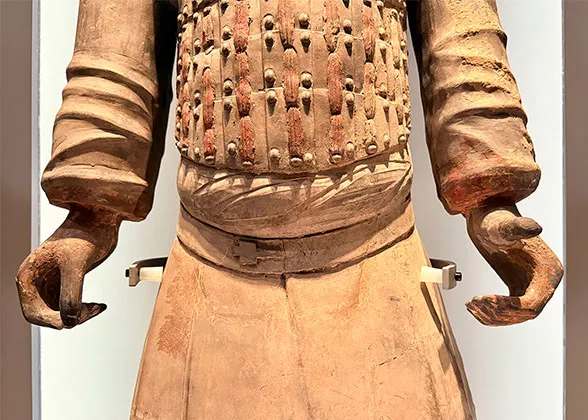 | | Hands of Cavalry Warrior | |
The cavalry's role in the military formation
In Pit 2, the cavalry was arranged in a rectangular battle formation: four horses and their riders made a unit, twelve units formed a column, and nine columns stood side by side, giving 108 cavalrymen. Another eight were placed in a mixed unit, bringing the total to 116. These cavalry units were usually deployed on the flanks or behind the main force, ready to charge, pursue fleeing enemies, or scout ahead. The Qin army was famous for its heavy
infantry and chariots, but the cavalry gave it a completely new kind of battlefield capability - extreme mobility. With cavalry, the Qin army could strike suddenly, retreat swiftly, and harass enemy flanks in ways that slow, armored infantry never could. This speed optimized their tactics and made the Qin military one of the most flexible forces of its time.
The saddle horse and its equipment
Each cavalryman leads a sturdy terracotta horse. When you look closer, you will notice that its nostrils are very large and its legs are quite short. These are typical features of the northwestern Chinese horse breed. Such horses are not particularly fast, but they have excellent endurance and tremendous strength, ideal for long campaigns. The horse is approximately 2 meters (6.6 feet) long and 1.3 meters (4.3 feet) tall at the shoulder, with a strong, muscular build. Its mane is cropped short, and its tail is braided into a long plait, which keeps balance and looked neat. On its back is a soft leather saddle, slightly raised at both ends and originally painted in red, white, blue, and brown pigments. Two belly bands pass under the horse to secure the saddle, and a crupper strap runs around the base of the tail. The horse's head is fitted with a bronze bit and bridle, and two reins end in bronze rings for the cavalrymen to hold.
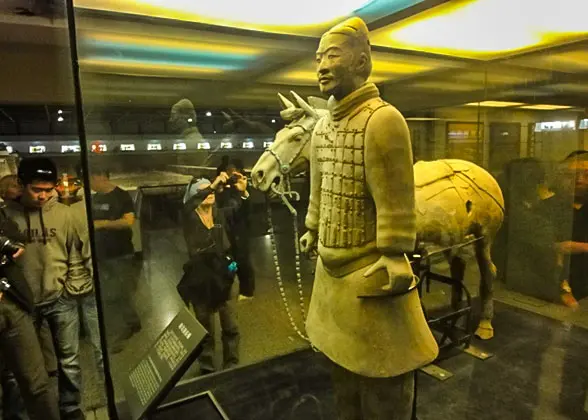 |
| Saddle Horse Leaded by Cavalry Warrior |
Notably, the horse has no stirrups, which did not appear until the Western Jin Dynasty (265 - 316 AD), about 470 years after the end of the Qin Dynasty. This means a Qin cavalry warrior had to grip the horse with his legs and maintain balance purely through skill. Imagine fighting with a bow and arrow on a moving horse without stirrups. It was a major challenge in battle, requiring years of training and extraordinary physical coordination. Apart from stirrups, the terracotta horses are equipped with all other necessary riding gear, and the cavalry warriors are dressed in specialized clothing. This shows that by the Qin Dynasty, cavalry had already become a fully equipped, independent branch of the military.
 Further Reading:
- Last updated on Apr. 22, 2026 by Doris Xue -