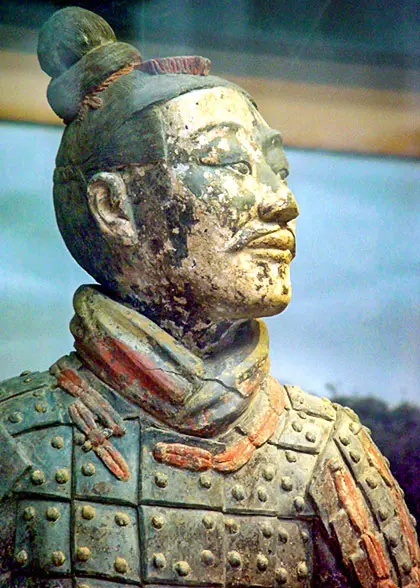
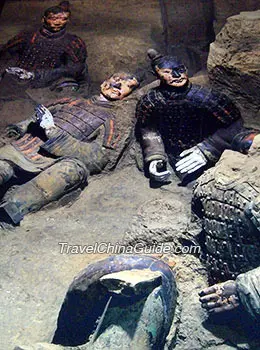
The kneeling archers have their hair tied in buns and wear armor over long robes. Their hands, positioned at waist level, are shaped as if holding crossbows, ready to release an arrow at any moment. Their eyes gaze intently forward, radiating a warrior's spirit.
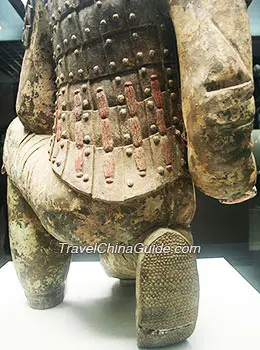
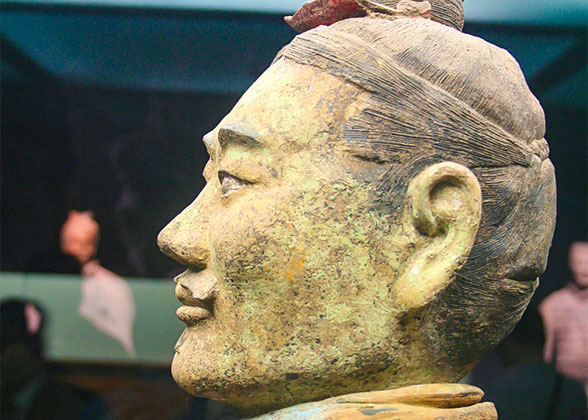
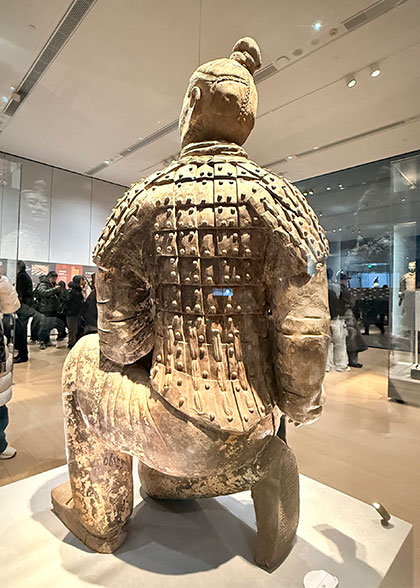
Step closer, and you'll notice the details. The buns are tied on the right side of the head, reflecting the Qin cultural preference for the right over the left. Look even more carefully, and you can see individual strands of hair, carved with such precision that you might forget you are looking at clay. The armor is equally impressive: the plates on the chest overlap from top to bottom, allowing a soldier to bend forward, while those on the shoulders and waist overlap from bottom to top, making it easier to raise the arms and shoot.
Their hands are positioned one above the other on the right side of the body, forever frozen in the act of holding a crossbow. Although the wooden bows themselves decayed long ago, the powerful hand gestures still convey the tension of a warrior waiting for the command to fire.
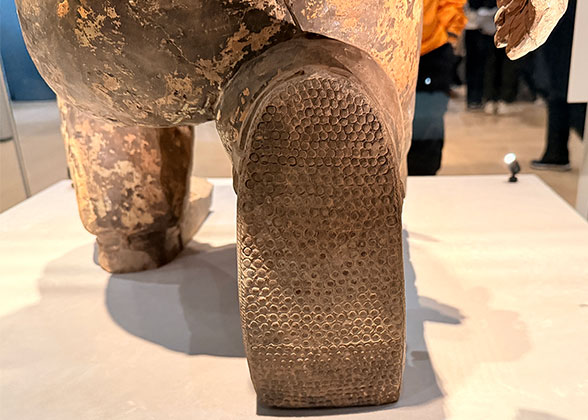
Perhaps the most fascinating detail is on the soles of their shoes. The soles are carved with stitch marks: denser at the heel and toe, where shoes experience the most wear, and looser across the arch, to allow bending when kneeling. Such careful observation of daily life brings these ancient figures to life. The kneeling archers are life-sized, and the folds of their clothing shift naturally with their postures, creating graceful lines that reveal the sophistication of Qin sculpture.
 You may like: True Colors of Terracotta Warriors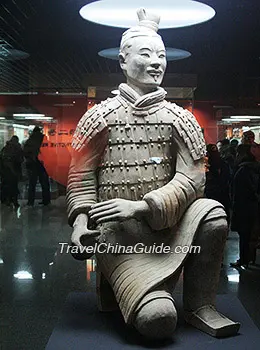
 Further Reading: