What is Huangshan famous for?
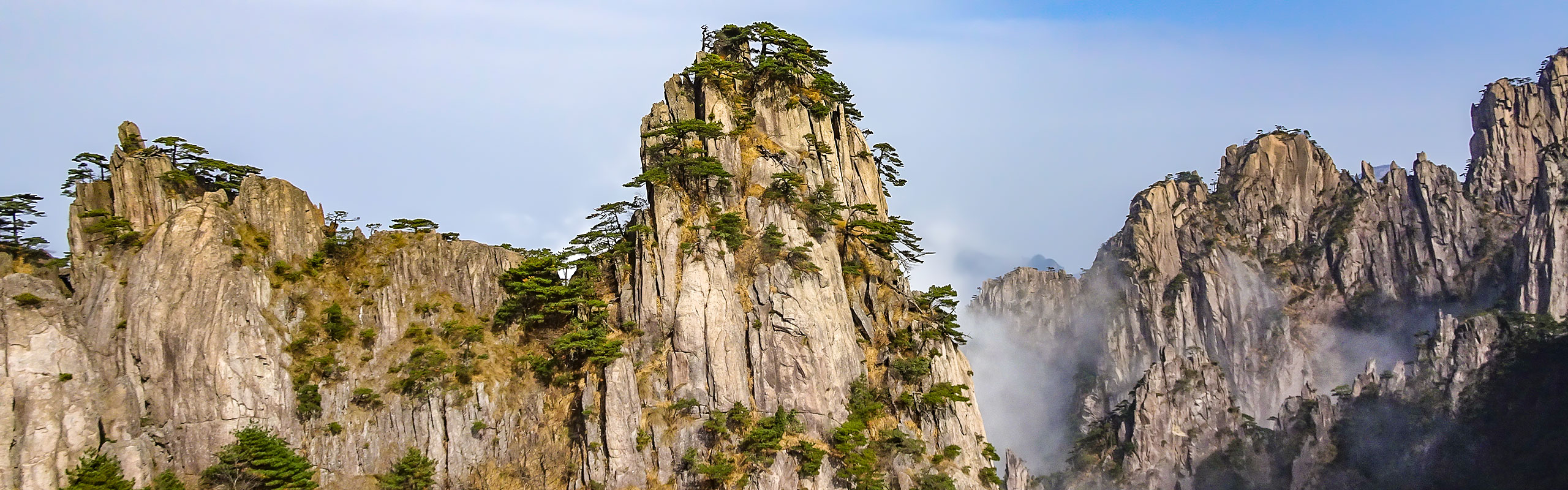
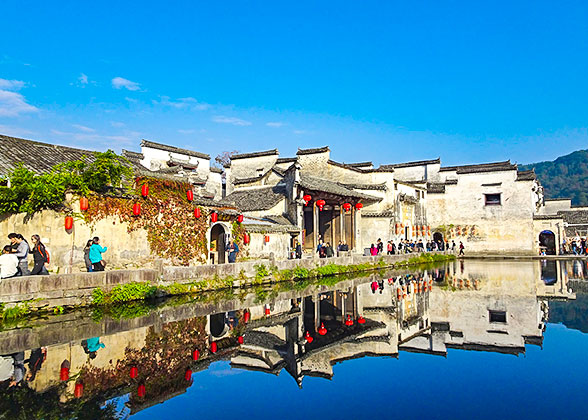
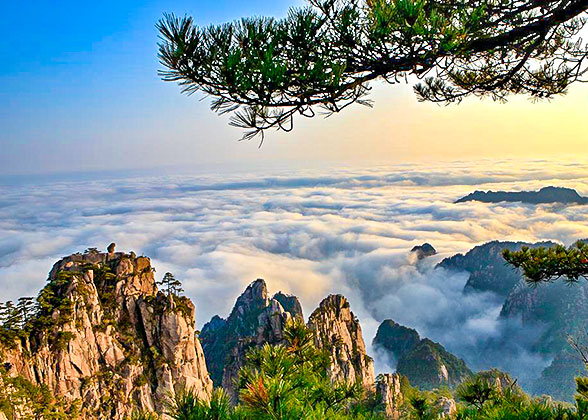
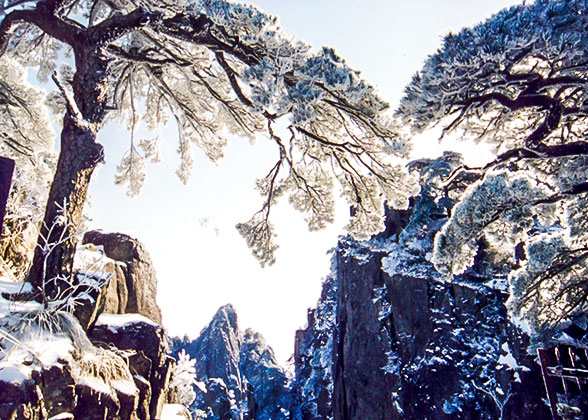
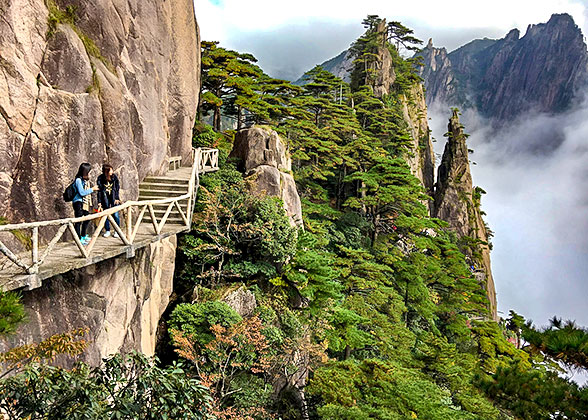
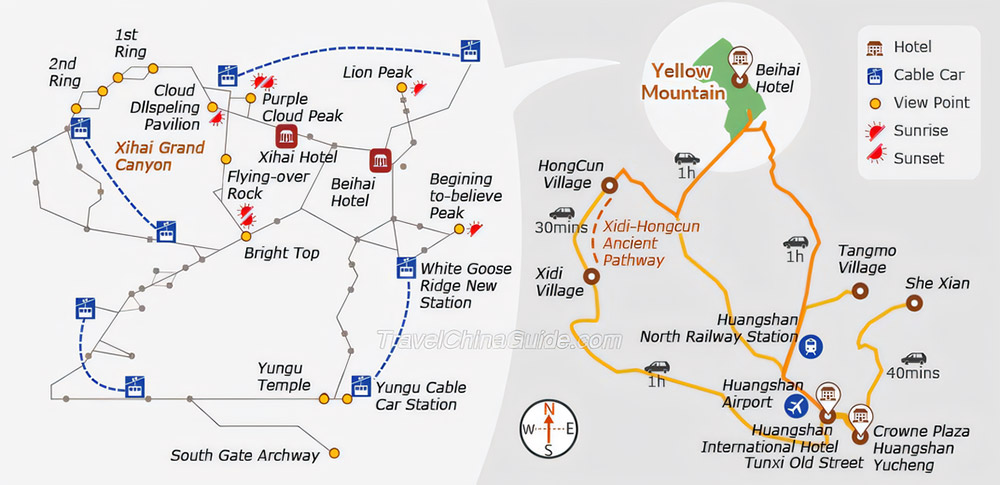
Huangshan is best known for Mt. Huangshan, aka Yellow Mountain, which boasts five wonders: twisted pines, strange rocks, sea of clouds, hot springs, and snowscapes. Among its many awe-inspiring sights are the most iconic Greeting Guests Pine at the cliffside of Jade Screen Peak; the steep, mysterious, and secluded West Sea Grand Canyon; the precariously balanced Flying-over Rock supported by a tiny area; the Beginning to Believe Peak, home to various pines like the Black Tiger Pine and the Harp Pine; and the Bright Summit, a wonderful spot to savor breathtaking seas of clouds, sunrise, and sunset. Beyond the mountain, the region is equally celebrated for its historic villages, which offer a deep dive into China’s rich cultural and architectural heritage.
How many days do you need in Huangshan?
Normally, 3 to 4 days are sufficient to explore popular attractions, including Mt. Huangshan, Hongcun
Village, Xidi Village, and Tunxi Old Street. If you are a bit pressed for time, you can just schedule 3
days. A one-day trip is hardly feasible. For Yellow Mountain travelers, it’s recommended to stay
overnight on the mountain, which allows you to admire both sunrise and sunset. Got 4-5 days? Consider
including a side trip to Tangmo Village, Chengkan Village, Tangyue Memorial Archways, and Bao’s Family
Garden to enjoy local ancient architecture and culture. If you have a full week, you can branch out to
nearby destinations like Wangxian Valley, Wuyuan, or Jingdezhen, acclaimed as the “Millennium Porcelain
Capital”. With our carefully tailored private Huangshan tour itineraries, your journey will be truly
memorable!
Is Huangshan difficult to climb?
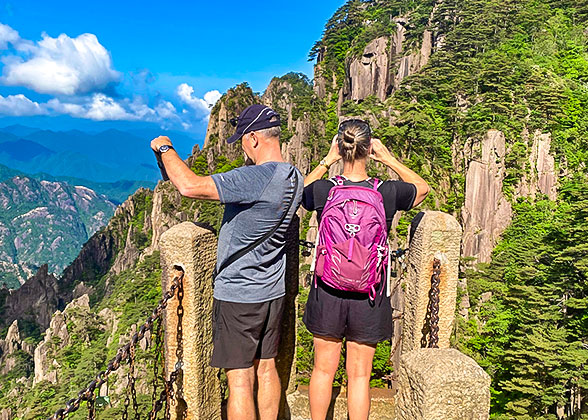
The climbing difficulty varies by route and the method you choose. With nearly 60,000 steps and constant ups and downs, a full hike of Mt. Huangshan takes about 8-12 hours and is only suitable for super-fit hiking fanatics. Most visitors prefer taking the cable car up and down to conserve energy for the main sights at the top, and they typically stay overnight there to make the most of their time. People with better physical strength tend to take the most classic route: tackle the steep Front Mountain with a vertical climb of about 700 meters (2,296 feet), visit key spots like Greeting-guests Pine, Bright Summit, Flying-over Rock, Beginning to Believe Peak, Cloud Dispelling Pavilion, and West Sea Grand Canyon on the mountaintop, then descend via the more scenic and gently sloped Rear Mountain - also doable in one day if planned well. While those with less stamina, families with children, and elders are better off going up from the Rear Mountain and coming down the Front.
How do I get to Huangshan?
Huangshan is easily accessible by high-speed rail from major cities, including Beijing, Xi’an, Shanghai,
Hangzhou, Suzhou, and Guangzhou. Travelers from distant cities such as Xi’an and Guangzhou can also take direct
flights to Huangshan. Below are more details for your reference.

By High
Speed Train
|
By High-speed Train
|
Beijing
|
Daily 10 trains from 06:56 to 14:41
|
5-7.5 hours
|
Xi’an
|
Daily 3 trains from 10:57 to 12:17
|
7.5 hours
|
|
Shanghai
|
Daily 68 trains from 06:27 to 19:34
|
2.5-5 hours
|
|
Hangzhou
|
Daily 63 trains from 07:15 to 21:41
|
1.5-2.5 hours
|
|
Suzhou
|
Daily 65 trains from 07:19 to 20:02
|
2-4.5 hours
|
|
Guangzhou
|
Daily 9 train from 08:41 to 15:25
|
5-10.5 hours
|

By Flight
|
|
By Flight
|
Beijing
|
Daily
|
2.5 hours
|
Xi’an
|
Daily
|
2.5 hours
|
|
Chongqing
|
Daily
|
2 hours
|
|
Guangzhou
|
Daily
|
2 hours
|
The Yellow Mountain is around 60 kilometers (37 miles) from Huangshan city, with a roughly hour-long drive. For independent travelers, a taxi costs approximately USD 22. The budget choice is taking a direct bus to the scenic area in one hour from Huangshan Bus Station. It offers 10 daily services between 6:00 and 16:00, for about USD 4 per person. If you stay near Huangshan North Railway Station, buses are also available here, with 33 daily services from 7:00 to 19:00, priced at around USD 4-7 per ticket. Fancy more convenience and comfort? Choose our Huangshan tour packages for professional English guide service and seamless transfer.
What is the best time to visit Huangshan?
March-May and September-November are the best times, thanks to comfortable weather, fewer crowds, and the most
breathtaking scenery. Temperatures during these two periods range from 5-18℃ (41-64℉), making long-sleeved
shirts or thin sweaters, windproof jackets, and sweatpants appropriate.
June-August brings hotter, rainier weather, but it also offers a high chance of encountering breathtaking
rainbows, seas of clouds, rosy dawns or sunsets, and rushing waterfalls on Mt. Huangshan. Despite cold
temperatures between December and February, you’ll be rewarded with winter snowscapes, seas of clouds, and a
quieter atmosphere. It’s better to avoid the National Day holiday from Oct 1st to Oct 7th to escape large
domestic crowds.
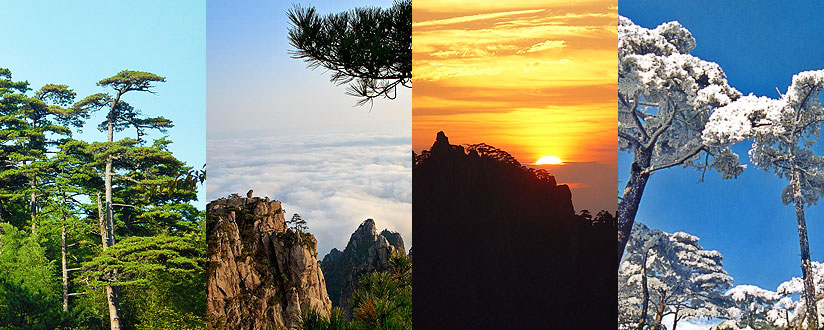
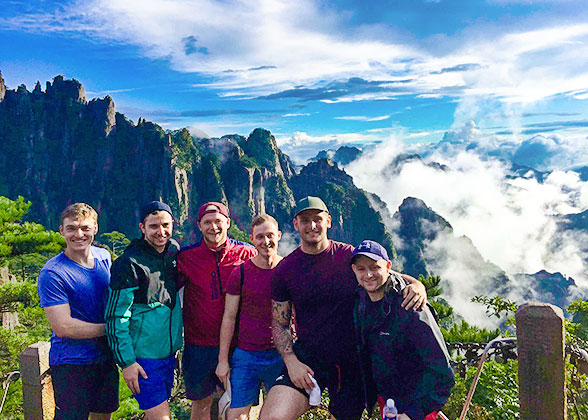
Mt. Huangshan in Different Seasons
What to pack for a Huangshan tour?
Please travel as light as possible. Since there is definitely a Yellow Mountain visit planned, preparing suitable hiking gear and appropriate clothing to deal with the unpredictable weather is essential. Comfortable hiking shoes are the most important item, especially in winter (December-February), when you need to pay attention to traction and crampons. For other clothing, prepare quick-drying and lightweight options: T-shirts, shorts, long-sleeve shirts, long pants, a thin coat or down jacket, and a hat, depending on the season. Also, remember to pack rain gear, or sunglasses and sunblock in summer (June-August). High-calorie snacks like chocolate and protein bars are also advised to replenish your energy.
Tip: for your easier hike on the mountaintop, we recommend storing your heavy luggage at the foot of the mountain and only carrying a lightweight backpack with necessities for your night there.
How to travel from Shanghai to Huangshan?
The distance between the two places is more than 400 kilometers (249 miles), about a 5-hour drive. Taking the bullet train is the most recommended option, taking just 2.5-4.5 hours, with first-class tickets priced at USD 45-60 and second-class tickets at USD 28-43. For a more economical option, consider taking a coach, which takes 5.5 hours and costs about USD 17-25 per person.
What is the difference between Zhangjiajie and Huangshan?
Both are among China’s premier natural wonders, but there are three main differences as follows:
1. Geological Landscape: Zhangjiajie features a quartz sandstone peak forest, densely dotted with thousands of soaring, independent stone pillars, creating a strong fantastical vibe. In contrast, Mt. Huangshan is a granite peak forest, complete with unique ancient pines, oddly shaped rock formations, and seas of clouds, much like a mist-shrouded fairyland.
2. Cultural Background: Zhangjiajie is world-famous for its pristine, wild scenery, while Mt. Huangshan boasts both natural and cultural heritage. Beyond its iconic peaks, its millennia-old trails, cliffside inscriptions, and surrounding historic villages are all big pluses of the mountain.
3. Travel Experience: Zhangjiajie is well-equipped with sightseeing shuttles, cable cars, and lifts, making it more leisurely and suitable for most visitors. However, Yellow Mountain is more physically challenging. Though it offers cable cars, plenty of climbing is still required, making it a favorite for hikers and shutterbugs.
What to eat in Huangshan?
During your Huangshan trip, don’t miss stinky mandarin fish, a local signature dish well-known for its fermented aroma and tender mouthfeel. Hairy tofu, topped with special spicy sauce, is another must-try snack. Huangshan pancakes stuffed with savory pork and dried vegetables can also offer you an unexpected treat.