The Nestorian Stele, also known as the “Stele Commemorating the Spread of Nestorianism in China by Roman Empire (Chinese name: Daqin)”, derives its name from two key terms: “Daqin”, the ancient Chinese designation for the Roman Empire, and “Nestorianism”, a distinct branch of Christianity. The inscriptions on the stele document the propagation of the Nestorian Church in China, along with its core doctrines and ecclesiastical regulations, spanning the period from 635 AD to 781 AD. Hailed as one of the four most renowned steles globally, it holds unparalleled historical significance and is currently preserved at the
Xi'an Stele Forest Museum.
 Stele Forest Museum Tickets Booking
As a pivotal artifact attesting to the spread of Christianity in China during the
Tang Dynasty (618 - 907), the stele confirms that Nestorianism was introduced to China from Persia in 635 AD by the Syriac missionary Alopen Abraham, while also detailing its subsequent development across the country. Furthermore, the stele stands as a unique convergence of Eastern and Western religious civilizations, bearing witness to the Tang Dynasty’s remarkable openness and cultural inclusivity. Notably, the ancient Syriac script inscribed at the bottom serves as a valuable philological reference, offering a critical key to deciphering Syriac texts found on other cultural relics and historical sites, thus cementing its status as an indispensable scholarly resource.
What Does the Nestorian Stele Look Like?
Carved from fine-grained blue stone, the stele measures 356 centimeters (140 inches) in height, 99 centimeters (39 inches) in width, and 28 centimeters (11 inches) in thickness. Its top is semi-circular with a pointed apex. The stele bears inscriptions in both classical Chinese and ancient Syriac, totaling more than 1,700 characters. Adorning the top of the stele is an intricate motif incorporating a cross, lotus flowers, and auspicious clouds - symbolic elements with profound cultural connotations. The cross represents Christianity, while the lotus and auspicious clouds are emblematic of Chinese Buddhism and Taoism, respectively. This tripartite design vividly reflects the historical process of Nestorianism’s syncretism with indigenous Chinese cultural and religious traditions.
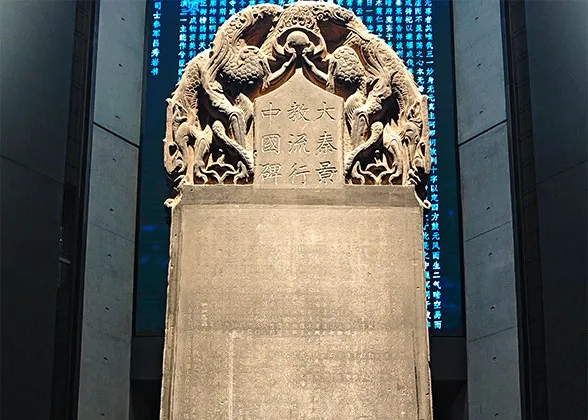 | | The top design of the Nestorian Stele | | 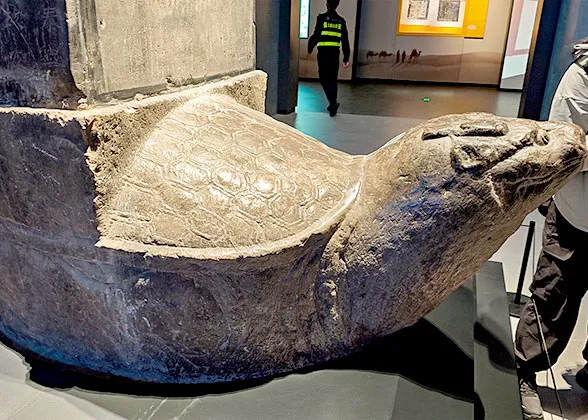 | | The base of the Nestorian Stele | |
What Does the Nestorian Stele Record?
The content of the stele is structured into three distinct sections:
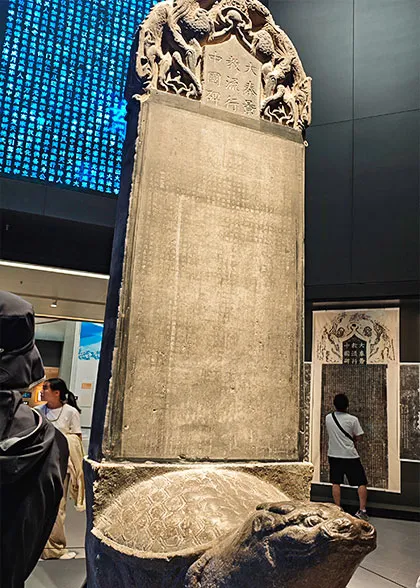 |
| Nestorian Stele |
The first section primarily elaborates on the foundational tenets of Nestorianism. Its core narrative centers on the origin of God, the divine act of salvation for humanity, and the revelation of the Bible as a moral compass to guide human conduct, enabling believers to revert to their innate state of purity and virtue.
The second section recounts the journey of Nestorianism’s introduction to China and its flourishing development within the Tang Empire. To provide context, it traces the doctrinal schism within early Christianity: a bishop from the Eastern Roman Empire propounded the belief that Christ possessed two separate and distinct natures - one divine, one human - a view that diverged sharply from orthodox Christian teachings, sparking intense theological debates. Subsequently, religious authorities condemned this doctrine as heresy and exiled its proponent. The exiled bishop traveled eastward to present-day Syria, where he propagated his teachings in the Syriac language. Later, in 635 AD, the missionary Alopen journeyed to Chang’an (the Tang capital), after arduous travels, bringing with him a collection of Nestorian scriptures. Emperor Taizong of Tang, Li Shimin, regarded this foreign faith with great esteem; after listening to Alopen’s exposition of its tenets, he concluded that Nestorianism was not incompatible with China’s indigenous belief systems and consequently authorized its nationwide dissemination. The first Nestorian place of worship, the Daqin Temple, was erected in Chang’an, followed by the construction of Daqin Temples in prefectures and counties across the empire, facilitating the widespread diffusion of Nestorianism. Historical records even note that on Christmas Day each year, the Tang emperor would bestow gifts and banquets upon Nestorian missionaries to commemorate the birth of Jesus, marking the earliest documented celebration of Christmas in China.
The third section consists of an encomium eulogizing Issu, who served as the de facto Nestorian bishop of the Chang’an region and played an instrumental role in advancing the faith in China. At the bottom of the stele, the names of more than 70 Nestorian monks are inscribed in ancient Syriac.
The True and False Nestorian Steles
Beyond the authentic Nestorian Stele preserved at the Xi'an Stele Forest Museum, an exact replica also exists, with its origins rooted in a dramatic historical episode. In 1907, the Danish explorer Frits Holm devised a scheme to transport the original stele to Europe. He visited the temple where the stele was housed, bribed the abbot with three thousand taels of silver to secure a private purchase, and commissioned craftsmen to create a meticulous replica to substitute for the original. However, his plot was uncovered before it could be executed, forcing him to abandon the original and ship only the replica to New York. A decade later, the replica was acquired from Holm by Mrs. George Lillie, a wealthy New York philanthropist, who then donated it to the Rome as a gift to the Pope. Today, this replica is on permanent display at the Vatican Museum.
You may like:
National Treasures in Stele Forest
- Last updated on Jan. 27, 2026 by Gabby Li -