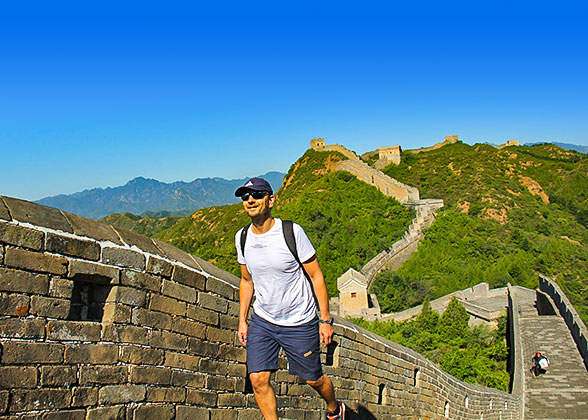
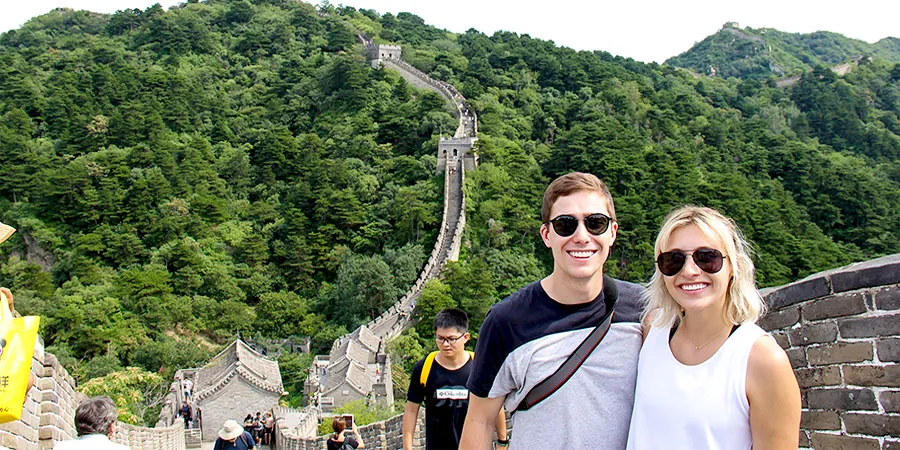
The construction of the Mutianyu Great Wall spanned multiple historical periods, yielding a rich array of architectural forms. Comprising walls, passes, garrisons, ramparts, watchtowers, and beacon towers, it formed a comprehensive and impregnable military defense system, widely hailed as a masterpiece of the
Ming Dynasty Great Wall.
 |
| Mutianyu Great Wall |
Construction Materials of Mutianyu Great Wall
The primary building materials of the Mutianyu Great Wall include granite blocks, blue bricks, rammed earth, lime, and glutinous rice mortar. Most of these materials were either sourced locally or fired in nearby kilns. Granite blocks were employed for the wall foundations and main load-bearing structures, chosen for their exceptional durability and suitability for mountainous defensive fortifications. The outer walls were faced with uniformly sized blue bricks, a choice that streamlined construction while enhancing building efficiency. Rammed earth was packed into the wall cores to reinforce structural stability. Lime and glutinous rice mortar served as adhesives for bricklaying and structural reinforcement, significantly boosting the wall’s waterproofing capabilities and overall structural integrity. Together, these materials forged the Mutianyu Great Wall into a robust and ingeniously engineered defense system.
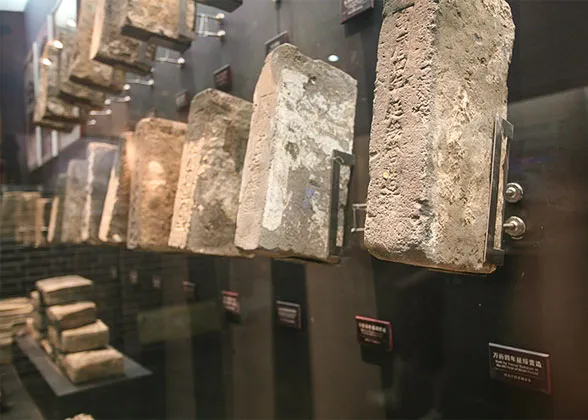 | | Great Wall bricks | | 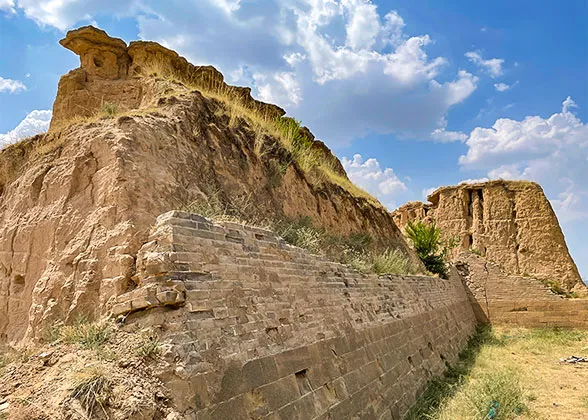 | | Yellow rammed earth inside the wall | |
When and by Whom Was the Mutianyu Great Wall Built?
The Mutianyu Great Wall traces its origins to the Northern Qi Dynasty (550 - 577 AD). Later, in 1368, General Xu Da, a trusted general of Zhu Yuanzhang - the founding emperor of the
Ming Dynasty (1368 - 1644) - undertook a full-scale reconstruction on the foundations of the Northern Qi Great Wall. In 1569, the renowned military strategist General Qi Jiguang was commissioned to carry out a systematic overhaul of the Mutianyu section. He pioneered the concept of hollow watchtowers, transforming the original solid structures into hollow, multi-functional fortifications to expand defensive space and operational utility. Concurrently, he oversaw the brick paving of the wall flanks, added double-sided battlements, horse paths, and advanced drainage systems, thereby perfecting the Great Wall’s defensive architecture.
The Wall Structure of Mutianyu Great Wall
The Mutianyu Great Wall is built directly atop mountain ridges and bedrock, leveraging the natural terrain to maximize defensive advantage. It measures approximately 6 meters (20 feet) wide at the base and tapers to 4.6 meters (15 feet) at the top, presenting a trapezoidal structure that is wider at the bottom and narrower at the top. This kind of structure can better resist external force impacts. Beyond its standard structural elements, the wall boasts several distinctive features unique to this section:
1. Double-Sided Battlements
Battlements are fortifications that provide cover for the defending troops. Unlike other sections where battlements are only built on the outer side, Mutianyu’s walls feature them on both sides. This double-sided design is uncommon in other Beijing sections of the Great Wall, underscoring Mutianyu’s significant strategic position in history. Furthermore, the crenels are not rectangular openings but jagged in shape. The embrasures, located beneath the crenels, are not round but square with arched tops. Gun platforms are also constructed at key strategic points.
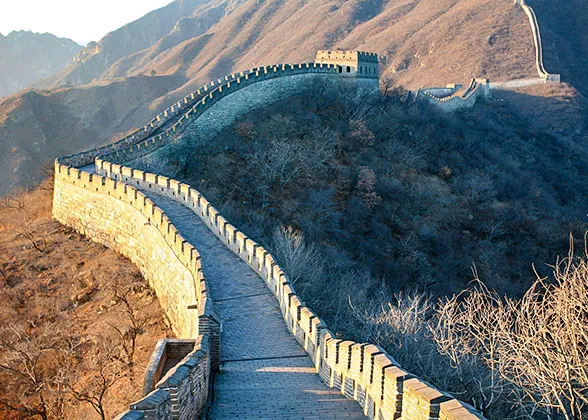 | | Double-Sided Battlements | | 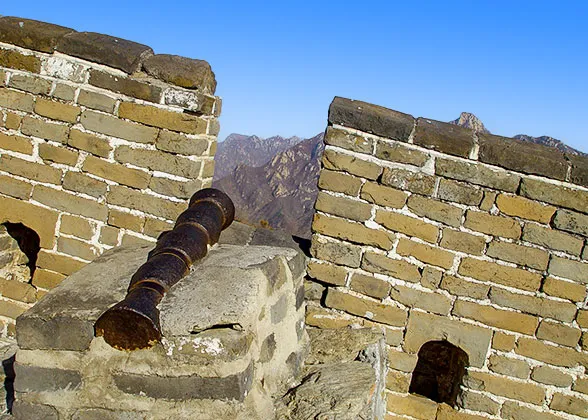 | | Arrow holes and ancient cannon | |
Mutianyu Great Wall is adorned with “branch walls” - additional segments extending from the inner or outer side of the main wall, typically atop high ridges or mountain peaks. Ranging in length from several meters to dozens of meters, these branches are equipped with watchtowers to reinforce the main wall’s defensive capabilities. There are two such branch walls at Mutianyu: one is located at the Big Corner Tower, extending southward for nearly a kilometer to a distant mountain peak, where a watchtower is erected at its terminus; the other connects to Watchtower No.11 and is approximately 40 meters (45 yards) long.
The Watchtowers of Mutianyu Great Wall
Stretching 5,400 meters (3.36 miles) in length, the Mutianyu Great Wall is dotted with 20 watchtowers, making it one of the most densely fortified sections of the Great Wall. Within a span of less than 500 meters (550 yards) from Watchtower No. 1 to No. 4, four watchtowers stand in close succession. The 3,000-meter (3,300-yard) between Watchtower No. 1 and No. 20 accommodates 25 defensive structures in total, including watchtowers, beacon towers, and guard posts, translating to roughly one fortification every 100 meters (110 yards), a layout unparalleled in the entire Great Wall system.
In addition to normal watchtower designs, Mutianyu is home to two exceptionally rare and distinctive structures:
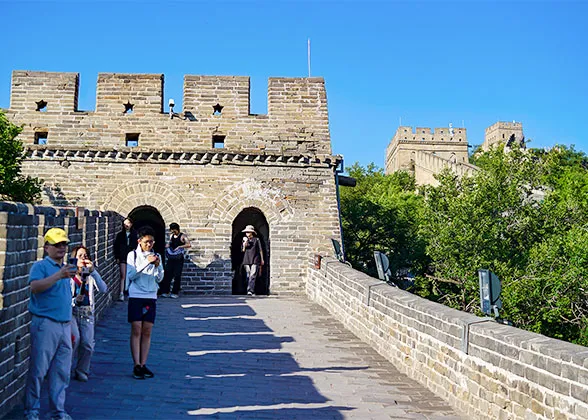 | | Watchtower on the Mutianyu | | 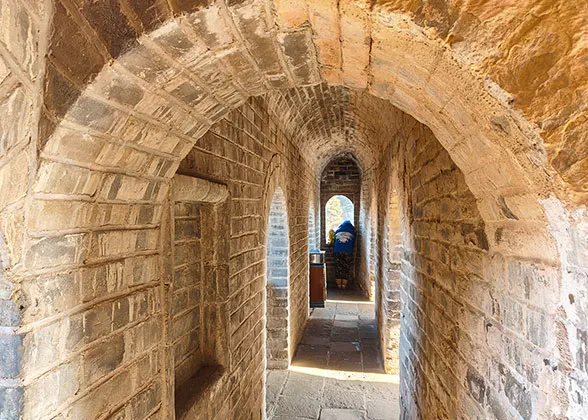 | | Inside the watchtower | |
1. Zhengguan Terrace (No. 4 Watchtower)
Zhengguan Terrace, also known as Mutianyu Pass, its most striking feature is three hollow watchtowers standing side by side. Each tower has two floors, with the ground floors interconnected to facilitate troop movement. The upper floors house three separate watchtowers to monitor and repel enemy attacks. The two flanking towers are smaller in size, while the central tower is notably larger. Another ingenious design detail is its gate: unlike most passes, where the main gate is centered, Zhengguan Terrace features a narrow side gate on its southern flank. This layout was a tactical deterrent against frontal assaults - invading forces would be forced to search for the gate, exposing them to defensive fire, and even if located, the narrow opening made it extremely difficult to breach. This design provided an extra layer of protection for the military command post stationed here.
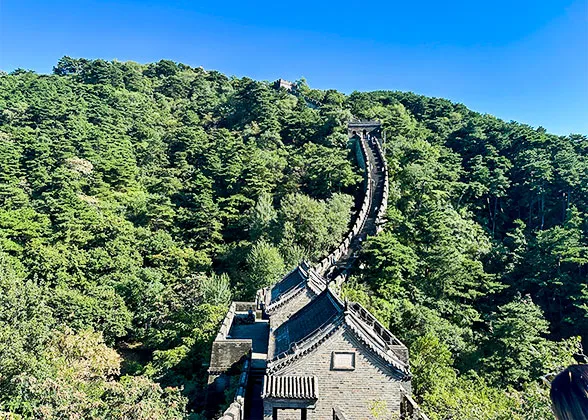 | | Zhengguan Terrace | | 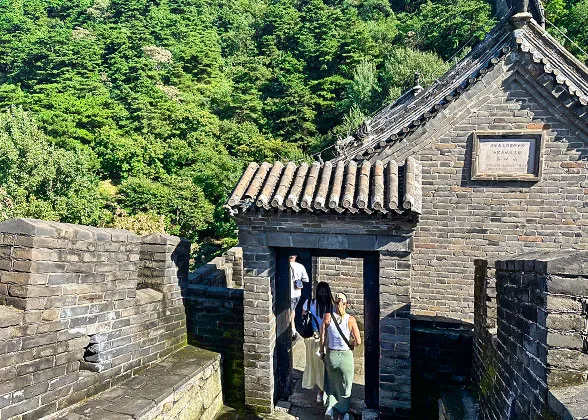 | | Gate of the Zhengguan Terrace | |
2. The Big Corner Tower (No. 1 Watchtower)
Watchtower No.1, known as “The Big Corner Tower,” is located at the easternmost end of Mutianyu Great Wall. This pivotal structure links three distinct Great Wall segments: extending eastward to Gubeikou, westward to Mutianyu, and southward to a branch wall. Consequently, when viewed from a distance, no matter the angle, a corner of the watchtower is visible, thus earning it the name “The Big Corner Tower.” It stands as a highly distinctive landmark of China’s Great Wall.
Mutianyu Great Wall History
- Last updated on Sep. 29, 2026 by Sherry Xia -