Has Qin Shi Huang’s Mausoleum Ever Been Robbed in the Past?
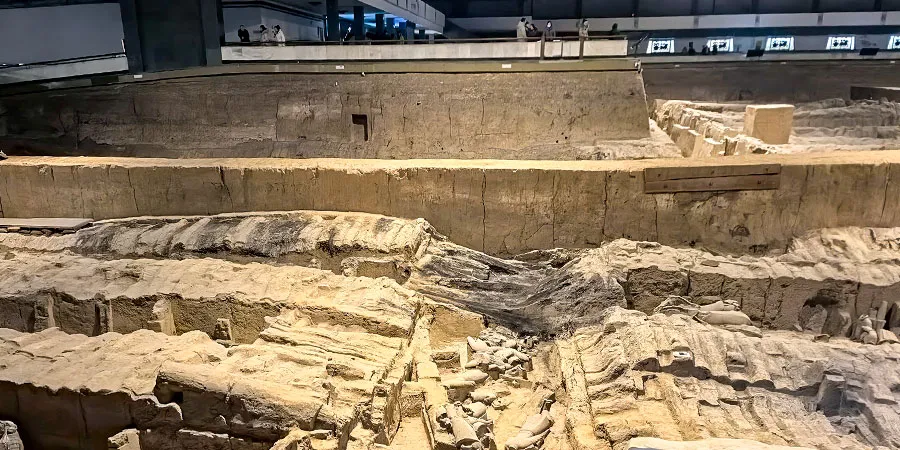 |
| Remains of Fire Damage in Pit 2 |
Why do some people believe the mausoleum of Qin Shi Huang was robbed in ancient times?
1. Han Dynasty records mention that Xiang Yu carried out a destructive attack on the mausoleum area.
2. Later records note further damage in the late turbulent times.
|
|
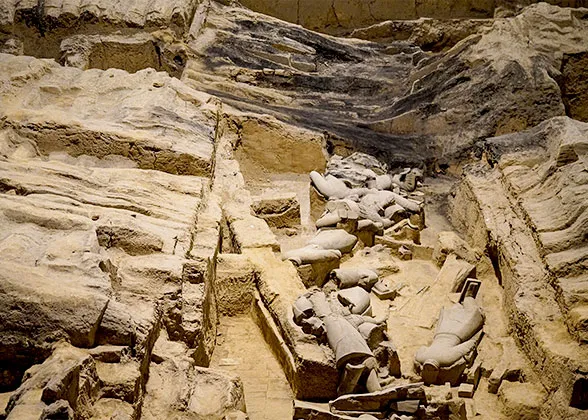
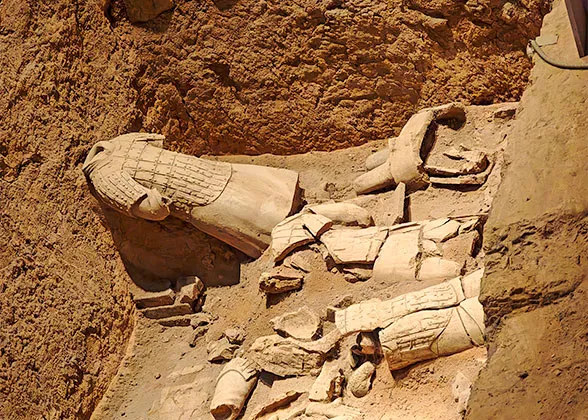
3. Modern archaeology confirms burning and structural damage within the mausoleum complex.
Modern archaeological research has uncovered widespread evidence of burning and destruction across the mausoleum area. Large quantities of charred bricks, tiles, wood ash and burnt soil have been unearthed at the site. Even in the famous Terracotta Army pits, many terracotta warriors and weapons show clear traces of hacking and burning, with visible cut and fire marks still preserved on some statues. These findings suggest that the above‑ground structures and outer burial pits may have suffered deliberate and severe damage, possibly at the hands of Xiang Yu's forces or later tomb robbers. Importantly, however, such evidence does not directly indicate that the main underground palace of the mausoleum was violated or robbed.
Why do others argue that the mausoleum's underground palace remains untouched?
1. Geophysical surveys show no ancient tunnel ever reached the core underground palace.
Modern archaeological teams have used remote sensing and magnetic surveys, techniques similar to a CT scan of the earth, to investigate the area around the underground palace. Results show that the palace is surrounded by a solid and thick wall, reinforced with brick cladding and covered by thick stone slabs. Although several ancient robber tunnels have been detected, the deepest ones only reached the outer side of the wall and none penetrated into the central chamber. More importantly, the soil filling those tunnels remains undisturbed, with no signs of human passage, indicating that grave robbers never gained access to the underground palace.
2. Abnormally high mercury levels in the soil prove the palace is still sealed.
Historical records state that mercury was used to simulate rivers and seas inside the emperor's underground palace. As a highly volatile heavy metal that evaporates easily, if the palace had ever been opened on a large scale, the mercury would have dispersed quickly and could not have survived for over two thousand years. Since 1981, however, geologists have conducted multiple surveys of mercury concentrations in the soil above the tomb mound and found that mercury levels in the central area are nearly 300 times higher than in the surrounding soil, covering a wide area. This indicates that mercury from the underground palace is still slowly seeping upward through the soil, which in turn suggests that the palace has remained largely sealed for over two millennia without large-scale intrusion.
3. No confirmed cultural relics from the underground palace have ever appeared in collections.
For over two thousand years, Chinese epigraphers and collectors have carefully documented the origin, shape, and changes in ownership of ancient bronzes, jades, stone carvings, and other valuable relics, leaving detailed records. If Qin Shi Huang's underground palace had been robbed, countless treasures would likely have spread into the hands of common people, been traded and collected, and would almost certainly have been recorded. Yet a comprehensive examination of all surviving documents reveals no clear record of any relic originating from the underground palace. This striking absence suggests that the treasures inside the palace never saw the light of day and were never obtained by ancient people.
In short, historical accounts about robbery of the Emperor Qin's tomb most likely describe the destruction of above‑ground buildings and outer burial pits, rather than a breach of the deep underground palace itself. The First Emperor's coffin and his most precious treasures may therefore still lie undisturbed beneath Mount Li, waiting for a future when technology can safely reveal their secrets without causing damage.
 Further Reading:
 10 Mysteries about Emperor Qin Shi Huang's Mausoleum City Walls to Protect Qin Shi Huang Mausoleum Why Does Qin Shi Huang's Mausoleum Remain Unexcated? Hot Topics on Qin Shi Huang Mausoleum Where Was Qin Shi Huang Buried? Terracotta Accessory Pits