Bund No.13 : Shanghai Customs House
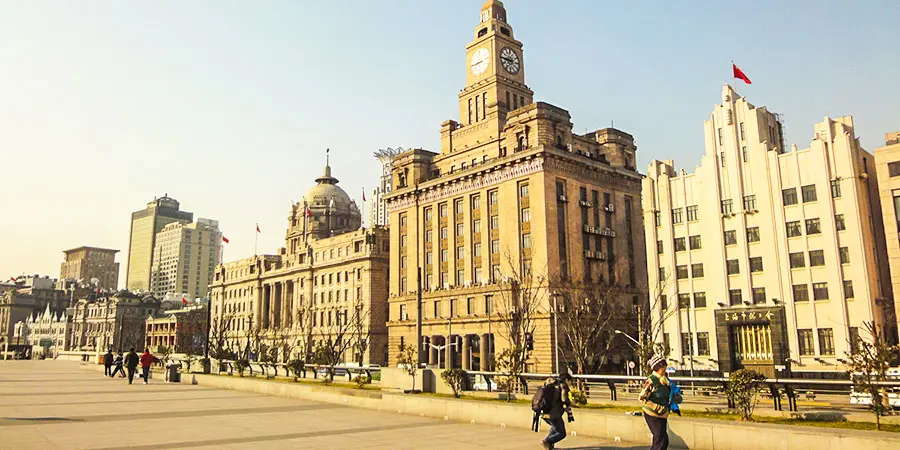
This building has undergone four updates and iterations since 1845. The existing building was built between 1925 and 1927 and is currently used by the Shanghai Customs. It is one of the most famous landmark buildings in Shanghai.
The overall style of the building is an eclectic combination of Greek classical and modern architecture, consisting of an 8-story main building on the east side and a 5-story auxiliary building on the west side. It was the tallest building on the Bund in Shanghai in the 1920s. The main building facade adopts a classical composition of three horizontal and three vertical sections, with the top floor bell tower as the vertical axis. The main exterior walls are all built with granite, and the entrance is a Greek porch supported by four Doric columns. The bell tower is three stories high, with each floor folded in, revealing artistic decoration. The big lamp in the center of the lobby on the first floor is made of white jade and bronze, with an octagonal dome above it. Each of the eight sides has a painting of a sailboat or warship made of colored mosaics, which has extremely high ornamental value. However, this building is generally not open to the public, and the first and third floors occasionally offer reservation-based and limited-time visits.
Bund No. 14 : Shanghai Council of Trade Unions
No.14 on the Bund is the former site of the Bank of Communications Building, which was last completed in 1948. It is the youngest buildings in the existing Bund complex in Shanghai. Since 1951, its has been used by the Shanghai Council of Trade Unions. The building has a total of eight floors: six for the main structure and two for the upper tower. Its roofline is roughly W-shaped with a high center and lower sides. Both the front and sides of the main body present vertical lines. Except for the bottom door frame which is covered with black marble, all other walls have been painted with white cement. The entrance through the gate shows a corridor paved with colored artificial marble, with circular escalators on both sides against the walls. The hall on the second floor is decorated with red tiles, tall and spacious, and its most eye-catching feature is the 9 marble columns in each row, totaling 4 rows. Currently, the building is only open to the public on the first floor and no reservation is required. It mainly serves as an exhibition of the remarkable achievements of outstanding individuals from all walks of life in Shanghai.
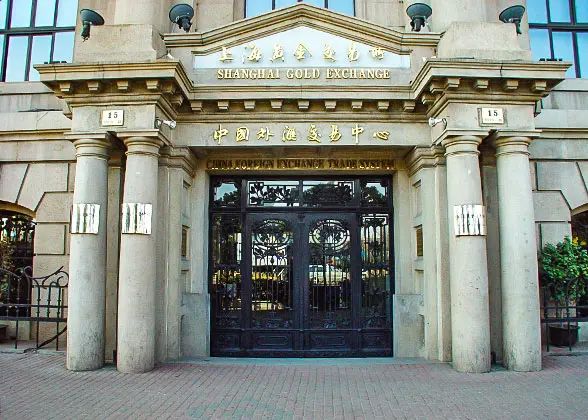
Bund No.15 : China Foreign Exchange Trade System
 |
| China Foreign Exchange Trade System |
It used to be Russo-Chinese Bank Building constructed in 1903 in the French classical style and is now used by the China Foreign Exchange Trade System. It is not open to the public for visits. Although it has only three floors, it is one of the earliest buildings in Shanghai to be equipped with an elevator. The building is solidly structured and elaborately decorated, with a symmetrical layout centered on the main entrance. On both sides of the main entrance on the first floor, there are double columns for support, and the windows are recessed. On the east facade of the second and third floors, there are Ionic columns and windows decorated with classical reliefs. Nowadays, this building has become the central trading hub for foreign exchange, currencies and bonds in China, and also the global pricing center for the RMB exchange rate and interest rates.
Bund No.16 : China Merchants Bank
This four-story historic building, constructed in 1924, is designed in the Greek Revival style, blended with Japanese modern Western architectural elements. It was originally used by the Japanese-funded Taiwan Bank and is now in use by the Bund Branch of China Merchants Bank.
Since the China Merchants Bank moved in, the building has undergone two overall renovations, but the original layout and structure have been preserved. The main facade of the building features four European classical-style columns, while the other three sides have square pilasters. On both sides of the entrance, there are two bronze lions. All the doors and windows are designed with flat arches, and the window frames have simple lines, with a strict overall proportion. The ground floor is the bank’s business hall in which the walls and columns are clad in Italian marble, creating a spacious and solemn atmosphere. It is well worth a visit for admiration.
Bund No.17 : AIA Building
The Bund No.17 Building was completed in 1924 and was originally occupied by the North China Daily News, one of the most influential English-language newspapers in China. In 1998, the Shanghai branch of American International Assurance Co. Ltd. (AIA) was granted the right to use the building. The entire structure is designed in the eclectic style, featuring a three-section composition on the facade. The first two floors are constructed with granite, while the sides of the main entrance are adorned with full-height Roman arch windows. The third to seventh floors incorporate simple square windows and Renaissance-style sculptural decorations. Two small towers are also designed on the north and south sides of the rooftop.
Bund No.18 : Chartered Bank Building
The Bund No.18 was built in 1922 and later served as the Mercalli Bank. It was renovated and completed in 2004, becoming a commercial complex that integrates international fashion brand flagship stores, high-end restaurants, bars, and art galleries. The building is a three-section structure with 7 floors, including 6 floors for the main body and one roof floor. The interior decoration is highly distinctive: the four ancient Greek-style marble columns inside the main entrance originated from an Italian church two hundred years ago; the entrance passage has two three-meter-high red glass chandeliers, which are assembled from 185 hollow glass tube parts; and there are also handcrafted mosaic murals in the lobby. Tourists visiting the Bund are inevitably attracted by its elegant architectural design. In addition, art exhibitions are held from time to time inside the building. You can even choose to go to the bar terrace on the 7th floor at dusk, leisurely savoring fine wine while enjoying the bustling night view of the Huangpu River across from you.
 |
| Buildings Group along the Bund |
Bund No.19 : South Building of the Peace Hotel
Separated from the North Building of the Peace Hotel by busy Nanjing Road, it was originally known as the Palace Hotel in 1906, and subsequently the South Building of the Peace Hotel in 1965. In 2011, it was renovated by the Swiss Swatch Group and opened as the Swatch Art Peace Hotel. The building has 6 floors and is designed in the European Renaissance style. The exterior walls are made of large areas of white bricks, separated by red strip bricks; The interior decoration blends historical style with modern functionality: the ground floor is the largest flagship store and banquet hall of Swatch in China, the 2nd to 4th floors are artist studios and luxurious guest rooms, and the 5th to 6th floors include a gourmet restaurant and an art multifunctional hall. As a carrier of international art residency projects, this building achieves the cross-border integration of art and commerce.
Bund No.20 : North Building of the Peace Hotel
 |
| North Building of the Peace Hotel |
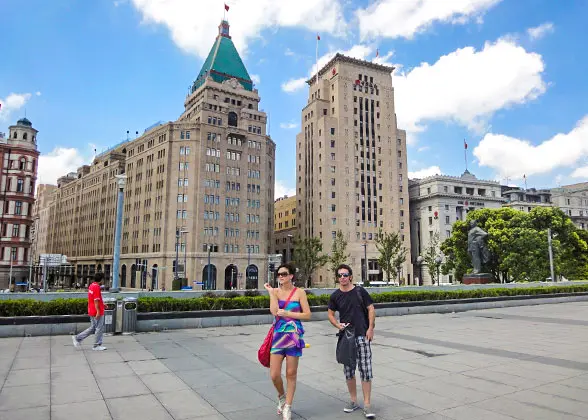
It is the former Sassoon House, built in 1929. The dark green pyramid shaped copper roof at its top, which is 19 meters high, has been a prominent symbol of the Bund for many years. The building has a total of 13 floors with the roof top included. Its most distinctive feature is the interior decorative art style, such as the spiral staircase, octagonal dome, bronze chandeliers, etc., as well as its nine-country themed suites, including the Chinese, American, British, Indian suites that retain the original historical style, and the French, Italian, Spanish, Japanese and German suites that have been redesigned and renovated. The suites have beautiful views of the Huangpu River outside the windows. The cost for a night’s stay in the hotel ranges from CNY 2,500 to 16,000. In addition, the hotel has upscale restaurants, bars, cafes, and observation terraces for consumers to relax and entertain. For instance, the Dragon Phoenix Hall and Cathay Room, the two major restaurants, perfectly combine traditional Shanghai flavors with international cuisine, with per capita price being CNY 677 and CNY 887 respectively.
 FAQ on the Bund
- Last updated on Feb. 13, 2026 by Shelly Wang -
 Huangpu River and the Bund Pictures
 Video of the Bund of Shanghai