Shanghai Museum East, as a world-class museum of ancient Chinese art, houses a rich collection of ancient relics—from bronzes, sculptures and jade to calligraphy, ceramics and more. Located in
Pudong New Area, it is a new branch of the Shanghai Museum fully completed and open to the public in November 2024. It covers 113,200 square meters (27.97 acres) and has eight floors, including six floors above ground and two floors underground. In this grand building, there are a total of 20 exhibition galleries with each relic vividly showcasing the exquisite craftsmanship of ancient Chinese and their avant-garde aesthetic pursuit.
Considering that you may be time-pressed or feel bewildered by the extensive area and massive collections of the Shanghai Museum East upon entering, this guide provides a list of prioritized galleries and cultural relics so as to assist you with an ideal museum tour.
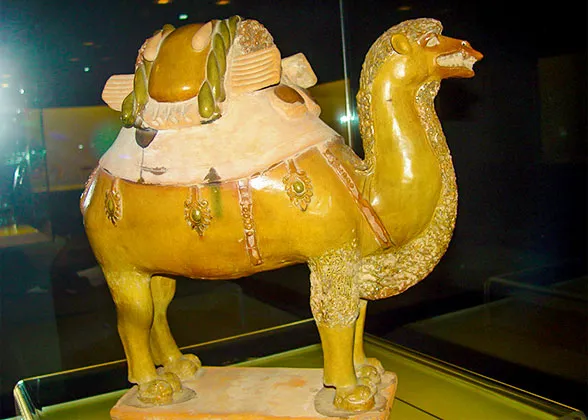 | | Polychrome Glazed Pottery Camel | | 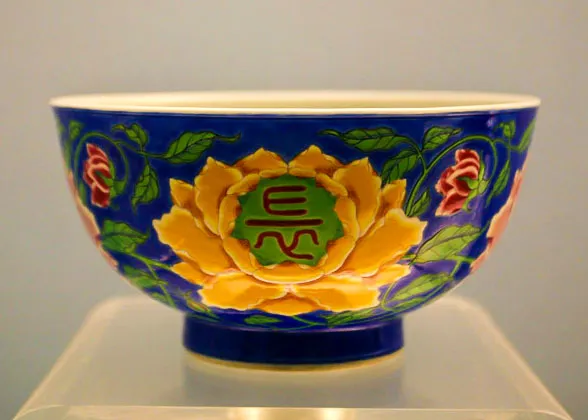 | | Pensive Bodhisattva | |
Must-see Cultural Relics
1. Great Bronze Cauldron (Da Ke Ding) – Bronze Gallery
—from Late
Western Zhou Dynasty (1046-771 BC)
This is a large bronze ritual tripod cauldron standing 93.1 centimeters (37 inches) high, with a mouth diameter of 75.6 centimeters (30 inches) and a weight of 201.5 kilograms (444 lbs). It features a pair of upright handles on the rim and three robust feet below. The exterior is decorated with beast-mask patterns and wave bands, while the interior wall bears inscriptions that record a noble’s tribute to his grandfather and the royal commissions and rewards he received from the Zhou king. This tripod cauldron represents not only the pinnacle of bronze-casting technology 3,000 years ago, but also an important source of historical material for that period.
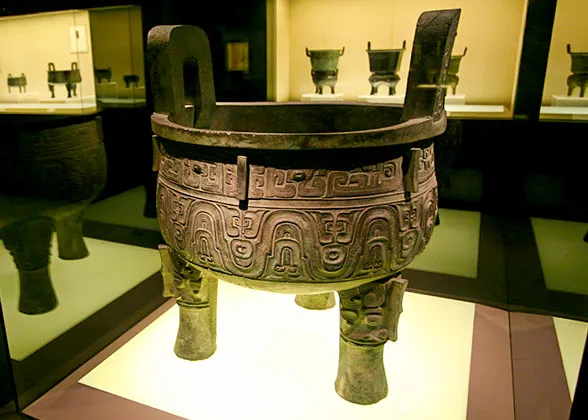 | | Great Bronze Cauldron | | 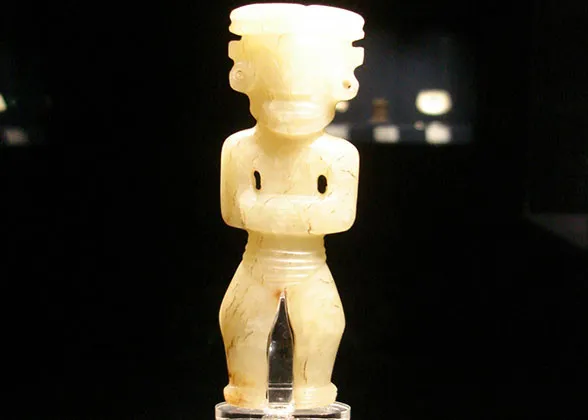 | | Jade Humanoid Deity | |
2. Jade Humanoid Deity – Jade Gallery
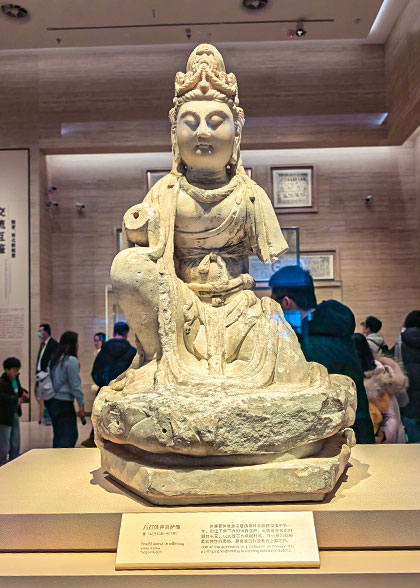 |
| Bodhisattva in Offering White Marble |
—from
Neolithic Period (Approximately 4200 - 4500 years ago)
It’s a 10.3-centimeter-tall (4-inch-tall) small deity figure carved from greenish-yellow jade, with a flat-topped crown, crossed hands over the chest, and slightly bent knees. This jade figure is considered as an intermediary through whom the prehistoric shaman or tribal leader devoutly communicates with the divine during sacrificial rituals.
3. Bodhisattva in Offering White Marble – Sculpture Gallery
—from
Tang Dynasty (AD 618-907)
This white marble statue of a bodhisattva stands 70 cm (28 inches) tall and 40 cm (16 inches) wide. It was originally part of a group of devotional figures beneath a main Buddha statue. Carved from solid white marble, the statue delicately captures the soft texture of human skin. The figure has a high piled bun and an ornate crown, with a gentle smile and a serene expression. It is adorned with pearl necklaces, draped scarves, and a long skirt, and kneels barefoot on a lotus base. Although its arms are missing, the statue remains graceful and majestic, representing a masterpiece of high-quality white marble sculpture from the prosperous Tang Dynasty.
4. Sky blue-glazed Plate – Ceramics Gallery
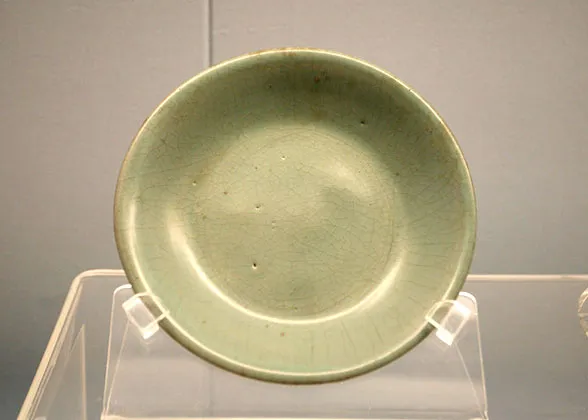 |
| Sky Blue-glazed Plate |
—from
Northern Song Dynasty (AD 960-1127)
With a mouth diameter of 17.1 centimeters (7inches) and luminous sky-blue glaze, this elegant plate is a masterpiece from the most prestigious kiln of the Northern Song Dynasty, which made porcelains exclusively for the imperial court of that era. It’s undeniably a representative artwork, manifesting the incredible craftsmanship of Chinese ceramics in a time when no machines were available for production.
5. Round Coinage with Square Hole – Numismatics Gallery
—from Qin Dynasty (221-207 BC)
Before the Qin Dynasty, currencies varied widely in shape, size and weight across states, causing great inconvenience to trade. After unifying the six rival states, the Qin established a standard round coin with a square hole in the center, which laid the foundation for China’s coinage for over 2,000 years. It also facilitated trade, stabilized the economy and strengthened political rule
Top 5 Unmissable Permanent Galleries
1. Bronze Gallery – 1F
Bronze Gallery is one of the must-visit galleries at Shanghai Museum East, offering a complete chronological narrative and visual encyclopedia of ancient Chinese bronzes. It presents a nearly uninterrupted collection of bronze artifacts from their emergence, development, flourishing, transformation, and renewal between the 21st century BC and the 3rd century BC. Here you will find a wide variety of bronze objects used as ritual vessels, wine vessels, food vessels, weapons, musical instruments, and other practical tools. Many are decorated with distinctive patterns, including animal masks, dragons, phoenixes, birds, flame motifs, and eye designs. These abundant bronze treasures vividly depict the unique features of ancient Chinese civilization nearly 3,000 years ago.
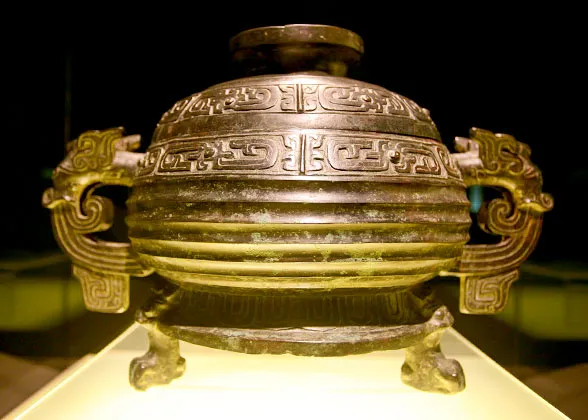 | | Bronze Wine Vessel of Western Zhou | | 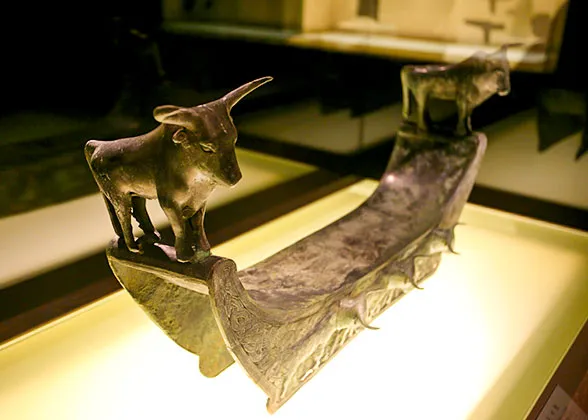 | | Ox-shaped Wine Vessel | |
2. Sculpture Gallery – 1F
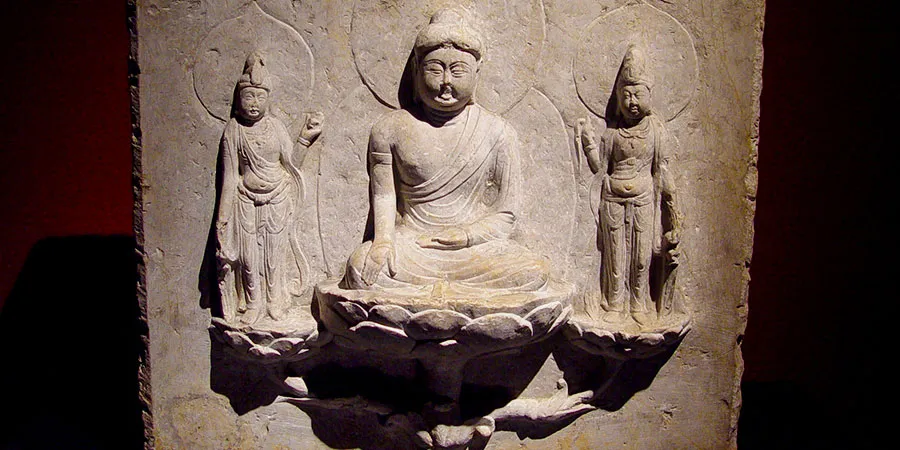 |
| Stone Monument of Buddhas |
The Sculpture Gallery houses a superb collection of ancient Chinese sculptures spanning various dynasties, primarily including gilt-bronze, stone, and wood Buddhist statues, as well as exquisite tomb carvings. It also features other fine sculptural works such as pottery figurines, bone carvings, and ivory carvings. These sculptures artistically illustrate the social beliefs and civilizational exchanges of ancient China across different eras. Here, you can strongly perceive that in contrast to Western classical sculpture, which emphasizes realistic human anatomy and proportion, traditional Chinese sculpture prioritizes overall artistic charm and inner spiritual expression over naturalistic representation.
3. Jade Gallery – 2F
China has long been known as the “land of jade”, with a history of about 10,000 years in jade craftsmanship. This gallery arranges the exhibits along a timeline into six sections, showcasing the development of Chinese jade culture over 8,000 years from prehistoric times to the
Qing Dynasty (1644-1911). The roughly 300 pieces of artifacts displayed here, such as jade vessels, jade ornaments, and jade sculptures, are far more than just beautiful objects; they also bear the weight of profound historical narratives. In the early civilizations, the jade served as sacred medium for worship and a symbol of divine power. Later, it became an important part of ritual systems, representing social status and political hierarchy. Influenced by Confucius, jade gradually became a moral symbol associated with virtues. If you appreciate these rarities in a chronological order, you’ll also notice how the craftmanship evolved from simple carvings into delicate openwork and meticulous polishing.
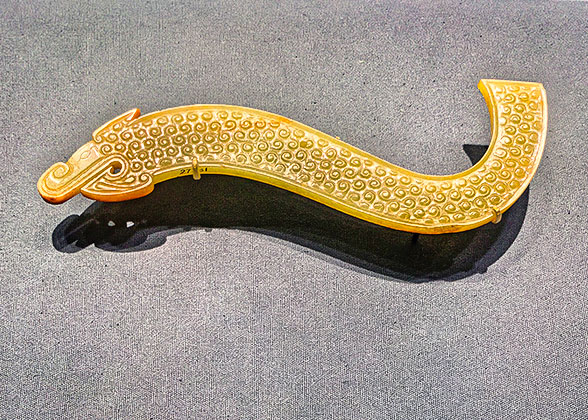 | | Jade in Dragon Shape | | 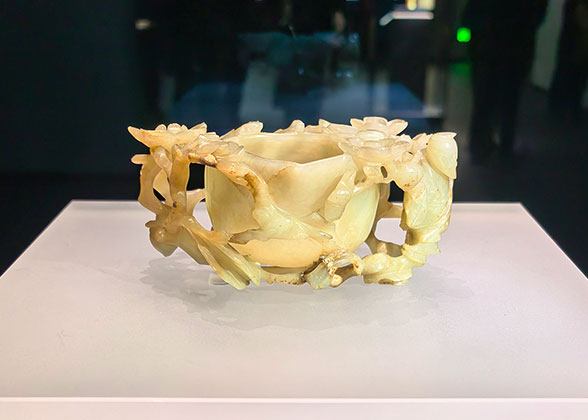 | | Jade Cup in Ming Dynasty | |
4. Ceramics Gallery & CeraMIX Gallery– 3F
Just like the Jade Gallery, the Ceramics Gallery also follows the chronological order to divide the exhibits into seven sections, showing exquisite ceramics from the Neolithic Age to the end of the Qing Dynasty. It presents the complete history of Chinese ceramics as well as the breathtaking charm of ceramic art to the visitors. These ceramics mainly take the form of vessels, including bottles, pots, jars, bowls, plates, cups, etc. Moreover, as time passed, the colors, patterns and types of these ceramics became increasingly diverse, profoundly reflecting the refined pursuit of living standards by ancient Chinese people, especially the imperial courts. It’s exciting to mention that this gallery breaks through traditional display concepts by introducing interactive exhibits that allow visitors to touch and directly perceive the physicality of ancient Chinese ceramics.
In addition, there is a CeraMIX Gallery on the 3rd floor that offers an abundant collection of trade ceramics. These ceramics in this gallery are different from the traditional Chinese ones. They more prominently unveil the exotic ceramic styles, demonstrating the economic, political and cultural exchanges between China and foreign countries from around the 6th century AD to the beginning of the 20th century. For instance, not only will you see porcelain imitating the styles of countries in the Middle East such as Iran, Egypt, Iraq, and Turkey, but you will also be able to witness replicas of Chinese porcelain from other Asian countries such as Korea, Vietnam, as well as European countries like Portugal and France.
 |
| Trade Ceramics of Islamic Shapes |
5. Numismatics Gallery – 3F
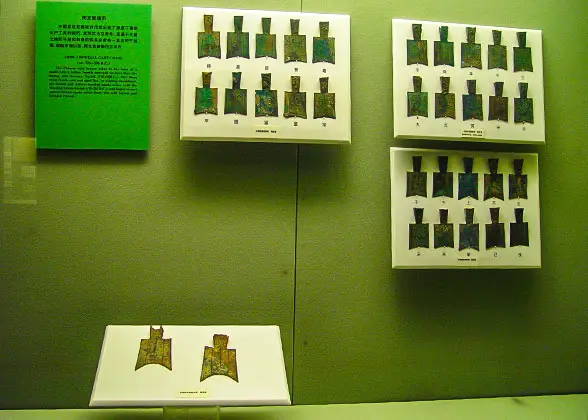
The Numismatics Gallery of the Shanghai Museum East can be regarded as a condensed history of Chinese currency and a microcosm of China’s thousands of years of political and economic development. Approaching the showcases, you’ll see a wide variety of relics once functioned as money in different periods, ranging from seashell coins, knife coins, and copper coins of earlier times to silver ingots and paper money of later ages. Besides, there is an electronic screen that presents the evolution of Chinese currency in a more intuitive timeline format, which would surely help you understand how primitive transaction means evolved into current QR code payment method.
 |
| Silver Ingot of Qing Dynasty |
Other Permanent Galleries
If you are interested with Chinese seal art, the Seal Gallery on the 2nd floor will surely delight you since there is a comprehensive collection of seals spanning different periods, from imperial and official seals to those of scholars and literati.
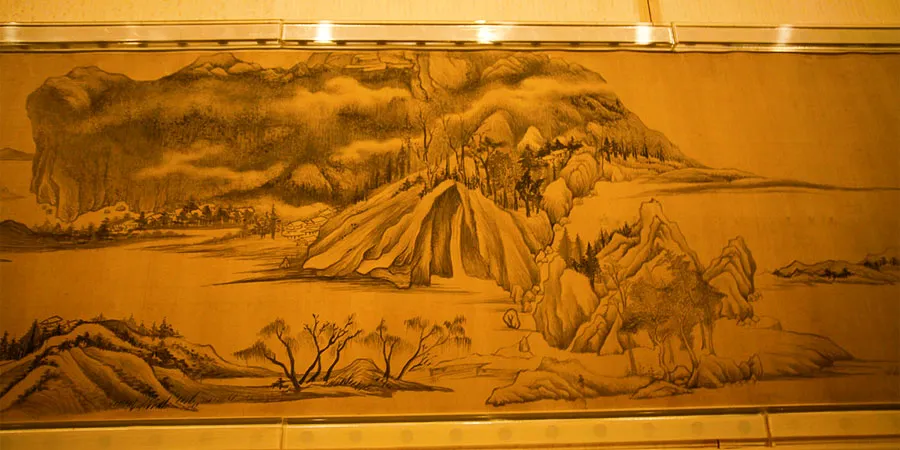
In addition to the permanent galleries mentioned above, the museum also has several other permanent halls worth visiting, including Painting Gallery, Calligraphy Gallery, Painting and Calligraphy of Shanghai Gallery, and Zhao Puchu Gallery. These four galleries collectively form the core Chinese calligraphy and painting zone in Shanghai Museum East, highlighting the supreme achievements of traditional Chinese painting and calligraphy across history, as well as the rich cultural legacy of the Shanghai School. What’s more, the Jiangnan Gallery and the Shanghai Archaeology Gallery display distinct themes respectively: the former features traditional handicraft masterpieces that embody the aesthetic, craftsmanship and cultural aspects of Southern China, while the latter presents local archaeological finds tracing Shanghai’s history from prehistory to the Qing Dynasty.
Temporary Special Exhibition Galleries
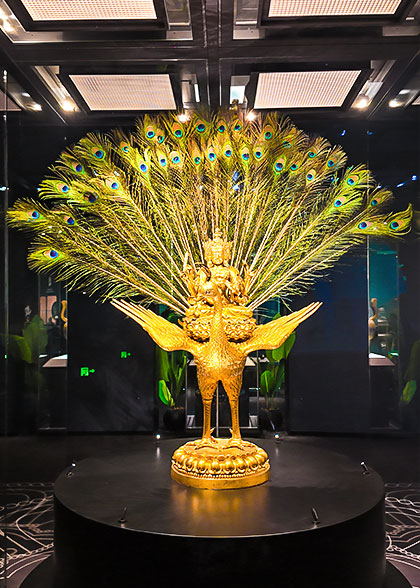 |
| Gilt-bronze Statue of Mahamayuri |
The Shanghai Museum East has three temporary special exhibitions, located on the 1st to 3rd floors respectively. The exhibits in the temporary exhibition area are of extremely high specifications, usually featuring national treasures, unique pieces, first-time exhibitions, or cultural relics returned from overseas as the core. One of the most representative artefacts is the Gilt-bronze Statue of Mahamayuri (Peacock King), a monumental imperial work from the Xuande reign (1426–1435) of the Ming Dynasty.
Meanwhile, a large number of cross museum exhibitions are used, gathering top collections from across the country and even the world, such as the Sanxingdui relics, Shakespeare’s portrait, and the most popular portraits and manuscripts of writers in British literary history, which will be displayed during the first few months of 2026. In addition, the exhibits in the exhibition area are diverse and complementary, gathering collections from many important museums in Asia, Europe, and the United States, supplemented by contemporary paintings, ceramics, enamelware, and more. All these combinations bring a more immersive experience to the visitors.
Interactive Spaces
More interestingly, the museum also has a variety of interactive experience areas, including a souvenir zone on the 1st floor featuring cultural and creative products, a Digital Gallery on the 2nd floor, Curio-City on the 3rd floor, and the Open Conservation Lab on the 4th floor. These areas are particularly suitable for family visits, allowing parents to accompany their children on a very meaningful journey of interacting with cultural relics.
How to Tour the Shanghai Museum East?
The essence of the museum lies in the top 5 permanent galleries, so you may start your visit from the first floor and walk your way up by sequence. If you are not in a hurry and prefer an in-depth admiration, then you can add some other temporary special exhibition galleries or interactive spaces in between.
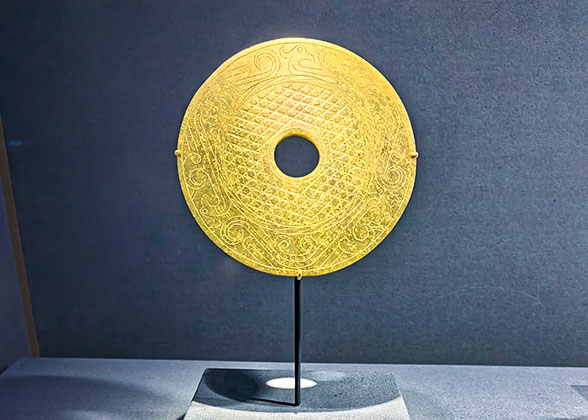 | | Delicate Jade with Phoenix Patterns | | 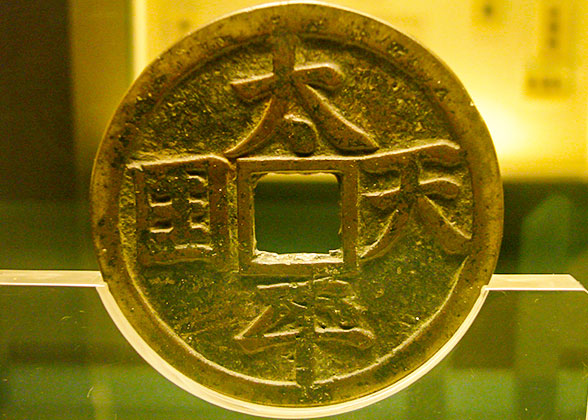 | | Non-tradable Coin of the Taiping Heavenly Kingdom | |
How to Get to the Shanghai Museum East
By Metro
1. Take Shanghai
Metro Line 2 to Shanghai Science and Technology Museum, head out through Exit 8, and then walk approximately 500 meters (550 yards) south.
2. Take
Metro Line 6 to Pudian Road, head out through Exit 1, and then proceed west for around 300 meters (330 yards).
By Bus
1. Take Bus No. 638 or 975 to South Yanggao Road, Century Avenue, and then walk north for about 300 meters (330 yards).
2. Take Bus No. 987 or Pudong 36 to Dingxiang Road, Century Avenue, and a 300-meter (330-yard) walk north will lead you to the museum.
3. Take Bus Pudong No. 106 to Pudian Road-Zhulin Road and walk about 200 meters (220 yards) south
4. Take Bus Pudong No. 78 to Jindai Road-Yingchun Road and walk roughly 300 meters (330 yards) south.
General Information for Visiting Shanghai Museum East
| Entrance Fee | Free |
| Opening Hours | 10:00 - 18:00 (last entry at 17:00);
Closed on Tuesday except public holidays |
| Reservation | For individual visitors, only the Digital Gallery and Curio-City require advance reservation via the WeChat Mini Program (no English version provided). All other galleries are open to visitors without prior booking—simply bring your passport and enter directly through B1 East Gate (near Dingxiang Road);
Groups of 20 or more must book 7 to 14 days in advance. |
| Audio Guide in English | Rental: CNY 40
Deposit: None
The rental area is at the entrance of B1 and the main hall of 1F. |
| Recommended Visit Duration | 2 - 4 hours |
Useful Tips for Visiting the Museum
1. The museum provides “luggage storage service”. Visitors are required to go through a security check before depositing items and complete the storage procedure at the counter. Lockers on B1 are self-service and for “small luggage only”. On the 1st floor, both self-service lockers and staff-assisted storage are available for large luggage.
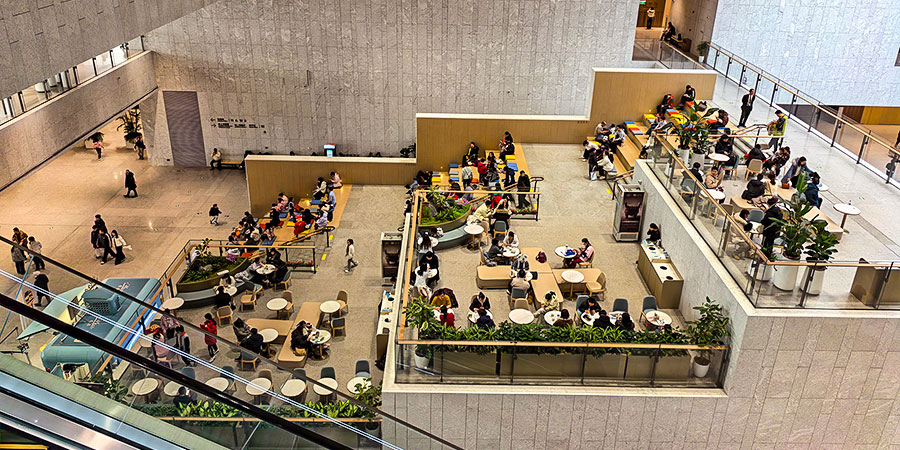 |
| Rest Area inside the Museum |
2. Remember to wear comfortable shoes in view of long-time walking needed in such an extensive space.
3. Dining area is available on F1 for you to replenish energy

Further Reading:
 15 Free Things to Do in Shanghai 12 Popular Shanghai Activities to Survive Summer Top 10 Places for a Shanghai Visit in Winter Shanghai Tourist Destinations in July: 7 Places to Go What to Do in Shanghai in December: 6 Places to Go Top 10 Shanghai Tourist Spots for Solo Travelers
- Last updated on Sep. 01, 2026 by Grace Yang -