Bund No.23: Bank of China
The Bund No. 23 was built in 1937 and is divided into two buildings: the East Main Building and the West Auxiliary Building. The former, along with two basement levels, has a total of 17 floors while the latter has a total of 4 floors. As it is the only building on the Bund that was designed by Chinese architects, the overall appearance of the building features traditional Chinese architectural styles. For example, there are hollowed out Chinese characters for “longevity” on both sides of each floor of the building, and the patterns on the railings and window frames also adopt traditional Chinese decorative motifs. Moreover, there are traditional Chinese stone lions guarding on both sides of the entrance.
The building also has an interesting story: The Bank of China building was originally planned to be a 91-meter twin-tower decorative art building, the tallest building in Shanghai at that time. However, the actual height was only 77 meters, lower than the nearby Sassoon House. It is said that this was because Victor Sassoon, the builder of the former Sassoon House, requested that no building in the public concession should be higher than it, so the Bank of China building was forced to adjust its height. With extremely high artistic value, it now offers free visits for tourists.
Bund No.24: Industrial and Commercial Bank of China
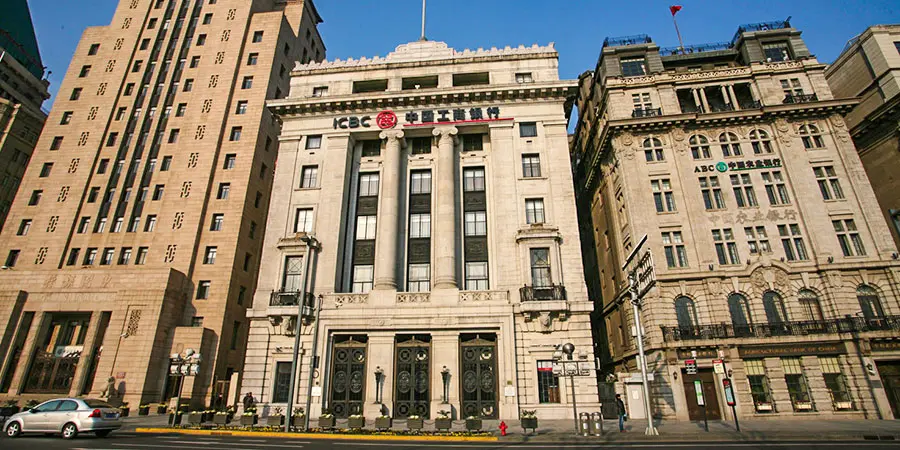
The building at the Bund No.24 was initially used as the branch office of the Yokohama Specie Bank of Japan in 1923. After several changes in occupancy, it now serves as the Shanghai Branch of the Industrial and Commercial Bank of China. The six-story structure features a Neoclassical style, with a three-sectioned facade that is axially symmetrical on both sides. The windows above the base walls on either side are adorned with carvings of Japanese samurai and Bodhisattvas, though some parts are severely damaged. Between the 2nd and 5th floors, two Ionic columns stand flanked by balconies and window frames, while the top floor boasts a Greek cornice. Overall, its exterior resembles that of the Bund No.18. The bank’s lobby is open for free public visits, where the slender golden glass dome overhead, paired with soft lighting, creates a sense of “gilded splendor”.
Bund No.26: Agricultural Bank of China
The 7-story historic architecture was constructed in 1918 and originally served as the Yangtze Insurance Association Building. It currently houses the Agricultural Bank of China. The structure features a reinforced concrete framework and an eclectic architectural style, with rough granite facades on the first and second floors, while the third to fifth floors exhibit polished stone paneling. A protruding cornice separates the fifth and sixth floors, and an Ionic colonnade adorns the central section of the sixth floor. The top level boasts a Mansard roof. The lobby on the first floor is open for public visits during business hours, though photography is prohibited.
Bund No.27: Former Jardine Matheson Building
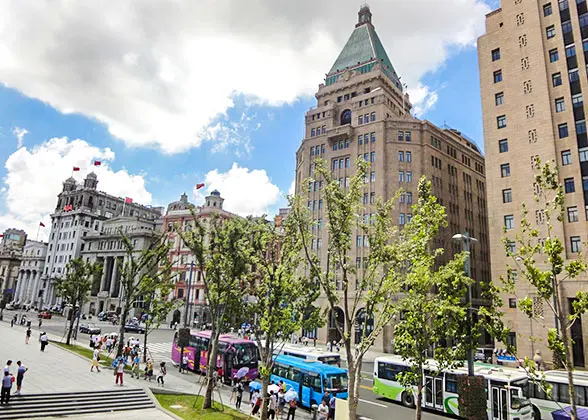 |
| Buildings Group along the Bund |
No. 27 was once the office building of the largest foreign firm on the Bund in Shanghai, Jardine Matheson, built in 1922. It was originally a six-story British Renaissance style architecture, with two additional floors added in 1983. The current first floor is the Rolex flagship store; floors 2, 3, 8 and 9 are used by the dining enterprise “Roosevelt Mansion”; and the fourth floor is a law firm.
There are nine Roman arch-shaped doors and windows on the first and second floors, including the main entrance in the middle. Above the central window on the second floor, there is a stone-carved sheep head decoration. On the third floor, there is a balcony with stone railings in the middle, and from here, four Corinthian columns extend all the way to the fifth floor. The cornice on the fifth floor is relatively wide. Entering the interior, the first thing that catches the eye is the shiny marble floor. The upstairs corridor has a mosaic floor, and a large part of it has been preserved to this day. The green bricks inlaid in it are made of jade. Other interior decorations also exude elegance and luxury. The lobby and corridor on the first floor can be visited for free. Art events are usually held on the sixth floor and tourists who want to go there need to make an appointment in advance on the WeChat mini-program.
Bund No.28: Shanghai Clearing House
Bund No.28 was once the former Glen Line Building constructed in 1920, with 7 floors. The ground floor to the second floor feature granite exterior walls, and there are four projecting balconies on the second, sixth, and seventh floors respectively; The balcony on the third floor has semi-circular window frames; After 1949, Shanghai People’s Broadcasting Station used the building for more than 40 years and gradually added communication towers on the roof. Since 2011, the Shanghai Clearing House has been using this building to undertake financial clearing business between banks across the country, transforming it into a “financial hub” in China.
Bund No.29: China Everbright Bank
In 1911, Banque de l’Indochine, a French bank, purchased the foundation of No.29 on the Bund and began constructing an office building. This is the only building in the Bund complex with just three floors, but its average floor is the highest – with each over 7 meters. In addition, it is also the only building in the pure French Renaissance style. In 1995, China Everbright Bank leased this building and subsequently opened a Shanghai branch.
Bund No.33: Former British Consulate General Building
No. 33 on the Bund was the former location of the British Consulate General in Shanghai, including the main and auxiliary buildings. It suffered from a fire and was rebuilt in 1872. The main building is in the style of the British Renaissance, with features of veranda architecture, a brick wood mixed structure; there is a typical English lawn garden in front of the house. Nowadays, it is mainly used for holding art exhibitions, cultural lectures, small concerts and other entertainment activities, and some spaces are regularly open to the public. The auxiliary building, the former consul’s residence, is in Victorian Romanesque style, decorated with exquisite gray and red bricks, and is now the flagship store of Patek Philippe.
 FAQ on the Bund
- Last updated on Feb. 13, 2026 by Shelly Wang -
 Huangpu River and the Bund Pictures
 Video of the Bund of Shanghai