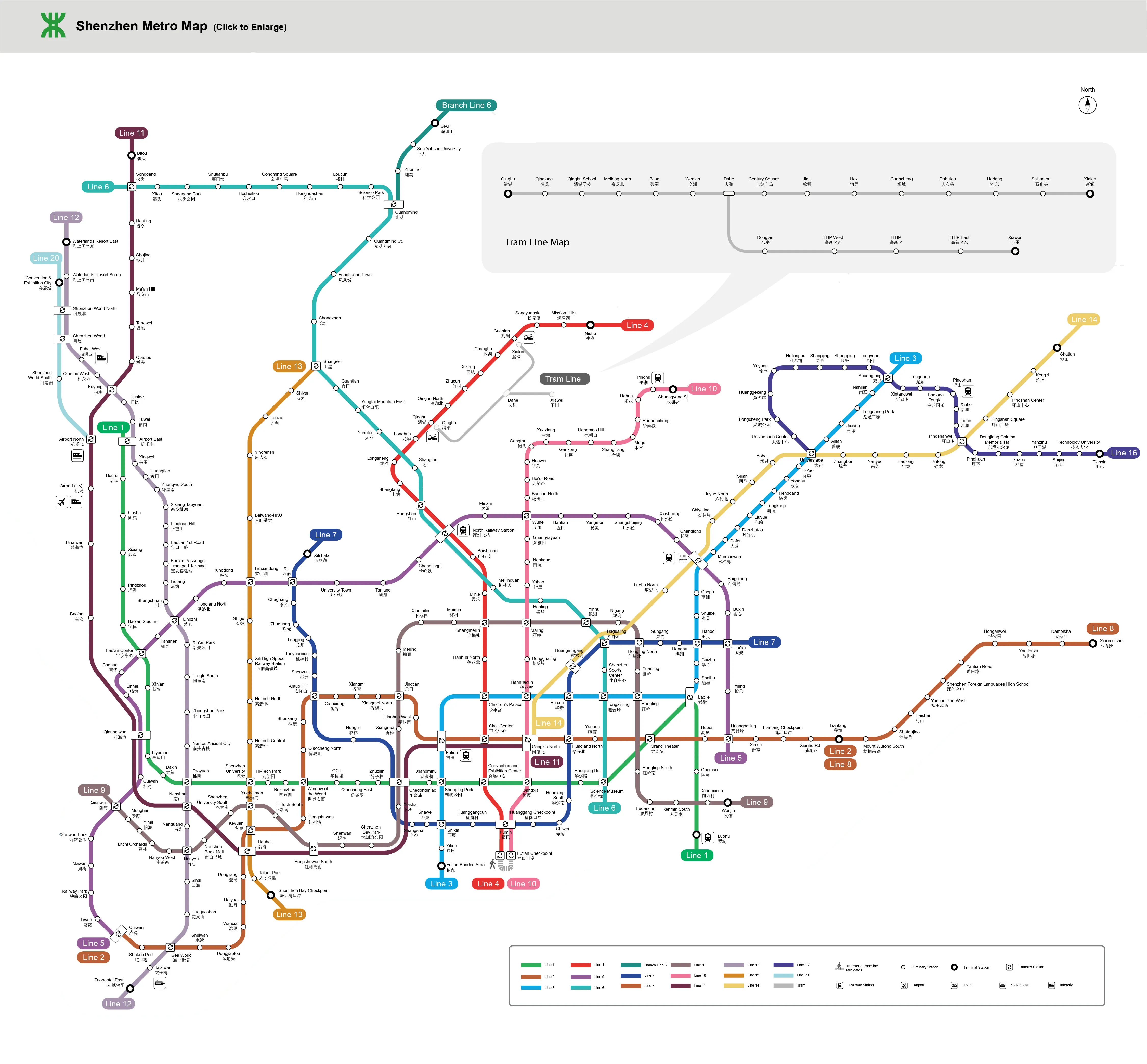
Metro is the first choice of transport for Shenzhen visitors. A total of 16 lines with 432 stations jointly form a dense Shenzhen subway network, extending 641.97 kilometers (398.9 miles). They connect all transportation hubs in the city and cover both newly emerging high-tech commercial districts and classic scenic spots, making it efficient for tourists to travel around. What’s more, multiple metro lines lead to the various ports between Shenzhen and Hong Kong, offering great convenience for people to travel between these two metropolises.
Shenzhen subway is particularly friendly to overseas tourists. One can tap international credit cards like Visa, Mastercard, American Express, and JCB to take the metro directly without the hassle of downloading any local payment tool or buy a physical ticket. The announcements inside the trains and stations are made in Mandarin, Cantonese, and English in turn. Airport Line is equipped with business class carriage with comfortable seats and luggage racks, helping air passengers to reduce fatigue during their travels.
 Shenzhen Metro Lines in Operation

 Note: Line 2 and Line 8 are through lines, which means that passengers do not need to get off the metro train at the connecting station, Liantang.
 Major Destinations Accessible by Metro
Tip: Air passengers are recommended to take Line 11 to get access to Airport T3 station directly. Airport East station on Line 1 and Airport North station on Line 20 are not actually within the airport, and passengers need to transfer to a taxi or another subway line to reach the airport terminal.
Line 2/8, 7: Huaqiang North
Line 5: Liuxiandong
Line 1/ 3: Laojie
Line 4: Convention and Exhibition Center
Operating Hours
Shenzhen metro lines operate for a long time daily. Most of them send the first train before 06:00 in the morning, and don’t stop service until 00:00 the next day; during holidays or major events, those serving Shenzhen North Railway Station and Shenzhen Airport often extend their operation to 1 am.The train departs every 2 - 5 min on average during peak hours and 5 - 9 min at other times. Metro Line 11 running towards the city center from the airport and Line 2/8 to Dameisha and Xiaomeisha add 3 grand station express trains on working days and holidays, respectively, saving passengers’ 5 - 10 minutes compared with normal departures.
It is worth noting that during the morning and evening rush hours on weekdays, 07:30 to 09:30 and 17:00 - 19:30, the congestion of popular commuter lines 5, 1, 4, 11, and 3 is beyond imagination. Perhaps you are squeezed into the carriage after waiting for about 10 - 20 minutes, which is particularly evident at large transfer stations like Gangxia North, Shenzhen North Railway Station, Futian, and Chegongmiao. If possible, avoid those time slots and stations.
How to Pay for Shenzhen Metro
 1. Scan the transit code on Alipay or WeChat
If you have activated a local payment app for your Shenzhen trip, such as WeChat or Alipay, get a ride code and scan it to pass through the ticket gate.
2. Buy a single-way ticket
It’s easily available at ticket vending machines and service windows inside the metro stations.
3. Purchase a one-day or three-day pass
It costs CNY 25 and CNY 75, respectively, allowing unlimited rides on all metro lines within 24 hours and 72 hours from the first entry. To note that it’s not applicable for trams and business class carriages of Line 11. Only major subway stations sell the pass. Some are listed below:
Line 1: Qianhaiwan, Luohu
Line 2: Window of the World, Shekou Port, Liantang Checkpoint
Line 3: Futian, Buji
Line 4/5/6: Shenzhen North Station
Line 7: Fumin, Huanggang Checkpoint
Line 8: Dameisha
Line 9: Shenzhen Bay Park, Yinhu, Wenjin
Line 10: Futian Checkpoint
Line 11: Airport T3
Line 14: Universiade
Line 16: Shuanglong
4. Rent a Shenzhen Pass
Tourists who stay in Shenzhen for more than three days are advised to rent a physical Shenzhen Pass from its service center at Shenzhen North Railway Station, Shenzhen Airport, Shenzhen Bay Port, Convention and Exhibition Center, Laojie, Bao’an Center, or Luohu metro station. This card not only offers a 5% discount for metro rides but also helps pass through the ticket gate smoothly. What’s more, it can also be used to take the city bus. The deposit of CNY 20 is refundable.
5. Tap the credit card
Passengers can tap Visa, Mastercard, American Express, and JCB cards at ticket gates to ride the metro, but you need to find the qualified gate with a contactless payment logo.
Ticket Fare
Shenzhen metro employs a stage fare system. The longer you travel, the more you pay.
Ticket price of business class carriages on Line 11
The fare is three times that of the corresponding regular carriage, CNY 6 - 36. For example, it charges CNY 12 from the airport to Shenzhen World.
Tips on Taking Shenzhen Metro
1. Exit and re-enter at transfer stations without an internal connecting passage
Passengers changing metro trains at Hongling South and Futian Checkpoint need to exit the station first and walk on the ground to access another entrance for the second ride. Hubei station, although equipped with a transfer passage, adopts separate billing, also requiring passengers to pay to exit and recheck to enter.
2. Prepare sufficient time for transferring at large stations
Many hub stations cover a large area with long connecting channels, requiring at least 5 or even 10 minutes to make a transfer, such as Shenzhen North Railway Station, Futian, and Gangxia North.
3. Confirm the destination of the metro train before boarding
Some trains travel part of the normal route during peak hours; some additional express trains don’t stops at small stations during off-peak hours. Pay attention to the announcements at the platform and check the note on electronic screens.
4. Facilities
Most subway stations have toilets, and all transfer stations are equipped with baby care rooms.
Metro Lines to be Opened in the Future
Phase 1 of Line 22: Shangsha - LiguangLength: 34.7 km (21.6 mi)
Estimated Opening Time: 2028
Line 15: Tinghai - Xili High Speed Railway Station - TinghaiLength: 32.2 km (20 mi)
Estimated Opening Time: 2028
Phase 2 of Line 20: Airport North - BaishizhouLength: 24.82 km (15.4 mi)
Estimated Opening Time: 2028
Phase 1 of Line 25: Shilong - Jihua HospitalLength: 16.5 km (10.3 mi)
Estimated Opening Time: 2028
Phase 1 of Line 19: Nantangwei - JulongLength: 14.79 km (9.2 mi)
Estimated Opening Time: 2028
Phase 1 of Line 29: Hongshuwan South - XingdongLength: 11.16 km (6.9 mi)
Estimated Opening Time: 2028
Phase 1 of Line 32: Xichong - Kuichong EastLength: 9.51 km (5.9 mi)
Estimated Opening Time: 2028
Phase 1 of Line 17: Luohu West - ShanglilangLength: 18.62 km (11.6 mi)
Estimated Opening Time: 2029
Phase 1 of Line 27: Songpingcun - GangtouxiLength: 25 km (15.5 mi)
Estimated Opening Time: 2029
Phase 2 of Line 13, South Extension: Dongjiaotou - Shenzhen Bay PortLength: 4.067 km (2.5 mi)
Estimated Opening Time: 2030
Phase 2 of Line 13, North Extension: Shangwu - LisonglangLength: 19.23 km (11.9 mi)
Estimated Opening Time: 2030